THE ADVENTURE COLLECTIVE® · Independent discovery and booking for outdoor travel

A 14-day loop from Sarajevo through Bosnia, Croatia, Slovenia and Montenegro that pairs city history with active nature: waterfalls, a 23 km rafting section and short mountain treks. Expect comfortable hotels, guided walks and a steady rhythm of travel that highlights the region’s geological and cultural contrasts.
A 14-day loop from Sarajevo through Bosnia, Croatia, Slovenia and Montenegro that pairs city history with active nature: waterfalls, a 23 km rafting section and short mountain treks. Expect comfortable hotels, guided walks and a steady rhythm of travel that highlights the region’s geological and cultural contrasts.
The van eases out of Sarajevo before dawn and the city’s minarets recede into a low mountain haze. Over the next two weeks the route will weave between Ottoman bazaars and seaside ramparts, karst rivers and Alpine lakes — a careful sequence of short hikes, city walks and water that keeps the pace lively without feeling rushed. Guides handle the logistics; travelers are left to watch borders blur, languages change and landscapes sharpen.
Verified experiences and guided adventures in the surrounding area.
Operated by Visit Konjic · Sarajevo, Sarajevo Canton
The van eases out of Sarajevo before dawn and the city’s minarets recede into a low mountain haze. Over the next two weeks the route will weave between Ottoman bazaars and seaside ramparts, karst rivers and Alpine lakes — a careful sequence of short hikes, city walks and water that keeps the pace lively without feeling rushed. Guides handle the logistics; travelers are left to watch borders blur, languages change and landscapes sharpen.
This itinerary reads like a compressed history of the western Balkans. Sarajevo’s 15th-century Ottoman quarter gives way to Austro-Hungarian facades and the scars of 20th-century conflict; Jajce and Travnik recall medieval Bosnian courts and Ottoman craft, while Dubrovnik and Kotor tell maritime republic stories carved in stone. Geologically the trip travels a meeting of ranges: the Dinaric Alps’ limestone folds produce dramatic karst springs and waterfalls at Una and Plitvice, while glacial action left Lake Bled’s steep shores and the clear, island-dotted basin that’s distinct from the karst coast.
Culturally the journey balances urban rituals and rural persistence. Local guides point out Sarajevo’s columned bezistan, Mostar’s repaired old bridge, and Lukomir, an alpine hamlet at roughly 1,500 meters where stone houses and shepherding traditions persist. Food follows the route: hearty grilled meats and fresh river trout in Bosnia, pasta and seafood along the Adriatic, and Slovenian cream cakes by Lake Bled.
Practicals are straightforward: the tour runs 14 days with hotel stays in Sarajevo, Bihać, Zagreb, Split, Dubrovnik, Kotor and Mostar, plus a night in Konjic for rafting. Expect a variety of walking: a two-hour uphill hike to Kotor’s fortifications with roughly 250–300 meters of elevation gain, an easy 4–8 km loop on Plitvice’s boardwalks, a 23 km, five-hour guided rafting section on the Neretva, and a two-hour trek around Lukomir. Daily walking windows typically range from one to four hours.
Passports are required for multiple border crossings; carry local currency (Bosnia uses BAM, Slovenia and Croatia use the euro). Comfortable walking shoes, layered clothing for mountain-to-coast temperature swings, and a small daypack will make transitions easier. For those after photos, early mornings on Dubrovnik’s walls and late afternoons at Štrbački buk waterfalls yield the best light. If you prefer a slower rhythm, skip the optional swims and spend extra time in Baščaršija or the bays of Kotor.
Visa requirements depend on your nationality; you cross EU and non-EU borders, so check entry rules for Bosnia and Herzegovina, Croatia, Slovenia and Montenegro before booking.
The rafting on the Neretva is a 23 km guided run lasting about five hours; it’s designed for novices with full equipment provided, but a basic level of swimming comfort is recommended.
Yes, overnight stays in hotels are included each night according to the itinerary.
This listing is a private tour with a dedicated vehicle and guide for your booking.
Local guides can arrange meals to meet common dietary needs if you note restrictions at booking and in advance.
One medium suitcase and a carry-on/daypack are practical; transfers are frequent but straightforward.
Visit Konjic operates guided outdoor trips and adventures with an emphasis on safety, stewardship, and memorable experiences.


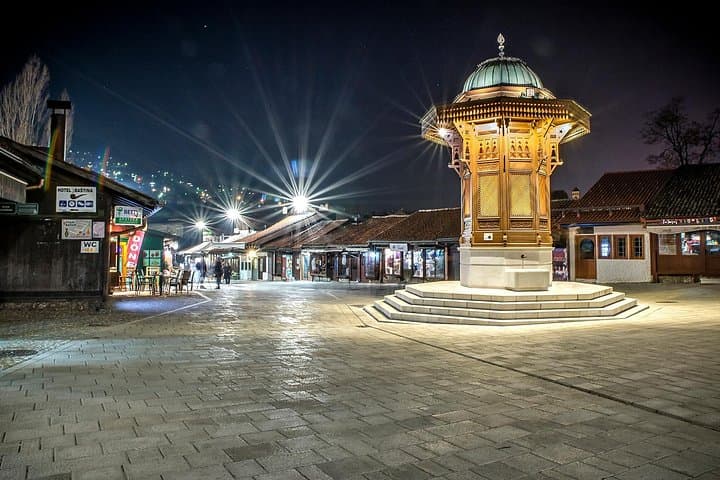

The van eases out of Sarajevo before dawn and the city’s minarets recede into a low mountain haze. Over the next two weeks the route will weave between Ottoman bazaars and seaside ramparts, karst rivers and Alpine lakes — a careful sequence of short hikes, city walks and water that keeps the pace lively without feeling rushed. Guides handle the logistics; travelers are left to watch borders blur, languages change and landscapes sharpen.
The van eases out of Sarajevo before dawn and the city’s minarets recede into a low mountain haze. Over the next two weeks the route will weave between Ottoman bazaars and seaside ramparts, karst rivers and Alpine lakes — a careful sequence of short hikes, city walks and water that keeps the pace lively without feeling rushed. Guides handle the logistics; travelers are left to watch borders blur, languages change and landscapes sharpen.
This itinerary reads like a compressed history of the western Balkans. Sarajevo’s 15th-century Ottoman quarter gives way to Austro-Hungarian facades and the scars of 20th-century conflict; Jajce and Travnik recall medieval Bosnian courts and Ottoman craft, while Dubrovnik and Kotor tell maritime republic stories carved in stone. Geologically the trip travels a meeting of ranges: the Dinaric Alps’ limestone folds produce dramatic karst springs and waterfalls at Una and Plitvice, while glacial action left Lake Bled’s steep shores and the clear, island-dotted basin that’s distinct from the karst coast.
Culturally the journey balances urban rituals and rural persistence. Local guides point out Sarajevo’s columned bezistan, Mostar’s repaired old bridge, and Lukomir, an alpine hamlet at roughly 1,500 meters where stone houses and shepherding traditions persist. Food follows the route: hearty grilled meats and fresh river trout in Bosnia, pasta and seafood along the Adriatic, and Slovenian cream cakes by Lake Bled.
Practicals are straightforward: the tour runs 14 days with hotel stays in Sarajevo, Bihać, Zagreb, Split, Dubrovnik, Kotor and Mostar, plus a night in Konjic for rafting. Expect a variety of walking: a two-hour uphill hike to Kotor’s fortifications with roughly 250–300 meters of elevation gain, an easy 4–8 km loop on Plitvice’s boardwalks, a 23 km, five-hour guided rafting section on the Neretva, and a two-hour trek around Lukomir. Daily walking windows typically range from one to four hours.
Passports are required for multiple border crossings; carry local currency (Bosnia uses BAM, Slovenia and Croatia use the euro). Comfortable walking shoes, layered clothing for mountain-to-coast temperature swings, and a small daypack will make transitions easier. For those after photos, early mornings on Dubrovnik’s walls and late afternoons at Štrbački buk waterfalls yield the best light. If you prefer a slower rhythm, skip the optional swims and spend extra time in Baščaršija or the bays of Kotor.