THE ADVENTURE COLLECTIVE® · Independent discovery and booking for outdoor travel

Experience close-up elephant herds with Kilimanjaro towering on the horizon during this concentrated two-day safari in Amboseli. Early morning and late-afternoon game drives maximize sightings, plus a cultural visit to Maasai villages.
Experience close-up elephant herds with Kilimanjaro towering on the horizon during this concentrated two-day safari in Amboseli. Early morning and late-afternoon game drives maximize sightings, plus a cultural visit to Maasai villages.
A pale dawn slides across the flat salt pans as Kilimanjaro’s summit pierces the clouds — and a herd of elephants moves like a slow river between the acacia and the lake. On a two-day Amboseli safari you trade city air for open sky, sitting high in a 4x4 while guides read spoor and light for the perfect silhouette.
Verified experiences and guided adventures in the surrounding area.
A pale dawn slides across the flat salt pans as Kilimanjaro’s summit pierces the clouds — and a herd of elephants moves like a slow river between the acacia and the lake. On a two-day Amboseli safari you trade city air for open sky, sitting high in a 4x4 while guides read spoor and light for the perfect silhouette.
Geologically, Amboseli is a low-lying basin shaped by volcanic activity and seasonal flooding; the park sits around 1,100–1,250 m in elevation while Kilimanjaro rises to 5,895 m just across the border. The landscape alternates grassy plains, marshy wetlands and alkaline pans that attract the park’s large elephant populations and the pink bands of flamingos on Lake Amboseli. Culturally, the Maasai communities around the park maintain pastoral traditions—visits offer views of manyatta huts, beadwork craft, and livestock herding that have persisted for generations.
Expect two game drives, one timed for early light and one at golden hour, with close-up photographic opportunities of elephant families, buffalo, zebra and, with luck, predators like lion. Guides typically include a Maasai village stop and basic lodge or tented accommodation; travel time from Nairobi is roughly 4–6 hours by road (about 240 km). Practicalities: pack a telephoto lens and binoculars, sun protection, insect repellent and a light jacket for cool mornings. Respect Maasai homes and ask before photographing people. Weather can change quickly; mornings and evenings offer the clearest views of Kilimanjaro. This short safari compresses big-game viewing, birdlife (400+ species reported) and cultural exchange into an accessible, photo-rich itinerary.
Amboseli is roughly 240 km from Nairobi; road transfer times are typically 4–6 hours depending on traffic and stops.
Kilimanjaro’s summit is visible on clear days, especially early morning and late afternoon; cloud cover or seasonal rains can obscure the peak.
Most operators include a cultural stop; confirm with your provider if you prefer to skip it—always ask guides about best etiquette before entering homes.
Children can participate but should be supervised; follow guide instructions and keep windows closed if wildlife is nearby.
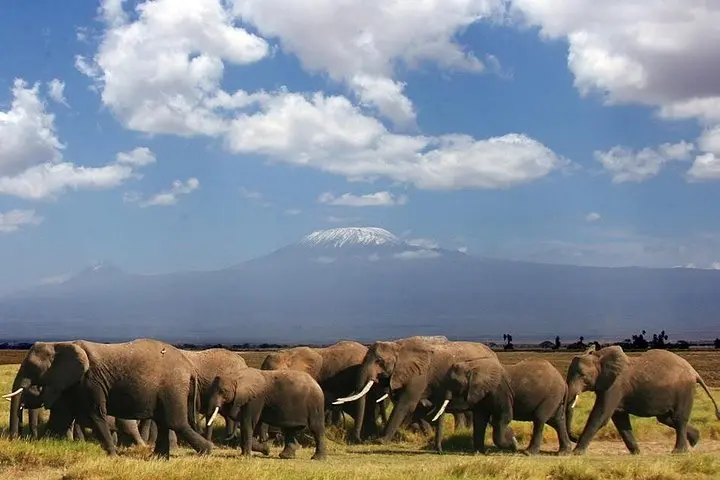
A pale dawn slides across the flat salt pans as Kilimanjaro’s summit pierces the clouds — and a herd of elephants moves like a slow river between the acacia and the lake. On a two-day Amboseli safari you trade city air for open sky, sitting high in a 4x4 while guides read spoor and light for the perfect silhouette.
A pale dawn slides across the flat salt pans as Kilimanjaro’s summit pierces the clouds — and a herd of elephants moves like a slow river between the acacia and the lake. On a two-day Amboseli safari you trade city air for open sky, sitting high in a 4x4 while guides read spoor and light for the perfect silhouette.
Geologically, Amboseli is a low-lying basin shaped by volcanic activity and seasonal flooding; the park sits around 1,100–1,250 m in elevation while Kilimanjaro rises to 5,895 m just across the border. The landscape alternates grassy plains, marshy wetlands and alkaline pans that attract the park’s large elephant populations and the pink bands of flamingos on Lake Amboseli. Culturally, the Maasai communities around the park maintain pastoral traditions—visits offer views of manyatta huts, beadwork craft, and livestock herding that have persisted for generations.
Expect two game drives, one timed for early light and one at golden hour, with close-up photographic opportunities of elephant families, buffalo, zebra and, with luck, predators like lion. Guides typically include a Maasai village stop and basic lodge or tented accommodation; travel time from Nairobi is roughly 4–6 hours by road (about 240 km). Practicalities: pack a telephoto lens and binoculars, sun protection, insect repellent and a light jacket for cool mornings. Respect Maasai homes and ask before photographing people. Weather can change quickly; mornings and evenings offer the clearest views of Kilimanjaro. This short safari compresses big-game viewing, birdlife (400+ species reported) and cultural exchange into an accessible, photo-rich itinerary.