THE ADVENTURE COLLECTIVE® · Independent discovery and booking for outdoor travel

A condensed, two-day route into Kruger National Park from Johannesburg that pairs an afternoon and a dawn open-vehicle safari for a strong chance to see the Big Five. Comfortable lodge nights in Hazyview and experienced guides make this a compact wildlife immersion.
A condensed, two-day route into Kruger National Park from Johannesburg that pairs an afternoon and a dawn open-vehicle safari for a strong chance to see the Big Five. Comfortable lodge nights in Hazyview and experienced guides make this a compact wildlife immersion.
Dust rises on the tar as the van peels away from Johannesburg; by late afternoon the light has the hard, honeyed edge of the Lowveld and the landscape opens into long grass, mopane and knob-thorn acacias. You step onto an open safari vehicle and the bush itself seems to lean closer — waterholes dare you to look for reflection and spoor, and distant wind-scalloped ridges hold the promise of prowling cats.
Verified experiences and guided adventures in the surrounding area.
Operated by Kruger Safari Africa · Hazyview, Mpumalanga
Dust rises on the tar as the van peels away from Johannesburg; by late afternoon the light has the hard, honeyed edge of the Lowveld and the landscape opens into long grass, mopane and knob-thorn acacias. You step onto an open safari vehicle and the bush itself seems to lean closer — waterholes dare you to look for reflection and spoor, and distant wind-scalloped ridges hold the promise of prowling cats.
Kruger National Park is one of Africa’s oldest and largest reserves, carved from colonial hunting areas and formalized in the early 20th century to protect species that had been driven back from much of the continent. Geologically the park sits on ancient sandstone and granite platforms; terrain is generally low and gently undulating (roughly 200–600 m elevation in the northern to central sectors) with riverine corridors and broad pans that concentrate wildlife.
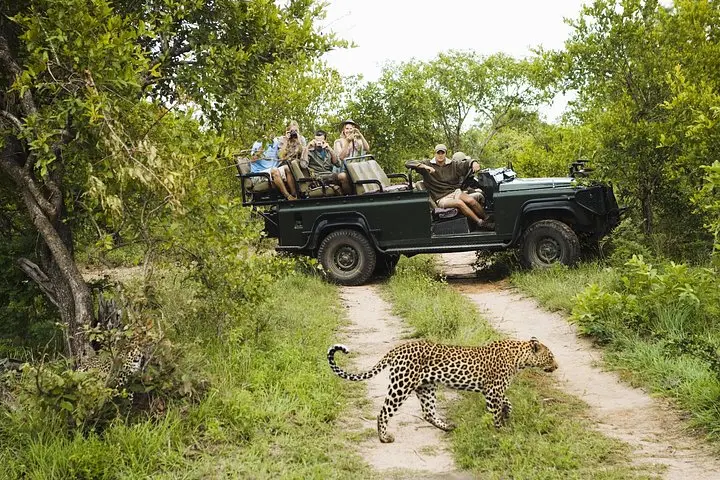
Culturally, towns like Hazyview serve as gateways — small lodges, local craft markets and guides who read the bush in spoor and silence. Expect open-vehicle game drives in the afternoon (about 3 hours) and a dawn safari beginning around 05:30 for 3–4 hours, with stops at established camps like Skukuza for a pre-packed breakfast.
Practical guidance: this is a low-impact, low-technical trip but it rewards early rising, patience and quiet observation. Wear neutral clothing, bring a telephoto lens, insect repellent and malaria advice from your doctor. Roads within the park are rough; motion sensitivity and cooler pre-dawn temperatures are common. Respect park rules — remain seated, keep noise low and never feed wildlife. The trip delivers concentrated Big Five viewing in a short window, pairing the comfort of a guest lodge near Hazyview with true wilderness sightings.
Morning game drives usually start around 05:30 so vehicles can be inside the park by sunrise—arrive at pick-up points 10–15 minutes early.
Yes—Kruger is a malaria area; consult a travel health clinic for current prophylaxis recommendations and pack effective repellent.
There are strong chances, especially with experienced guides and visits to waterholes, but sightings aren’t guaranteed—wildlife is wild and movements vary.
Children are allowed but operators advise age considerations; this particular tour notes it’s not recommended for pregnant travelers—check specific operator guidance before booking.
Kruger Safari Africa operates guided outdoor trips and adventures with an emphasis on safety, stewardship, and memorable experiences.
Dust rises on the tar as the van peels away from Johannesburg; by late afternoon the light has the hard, honeyed edge of the Lowveld and the landscape opens into long grass, mopane and knob-thorn acacias. You step onto an open safari vehicle and the bush itself seems to lean closer — waterholes dare you to look for reflection and spoor, and distant wind-scalloped ridges hold the promise of prowling cats.
Dust rises on the tar as the van peels away from Johannesburg; by late afternoon the light has the hard, honeyed edge of the Lowveld and the landscape opens into long grass, mopane and knob-thorn acacias. You step onto an open safari vehicle and the bush itself seems to lean closer — waterholes dare you to look for reflection and spoor, and distant wind-scalloped ridges hold the promise of prowling cats.
Kruger National Park is one of Africa’s oldest and largest reserves, carved from colonial hunting areas and formalized in the early 20th century to protect species that had been driven back from much of the continent. Geologically the park sits on ancient sandstone and granite platforms; terrain is generally low and gently undulating (roughly 200–600 m elevation in the northern to central sectors) with riverine corridors and broad pans that concentrate wildlife.
Culturally, towns like Hazyview serve as gateways — small lodges, local craft markets and guides who read the bush in spoor and silence. Expect open-vehicle game drives in the afternoon (about 3 hours) and a dawn safari beginning around 05:30 for 3–4 hours, with stops at established camps like Skukuza for a pre-packed breakfast.
Practical guidance: this is a low-impact, low-technical trip but it rewards early rising, patience and quiet observation. Wear neutral clothing, bring a telephoto lens, insect repellent and malaria advice from your doctor. Roads within the park are rough; motion sensitivity and cooler pre-dawn temperatures are common. Respect park rules — remain seated, keep noise low and never feed wildlife. The trip delivers concentrated Big Five viewing in a short window, pairing the comfort of a guest lodge near Hazyview with true wilderness sightings.