
2-Day Northern Lights Chase in Yellowknife: Prelude, Pontoon & Hidden Lake
Chase the Northern Lights over three distinct lakefront settings east of Yellowknife across two compact nights. This small-group tour uses local guiding knowledge to move quickly to the best dark-sky vantage points for varied aurora photography opportunities.
An Adventure In Yellowknife.
Chase the Northern Lights over three distinct lakefront settings east of Yellowknife across two compact nights. This small-group tour uses local guiding knowledge to move quickly to the best dark-sky vantage points for varied aurora photography opportunities.
Read the full experience
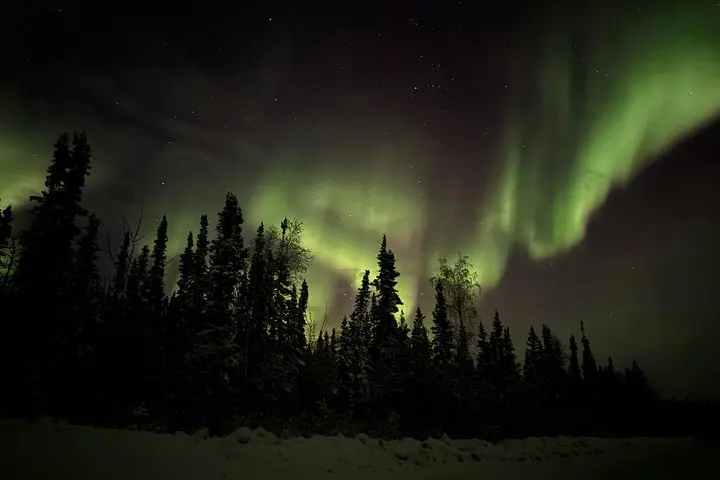
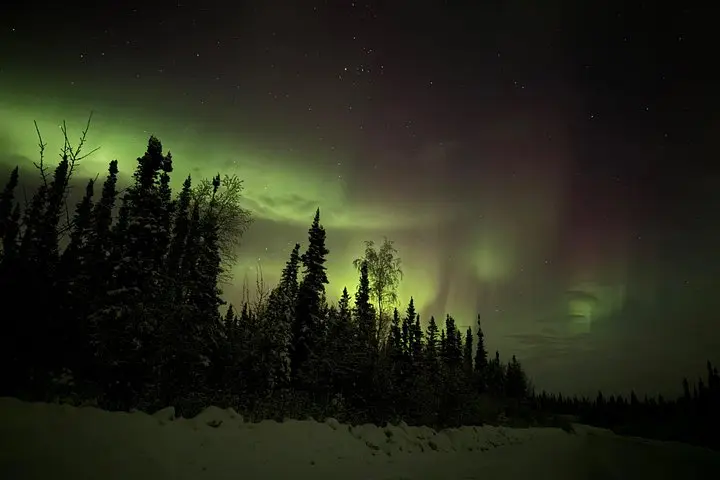
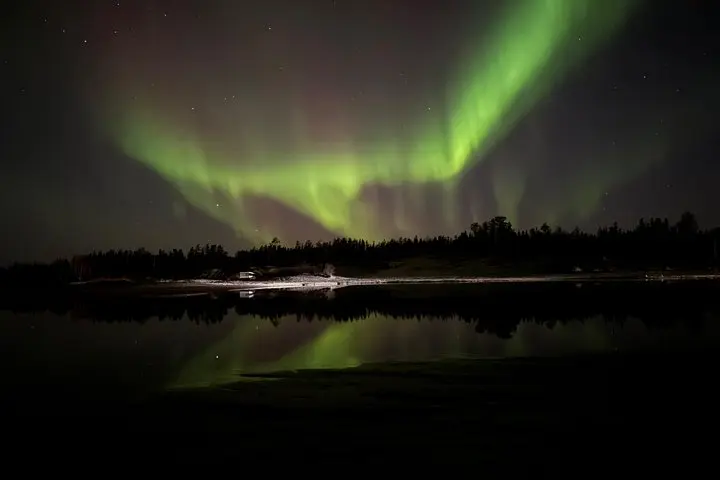
A cold sky opens above the Ingraham Trail, and headlamps dim as the van eases onto a side road. The first lake appears like a black mirror; you step onto packed snow and the horizon seems to inhale. Over two nights, guides ferry you between Prelude Lake, Pontoon Lake and Hidden Lake—each stop a different foreground for the same overhead show.
A cold sky opens above the Ingraham Trail, and headlamps dim as the van eases onto a side road. The first lake appears like a black mirror; you step onto packed snow and the horizon seems to inhale. Over two nights, guides ferry you between Prelude Lake, Pontoon Lake and Hidden Lake—each stop a different foreground for the same overhead show.
Yellowknife sits on the Canadian Shield where glacial scouring left a chain of shallow, reflective lakes and rocky outcrops that make exceptional aurora foregrounds. The city grew from Dene lands and a 20th-century gold rush; tonight’s route follows a road first blazed for industry, now repurposed for stargazers. Local guides use decades of observational knowledge—watching cloud banks, lake ice, and wind directions—to pivot quickly when skies clear.
Expect open horizons, bitter cold, and silence broken only by the guide’s quiet instructions and the shutter clicks of cameras. Practicalities matter: timing (9:00–2:00am windows), layered insulation, and a stable tripod will determine how much you see and how many sharp photos you take. Groups are small to maximize mobility and reduce light interference; that also means fewer footprints on delicate shorelines.
If visibility drops, the skill is in adapting—moving to darker shorelines or waiting out thin cloud. Respect wildlife and local protocols: keep noise low, pack out gear, and follow your guide’s route choices to avoid soft ice. This two-night plan condenses a broad regional experience into a focused, highly practical chase—ideal if you have limited time but want multiple, varied aurora settings in one short trip.
Frequently asked questions
Pick-up typically starts between 9:00–9:30pm; most viewing runs late into the night depending on aurora activity.
Stops are at remote lakefronts with no facilities—use the venue or vehicle before leaving and plan accordingly.
Very much so—cloud cover and solar activity govern visibility; guides can move between sites to improve chances but sightings cannot be guaranteed.
Guides commonly assist with camera settings and composition, especially for long exposures and framing reflections on frozen lakes.
About This Experience
Aurora Bus Tours operates guided outdoor trips and adventures with an emphasis on safety, stewardship, and memorable experiences.
Adventure tips
Recommended gear
- Insulated parka and pants: Provides core warmth during long exposures and stationary viewing in extreme cold.
- Sturdy tripod: Keeps your camera steady for long-exposure aurora photography.
- Headlamp with red filter: Hands-free light for gear changes that won’t ruin night vision or disturb others.
- Cold-weather camera batteries and thermos: Spare batteries kept warm and a hot drink help extend comfort and shooting time.
Photos of the experience
Related adventures & guides
Read the full experience
A cold sky opens above the Ingraham Trail, and headlamps dim as the van eases onto a side road. The first lake appears like a black mirror; you step onto packed snow and the horizon seems to inhale. Over two nights, guides ferry you between Prelude Lake, Pontoon Lake and Hidden Lake—each stop a different foreground for the same overhead show.
A cold sky opens above the Ingraham Trail, and headlamps dim as the van eases onto a side road. The first lake appears like a black mirror; you step onto packed snow and the horizon seems to inhale. Over two nights, guides ferry you between Prelude Lake, Pontoon Lake and Hidden Lake—each stop a different foreground for the same overhead show.
Yellowknife sits on the Canadian Shield where glacial scouring left a chain of shallow, reflective lakes and rocky outcrops that make exceptional aurora foregrounds. The city grew from Dene lands and a 20th-century gold rush; tonight’s route follows a road first blazed for industry, now repurposed for stargazers. Local guides use decades of observational knowledge—watching cloud banks, lake ice, and wind directions—to pivot quickly when skies clear.
Expect open horizons, bitter cold, and silence broken only by the guide’s quiet instructions and the shutter clicks of cameras. Practicalities matter: timing (9:00–2:00am windows), layered insulation, and a stable tripod will determine how much you see and how many sharp photos you take. Groups are small to maximize mobility and reduce light interference; that also means fewer footprints on delicate shorelines.
If visibility drops, the skill is in adapting—moving to darker shorelines or waiting out thin cloud. Respect wildlife and local protocols: keep noise low, pack out gear, and follow your guide’s route choices to avoid soft ice. This two-night plan condenses a broad regional experience into a focused, highly practical chase—ideal if you have limited time but want multiple, varied aurora settings in one short trip.
Make a day of it nearby.
Verified experiences and guided adventures in the surrounding area.