THE ADVENTURE COLLECTIVE® · Independent discovery and booking for outdoor travel

Spend three days moving from the monumental symmetry of Angkor’s temples to the fluid economy of Kampong Phluk on Tonlé Sap. This guided itinerary combines sunrise vistas, intricate stone carving, and a boat trip through flooded forests for a compact cultural immersion.
Spend three days moving from the monumental symmetry of Angkor’s temples to the fluid economy of Kampong Phluk on Tonlé Sap. This guided itinerary combines sunrise vistas, intricate stone carving, and a boat trip through flooded forests for a compact cultural immersion.
Morning light skims the moat and the towers of Angkor Wat pierce a pale sky — your first breath here tastes of dust, incense and humid history. Over three days you move from the measured geometry of sandstone galleries to the liquid, shifting lives of Tonlé Sap; temples give way to boats and wooden stilts, and each setting tests a different sense of travel.
Verified experiences and guided adventures in the surrounding area.
Operated by Angkor Daily Trip · Siem Reap, Siem Reap Province
Morning light skims the moat and the towers of Angkor Wat pierce a pale sky — your first breath here tastes of dust, incense and humid history. Over three days you move from the measured geometry of sandstone galleries to the liquid, shifting lives of Tonlé Sap; temples give way to boats and wooden stilts, and each setting tests a different sense of travel.
Angkor’s monuments were raised between the 9th and 13th centuries as expressions of state power and cosmology; Angkor Wat’s central quincunx echoes Mount Meru while the Bayon’s carved faces watch the old capital of Angkor Thom. Banteay Srei, farther out, showcases pink sandstone carving rarely matched in intricacy. Geologically, the region sits on alluvial plains fed by the Mekong and Tonlé Sap, the latter swelling in the monsoon and reversing the river’s flow — a seasonal heartbeat that sustains the floating villages.
On day three a boat to Kampong Phluk delivers an entirely different rhythm: mangrove trunks rise from floodwater and fishing families navigate narrow channels. Expect close encounters with local life, markets, and temple courtyards where monkeys and birds keep time with tourist footsteps.
Practical guidance: temples are best visited near sunrise or late afternoon to avoid heat and crowds; wear lightweight, respectful clothing that covers shoulders and knees. Bring insect repellent for the lakes and a credit card or cash for Angkor passes and small donations; cash dominates in village markets. Stay hydrated — humidity drains energy faster than distance does — and carry a compact rain layer in the wet months. Respect temple restoration zones and local customs; a quiet, observant approach yields the clearest experiences.
Yes — entrance to the Angkor Archaeological Park requires a ticket (1‑, 3‑ or 7‑day passes); operators commonly help arrange them but you can buy one at the ticket center.
Yes, but the appearance of Kampong Phluk changes with the monsoon: higher water (July–February) submerges walkways and emphasizes boat travel, while drier months expose more shoreline and stilts.
Yes — the itinerary includes air‑conditioned vehicle transfers and hotel pickup/drop‑off within Siem Reap as noted in the tour inclusions.
Major entrances and outer galleries are reachable, but many inner sanctuaries, steep steps and uneven ruins are not; travelers with serious mobility constraints should check specifics and consider ground-floor viewpoints.
Angkor Daily Trip operates guided outdoor trips and adventures with an emphasis on safety, stewardship, and memorable experiences.

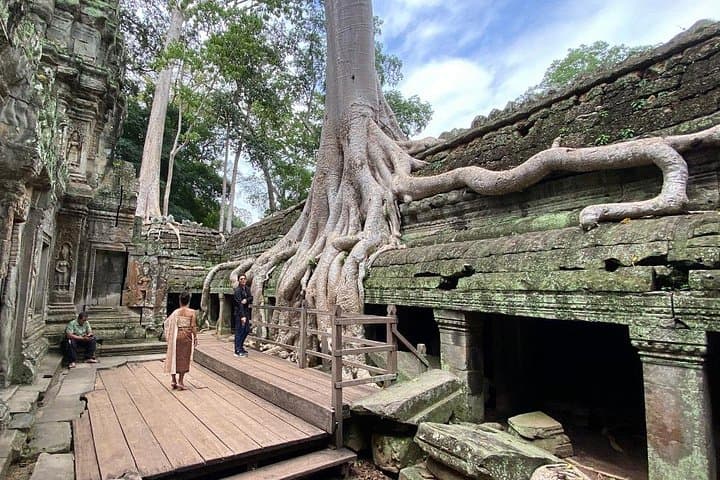


Morning light skims the moat and the towers of Angkor Wat pierce a pale sky — your first breath here tastes of dust, incense and humid history. Over three days you move from the measured geometry of sandstone galleries to the liquid, shifting lives of Tonlé Sap; temples give way to boats and wooden stilts, and each setting tests a different sense of travel.
Morning light skims the moat and the towers of Angkor Wat pierce a pale sky — your first breath here tastes of dust, incense and humid history. Over three days you move from the measured geometry of sandstone galleries to the liquid, shifting lives of Tonlé Sap; temples give way to boats and wooden stilts, and each setting tests a different sense of travel.
Angkor’s monuments were raised between the 9th and 13th centuries as expressions of state power and cosmology; Angkor Wat’s central quincunx echoes Mount Meru while the Bayon’s carved faces watch the old capital of Angkor Thom. Banteay Srei, farther out, showcases pink sandstone carving rarely matched in intricacy. Geologically, the region sits on alluvial plains fed by the Mekong and Tonlé Sap, the latter swelling in the monsoon and reversing the river’s flow — a seasonal heartbeat that sustains the floating villages.
On day three a boat to Kampong Phluk delivers an entirely different rhythm: mangrove trunks rise from floodwater and fishing families navigate narrow channels. Expect close encounters with local life, markets, and temple courtyards where monkeys and birds keep time with tourist footsteps.
Practical guidance: temples are best visited near sunrise or late afternoon to avoid heat and crowds; wear lightweight, respectful clothing that covers shoulders and knees. Bring insect repellent for the lakes and a credit card or cash for Angkor passes and small donations; cash dominates in village markets. Stay hydrated — humidity drains energy faster than distance does — and carry a compact rain layer in the wet months. Respect temple restoration zones and local customs; a quiet, observant approach yields the clearest experiences.