THE ADVENTURE COLLECTIVE® · Independent discovery and booking for outdoor travel

Descend from high puna ridges into one of the planet’s deepest canyons on this 3-day Colca backpacking route. Expect steep switchbacks, community homestays, an oasis pool and a demanding climb back to Cabanaconde.
Descend from high puna ridges into one of the planet’s deepest canyons on this 3-day Colca backpacking route. Expect steep switchbacks, community homestays, an oasis pool and a demanding climb back to Cabanaconde.
The first light of the minivan leaves Arequipa before dawn, and the Andes roll out like a succession of stone walls and blue-white peaks. You arrive in Cabanaconde (≈3,700 m), lace boots, and begin a steep descent that drops roughly 1,300–1,400 m over rocky switchbacks to the first village, San Juan de Chuccho (≈2,350 m). Wind, scrub, and highland birds keep you company; vicuñas and native alpacas punctuate the slope.
Verified experiences and guided adventures in the surrounding area.
Operated by Ventura Travel Arequipa · Cabanaconde, Arequipa
The first light of the minivan leaves Arequipa before dawn, and the Andes roll out like a succession of stone walls and blue-white peaks. You arrive in Cabanaconde (≈3,700 m), lace boots, and begin a steep descent that drops roughly 1,300–1,400 m over rocky switchbacks to the first village, San Juan de Chuccho (≈2,350 m). Wind, scrub, and highland birds keep you company; vicuñas and native alpacas punctuate the slope.
Colca’s geology is raw: folded volcanic deposits and river-cut terraces that reveal millions of years of uplift. The canyon rivals the Grand Canyon in depth; human history here is older and continuous—pre-Inca terraces, Spanish colonial towns and resilient Quechua communities who still farm the steep walls.
Day two moves through cultivated valleys to the oasis (Sangalle)—a sheltered palm pocket and natural pool where dry canyon walls press in close. The afternoon’s reward is the canyon’s thermal light and the required climb back up: a sustained 2–3 hour ascent with sharp exposure and loose stone. Night two is with a local family or basic hostel with hot showers; day three ends with a soak in Chivay hot springs before the return to Arequipa.
Practical edge: expect 8–10 hours of walking over the trip, steep descents/ascents, strong sun and thin air. Carry 2–3 L water, layers for 15–25°C day / near freezing nights, trekking poles and a basic first-aid kit. Mules are available for the uphill if needed. Entrance fee (70 soles) and bilingual guide are included—plan for moderate to challenging effort and prioritize acclimatization in Arequipa before departure.
Yes—spend 24–48 hours in Arequipa at moderate activity; symptoms of altitude sickness can appear quickly at these elevations.
Yes—mules are commonly available to hire for the ascent out of the oasis if you prefer not to climb back on foot.
Accommodations are basic: one night with a local family (private room), and one night in a simple hostel with private baths; hot springs visit in Chivay on day three.
Yes—the Colca Canyon entrance fee (70 soles) is included in the tour price, along with bilingual guide and round-trip transport.
Ventura Travel Arequipa operates guided outdoor trips and adventures with an emphasis on safety, stewardship, and memorable experiences.
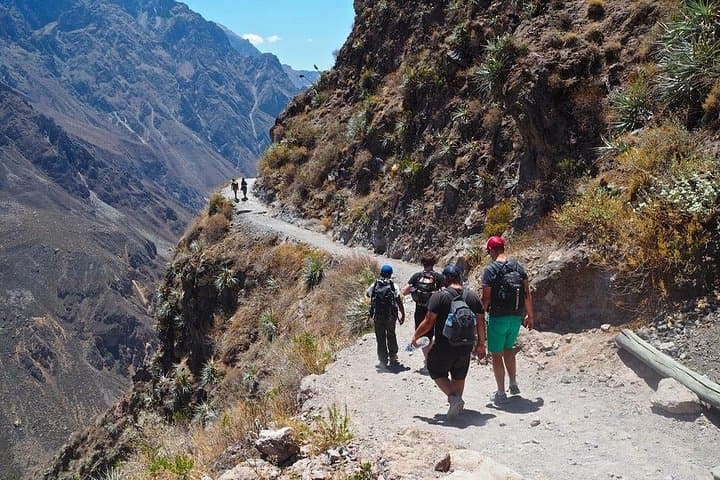
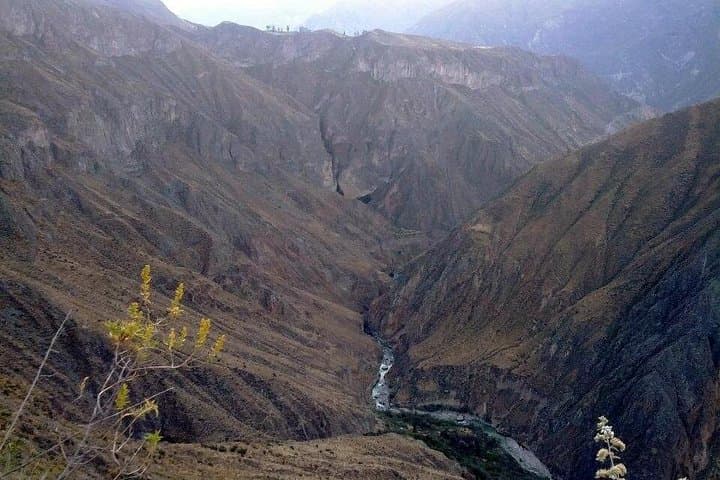
The first light of the minivan leaves Arequipa before dawn, and the Andes roll out like a succession of stone walls and blue-white peaks. You arrive in Cabanaconde (≈3,700 m), lace boots, and begin a steep descent that drops roughly 1,300–1,400 m over rocky switchbacks to the first village, San Juan de Chuccho (≈2,350 m). Wind, scrub, and highland birds keep you company; vicuñas and native alpacas punctuate the slope.
The first light of the minivan leaves Arequipa before dawn, and the Andes roll out like a succession of stone walls and blue-white peaks. You arrive in Cabanaconde (≈3,700 m), lace boots, and begin a steep descent that drops roughly 1,300–1,400 m over rocky switchbacks to the first village, San Juan de Chuccho (≈2,350 m). Wind, scrub, and highland birds keep you company; vicuñas and native alpacas punctuate the slope.
Colca’s geology is raw: folded volcanic deposits and river-cut terraces that reveal millions of years of uplift. The canyon rivals the Grand Canyon in depth; human history here is older and continuous—pre-Inca terraces, Spanish colonial towns and resilient Quechua communities who still farm the steep walls.
Day two moves through cultivated valleys to the oasis (Sangalle)—a sheltered palm pocket and natural pool where dry canyon walls press in close. The afternoon’s reward is the canyon’s thermal light and the required climb back up: a sustained 2–3 hour ascent with sharp exposure and loose stone. Night two is with a local family or basic hostel with hot showers; day three ends with a soak in Chivay hot springs before the return to Arequipa.
Practical edge: expect 8–10 hours of walking over the trip, steep descents/ascents, strong sun and thin air. Carry 2–3 L water, layers for 15–25°C day / near freezing nights, trekking poles and a basic first-aid kit. Mules are available for the uphill if needed. Entrance fee (70 soles) and bilingual guide are included—plan for moderate to challenging effort and prioritize acclimatization in Arequipa before departure.