THE ADVENTURE COLLECTIVE® · Independent discovery and booking for outdoor travel

Cross coastal Agadir, High Atlas passes and palm-lined valleys to reach the orange dunes of Erg Chebbi. This 3-day journey pairs cultural stops — Aït Ben Haddou and Todra Gorges — with a desert camp experience under an expansive Saharan sky.
Cross coastal Agadir, High Atlas passes and palm-lined valleys to reach the orange dunes of Erg Chebbi. This 3-day journey pairs cultural stops — Aït Ben Haddou and Todra Gorges — with a desert camp experience under an expansive Saharan sky.
You step out of the air-conditioned van and the desert welcomes you with a slow, warm inhale — sand shimmering like moved light, wind shaping ridgelines that seem to shift minute by minute.
Verified experiences and guided adventures in the surrounding area.
Operated by Morocco lifetime Tours · Merzouga, Drâa-Tafilalet
You step out of the air-conditioned van and the desert welcomes you with a slow, warm inhale — sand shimmering like moved light, wind shaping ridgelines that seem to shift minute by minute.
This three-day corridor links Morocco’s Atlantic coast to the heart of the Sahara. Beginning in Agadir, the route climbs through the Sirwa and Anti-Atlas spurs, passes the UNESCO ksar of Aït Ben Haddou and the movie-ready kasbahs of Ouarzazate, then threads oases and river valleys before arriving at Erg Chebbi near Merzouga. Geology here is readable: sedimentary basins, wind-polished sandstone, and great dunes built by north-african trade winds that pushed silts from ancient riverbeds into towering crescents.
Culture is hands-on — caravan towns like Rissani and Tinghir speak of trans-Saharan trade, saffron farms outside Taliouine, and Amazigh (Berber) hospitality in mountain auberges and desert camps. Expect a camel trek at sunset, a night in a traditional camp under a wide sky, and a sunrise that remaps the dunes with every color.
Practical notes: drives are long (several 4–6 hour legs), roads vary from high-quality highway to winding mountain passes. Hydrate, schedule acclimatization time if arriving from the coast, and allow flexibility for weather-driven changes. Accommodations alternate between simple auberges, guesthouses and a luxury-style desert camp. Pack layered clothing for cold desert nights, sun protection for daytime, and shoes that handle sand and rocky wadis. This itinerary condenses striking contrasts into 72 hours — coastal breeze, mountain passes, palm-lined valleys and the vast, patient Sahara.
Yes — the trip description includes two dinners, two breakfasts, one night in a standard hotel and one night in a desert camp; full details provided at booking.
Typical camel treks to the camp are about 1–1.5 hours, timed to reach the dunes before sunset.
The tour lists as physically easy and offers infant seats; however, camel riding and uneven surfaces at gorges and dunes may be challenging for some — check specific accessibility needs with the operator.
Bring a small overnight bag; larger luggage can be stored on the vehicle for the duration of the camel transfer.
Morocco lifetime Tours operates guided outdoor trips and adventures with an emphasis on safety, stewardship, and memorable experiences.

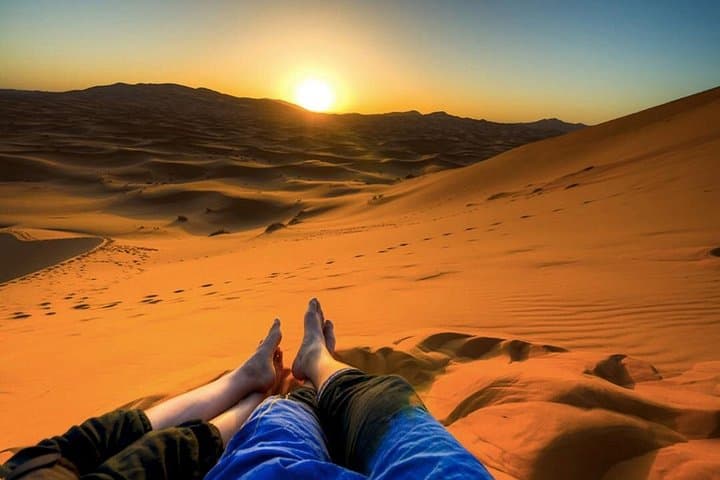


You step out of the air-conditioned van and the desert welcomes you with a slow, warm inhale — sand shimmering like moved light, wind shaping ridgelines that seem to shift minute by minute.
You step out of the air-conditioned van and the desert welcomes you with a slow, warm inhale — sand shimmering like moved light, wind shaping ridgelines that seem to shift minute by minute.
This three-day corridor links Morocco’s Atlantic coast to the heart of the Sahara. Beginning in Agadir, the route climbs through the Sirwa and Anti-Atlas spurs, passes the UNESCO ksar of Aït Ben Haddou and the movie-ready kasbahs of Ouarzazate, then threads oases and river valleys before arriving at Erg Chebbi near Merzouga. Geology here is readable: sedimentary basins, wind-polished sandstone, and great dunes built by north-african trade winds that pushed silts from ancient riverbeds into towering crescents.
Culture is hands-on — caravan towns like Rissani and Tinghir speak of trans-Saharan trade, saffron farms outside Taliouine, and Amazigh (Berber) hospitality in mountain auberges and desert camps. Expect a camel trek at sunset, a night in a traditional camp under a wide sky, and a sunrise that remaps the dunes with every color.
Practical notes: drives are long (several 4–6 hour legs), roads vary from high-quality highway to winding mountain passes. Hydrate, schedule acclimatization time if arriving from the coast, and allow flexibility for weather-driven changes. Accommodations alternate between simple auberges, guesthouses and a luxury-style desert camp. Pack layered clothing for cold desert nights, sun protection for daytime, and shoes that handle sand and rocky wadis. This itinerary condenses striking contrasts into 72 hours — coastal breeze, mountain passes, palm-lined valleys and the vast, patient Sahara.