THE ADVENTURE COLLECTIVE® · Independent discovery and booking for outdoor travel

Spend three days trekking into Gunung Leuser National Park from Bukit Lawang to search for wild Sumatran orangutans, camp in the jungle, and return by river tubing. This ethical tour pairs certified local guides with conservation support and community reinvestment.
Spend three days trekking into Gunung Leuser National Park from Bukit Lawang to search for wild Sumatran orangutans, camp in the jungle, and return by river tubing. This ethical tour pairs certified local guides with conservation support and community reinvestment.
Dawn arrives as the jungle exhales: mist lifts off the Bahorok River, insects settle, and the trail ahead narrows into a corridor of green. On a three-day ethical trek from Bukit Lawang you step into Gunung Leuser National Park—where forest floors give way to buttress roots, lianas weave through the canopy, and distant calls could be an orangutan or a gibbon testing its range.
Verified experiences and guided adventures in the surrounding area.
Operated by Sumatra Orangutan Trekking · Bukit Lawang, North Sumatra
Dawn arrives as the jungle exhales: mist lifts off the Bahorok River, insects settle, and the trail ahead narrows into a corridor of green. On a three-day ethical trek from Bukit Lawang you step into Gunung Leuser National Park—where forest floors give way to buttress roots, lianas weave through the canopy, and distant calls could be an orangutan or a gibbon testing its range.
The park is one of the last strongholds for the Sumatran orangutan and a patchwork of lowland rainforest, valley ridges, and river systems carved from volcanic soils. Human history here merges with colonial-era rubber and coffee plantations and modern conservation efforts; local guides combine traditional knowledge with ITGA-certified training to minimize impact and maximize wildlife encounters.
Expect mostly singletrack through humid, sometimes muddy terrain, roughly 18–25 km over three days with intermittent climbs totaling about 400–600 m of ascent. Trails cross secondary forest and primary pockets; stream crossings and short steep gullies are common. Nights are spent at simple jungle camps; evenings bring rain-slick leaves and the thicker chorus of nocturnal life.
Practical guidance: go light but prepared—sturdy waterproof boots, quick-dry layers, insect repellent, a headlamp, and a water-purification option. Leave no trace, follow your guide’s distance limits from wildlife, and time your trek in the dryer months if you prefer fewer river crossings. The exit is memorable: river tubing back to Bukit Lawang—an active, damp finale that literally carries you downstream from the jungle into village life.
Sightings are possible but not guaranteed; guides increase the odds by visiting known feeding and nesting areas and using quiet tracking techniques.
Camps are rustic—simple sleeping platforms, communal meal areas, and minimal facilities; you should expect basic sanitation and bring a headlamp and camp slippers.
Not recommended for very young children; the operator advises participants be in good physical condition and able to handle uneven terrain and long days.
Bukit Lawang is about a 3–4 hour drive northwest of Medan; many travelers arrange a private transfer or shared van from the city or the airport.
Sumatra Orangutan Trekking operates guided outdoor trips and adventures with an emphasis on safety, stewardship, and memorable experiences.
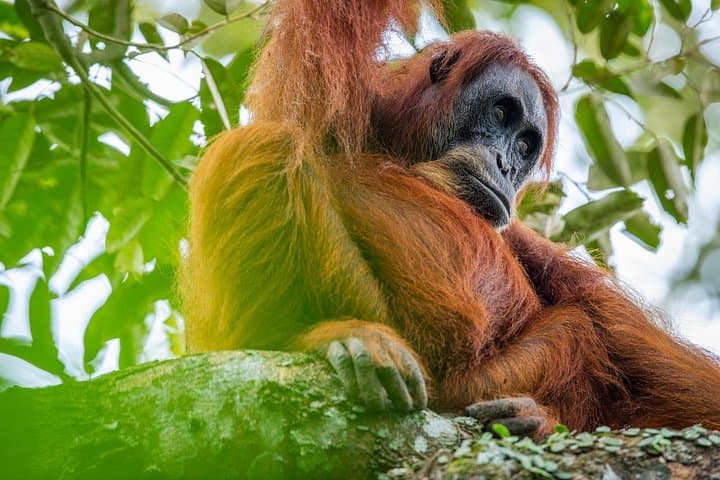


Dawn arrives as the jungle exhales: mist lifts off the Bahorok River, insects settle, and the trail ahead narrows into a corridor of green. On a three-day ethical trek from Bukit Lawang you step into Gunung Leuser National Park—where forest floors give way to buttress roots, lianas weave through the canopy, and distant calls could be an orangutan or a gibbon testing its range.
Dawn arrives as the jungle exhales: mist lifts off the Bahorok River, insects settle, and the trail ahead narrows into a corridor of green. On a three-day ethical trek from Bukit Lawang you step into Gunung Leuser National Park—where forest floors give way to buttress roots, lianas weave through the canopy, and distant calls could be an orangutan or a gibbon testing its range.
The park is one of the last strongholds for the Sumatran orangutan and a patchwork of lowland rainforest, valley ridges, and river systems carved from volcanic soils. Human history here merges with colonial-era rubber and coffee plantations and modern conservation efforts; local guides combine traditional knowledge with ITGA-certified training to minimize impact and maximize wildlife encounters.
Expect mostly singletrack through humid, sometimes muddy terrain, roughly 18–25 km over three days with intermittent climbs totaling about 400–600 m of ascent. Trails cross secondary forest and primary pockets; stream crossings and short steep gullies are common. Nights are spent at simple jungle camps; evenings bring rain-slick leaves and the thicker chorus of nocturnal life.
Practical guidance: go light but prepared—sturdy waterproof boots, quick-dry layers, insect repellent, a headlamp, and a water-purification option. Leave no trace, follow your guide’s distance limits from wildlife, and time your trek in the dryer months if you prefer fewer river crossings. The exit is memorable: river tubing back to Bukit Lawang—an active, damp finale that literally carries you downstream from the jungle into village life.