THE ADVENTURE COLLECTIVE® · Independent discovery and booking for outdoor travel

Follow a three-day loop from Marrakech across the High Atlas to Erg Chebbi’s sweeping dunes. Visit Ait Ben Haddou, Ouarzazate, Todra Gorge and sleep under the Sahara stars with sunrise camel rides.
Follow a three-day loop from Marrakech across the High Atlas to Erg Chebbi’s sweeping dunes. Visit Ait Ben Haddou, Ouarzazate, Todra Gorge and sleep under the Sahara stars with sunrise camel rides.
You push away from Marrakech before dawn, headlights carving the High Atlas as the road climbs to Tizi N'Tichka. Air thins; stone screes and terraced fields slide past until the landscape shifts — red clay kasbahs, palm oases, then the vast, wind-shaped ridges of Erg Chebbi. By sunset you are on a camel’s back, dune crests rolling like a living map under a wide, cooling sky.
Verified experiences and guided adventures in the surrounding area.
Operated by Menara Trip - Day Trip · Merzouga, Drâa-Tafilalet
You push away from Marrakech before dawn, headlights carving the High Atlas as the road climbs to Tizi N'Tichka. Air thins; stone screes and terraced fields slide past until the landscape shifts — red clay kasbahs, palm oases, then the vast, wind-shaped ridges of Erg Chebbi. By sunset you are on a camel’s back, dune crests rolling like a living map under a wide, cooling sky.
The route threads centuries of trade and film history: Ait Ben Haddou’s fortified ksar, a caravan stop along trans-Saharan routes, and Ouarzazate’s film studios where landscapes double for distant worlds. Geology here is dramatic — High Atlas granite gives way to eroded plateaus and Saharan sands formed from ancient river deposits and wind-driven silt.
Local culture is tactile and immediate: Berber hospitality, kasbah architecture of mud brick and lime, and night skies punctured by Saharan stars. Small villages sell hand-spun carpets and argan oil; guides who know dune behavior will read the sand like a map.
Practical side: travel is mostly by vehicle with short walks and a camel ride at sunrise and sunset. Nights in a desert camp mean big temperature swings — hot days, cold nights. Hydrate, layer, and protect skin and eyes from sun and sand. Expect long drives (200–300 km legs), basic yet comfortable camping, and an easy physical demand level suitable for most travelers. Bring a warm layer for dawn, sturdy shoes for oasis walks, and a sense of pace — the desert moves slow, but its views insist you pay attention.
Most departures include hotel pickup in Marrakech—confirm your pickup point when booking and allow time for morning collection.
Yes—sunset and sunrise camel rides are included; camels used for tourism are handled by experienced guides, but riders should follow the guide’s instructions and watch for sudden movements.
Camps are desert-style with sleeping tents (nomadic or Marabout style), basic sanitary facilities, and meals—comfortable but not luxury hotel-level.
The itinerary notes accessibility for various mobility levels; however, camel mounting and uneven camp surfaces may be challenging—ask the operator about specific accommodations.
Menara Trip - Day Trip operates guided outdoor trips and adventures with an emphasis on safety, stewardship, and memorable experiences.

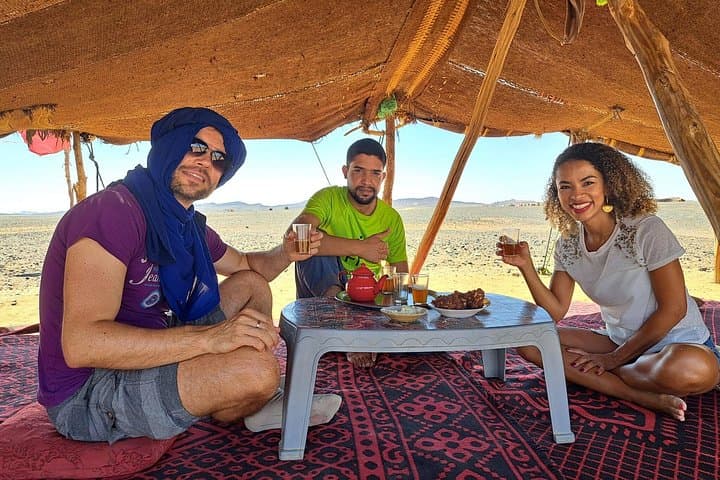


You push away from Marrakech before dawn, headlights carving the High Atlas as the road climbs to Tizi N'Tichka. Air thins; stone screes and terraced fields slide past until the landscape shifts — red clay kasbahs, palm oases, then the vast, wind-shaped ridges of Erg Chebbi. By sunset you are on a camel’s back, dune crests rolling like a living map under a wide, cooling sky.
You push away from Marrakech before dawn, headlights carving the High Atlas as the road climbs to Tizi N'Tichka. Air thins; stone screes and terraced fields slide past until the landscape shifts — red clay kasbahs, palm oases, then the vast, wind-shaped ridges of Erg Chebbi. By sunset you are on a camel’s back, dune crests rolling like a living map under a wide, cooling sky.
The route threads centuries of trade and film history: Ait Ben Haddou’s fortified ksar, a caravan stop along trans-Saharan routes, and Ouarzazate’s film studios where landscapes double for distant worlds. Geology here is dramatic — High Atlas granite gives way to eroded plateaus and Saharan sands formed from ancient river deposits and wind-driven silt.
Local culture is tactile and immediate: Berber hospitality, kasbah architecture of mud brick and lime, and night skies punctured by Saharan stars. Small villages sell hand-spun carpets and argan oil; guides who know dune behavior will read the sand like a map.
Practical side: travel is mostly by vehicle with short walks and a camel ride at sunrise and sunset. Nights in a desert camp mean big temperature swings — hot days, cold nights. Hydrate, layer, and protect skin and eyes from sun and sand. Expect long drives (200–300 km legs), basic yet comfortable camping, and an easy physical demand level suitable for most travelers. Bring a warm layer for dawn, sturdy shoes for oasis walks, and a sense of pace — the desert moves slow, but its views insist you pay attention.