THE ADVENTURE COLLECTIVE® · Independent discovery and booking for outdoor travel
Move from Marrakech’s Atlas passes to the sand seas of Erg Chebbi on a 3-day loop that blends kasbahs, gorges and a night in a desert camp. Expect long drives, a camel transfer, big skies and sharp temperature swings.
Move from Marrakech’s Atlas passes to the sand seas of Erg Chebbi on a 3-day loop that blends kasbahs, gorges and a night in a desert camp. Expect long drives, a camel transfer, big skies and sharp temperature swings.
You crest the final ridge and the dunes fall away like an ocean; wind-sculpted crests catch light and shadow as the camel train pads forward. This three-day loop from Marrakech moves from High Atlas passes to the ochre cliffs of the Dades and finally to the vast Erg Chebbi, where nights are wide and stars feel close enough to touch.
Verified experiences and guided adventures in the surrounding area.
Operated by Across Africa Tours LLC · Merzouga, Errachidia Province
You crest the final ridge and the dunes fall away like an ocean; wind-sculpted crests catch light and shadow as the camel train pads forward. This three-day loop from Marrakech moves from High Atlas passes to the ochre cliffs of the Dades and finally to the vast Erg Chebbi, where nights are wide and stars feel close enough to touch.
The route threads through Morocco’s layered history: kasbahs of rammed earth that once sheltered caravan traders, the fortified ksar of Aït Benhaddou rising above the river, and small Berber villages still shaped by centuries of mountain-to-desert exchange. Geologically, the Erg Chebbi dunes are wind-built sand seas fed by the Atlas highlands; their ridges shift with every season and every strong sirocco. Local culture centers on hospitality—mint tea and tagine punctuate long drives—and on dromedary life, the animal that has carried people and goods across these sands for millennia.
Practically, expect long stretches by air-conditioned minivan between highlights, a moderate amount of walking on rocky valley trails, and short but unsteady camel rides into the camp. Nights in the dunes are cold—bring layers—and daytime sun is intense. Plan for early starts to catch sunrise on the dune rim, and allow time to explore Aït Benhaddou’s lanes on day one and the Dades viewpoints on the way south.
Hydrate often, protect skin and eyes from fine sand, and book through reputable local operators who respect dune boundaries. For most travelers this itinerary offers a compact, manageable taste of Moroccan desert life with clear logistics and unforgettable skies.
Camel transfers to the desert camp are typically 30–60 minutes depending on the chosen dune camp location and pace.
The tour is family-friendly but not recommended for people with serious heart conditions; camel rides and desert terrain can be physically awkward for some.
Most small desert camps provide basic tented accommodations with shared toilets and hand-wash facilities; water is limited—check camp standards with your operator.
Yes; the route includes stops at Aït Benhaddou, the Dades Valley and viewpoints along the 1001 Kasbah Road before reaching Merzouga.
Across Africa Tours LLC operates guided outdoor trips and adventures with an emphasis on safety, stewardship, and memorable experiences.
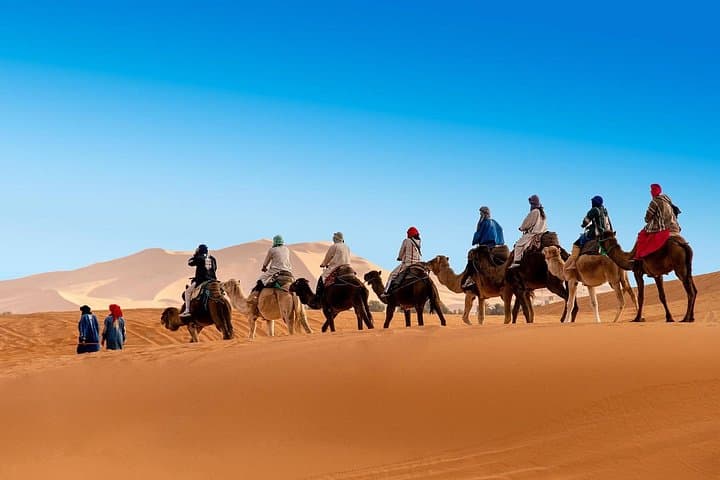
You crest the final ridge and the dunes fall away like an ocean; wind-sculpted crests catch light and shadow as the camel train pads forward. This three-day loop from Marrakech moves from High Atlas passes to the ochre cliffs of the Dades and finally to the vast Erg Chebbi, where nights are wide and stars feel close enough to touch.
You crest the final ridge and the dunes fall away like an ocean; wind-sculpted crests catch light and shadow as the camel train pads forward. This three-day loop from Marrakech moves from High Atlas passes to the ochre cliffs of the Dades and finally to the vast Erg Chebbi, where nights are wide and stars feel close enough to touch.
The route threads through Morocco’s layered history: kasbahs of rammed earth that once sheltered caravan traders, the fortified ksar of Aït Benhaddou rising above the river, and small Berber villages still shaped by centuries of mountain-to-desert exchange. Geologically, the Erg Chebbi dunes are wind-built sand seas fed by the Atlas highlands; their ridges shift with every season and every strong sirocco. Local culture centers on hospitality—mint tea and tagine punctuate long drives—and on dromedary life, the animal that has carried people and goods across these sands for millennia.
Practically, expect long stretches by air-conditioned minivan between highlights, a moderate amount of walking on rocky valley trails, and short but unsteady camel rides into the camp. Nights in the dunes are cold—bring layers—and daytime sun is intense. Plan for early starts to catch sunrise on the dune rim, and allow time to explore Aït Benhaddou’s lanes on day one and the Dades viewpoints on the way south.
Hydrate often, protect skin and eyes from fine sand, and book through reputable local operators who respect dune boundaries. For most travelers this itinerary offers a compact, manageable taste of Moroccan desert life with clear logistics and unforgettable skies.
