THE ADVENTURE COLLECTIVE® · Independent discovery and booking for outdoor travel

Three days on Mount Meru is compact, steep, and designed to prepare the body and mind for Kilimanjaro. Expect forested paths, giant heather, hut nights and a pre-dawn summit for sunrise views over an ash cone—and sometimes Kilimanjaro above the clouds.
Three days on Mount Meru is compact, steep, and designed to prepare the body and mind for Kilimanjaro. Expect forested paths, giant heather, hut nights and a pre-dawn summit for sunrise views over an ash cone—and sometimes Kilimanjaro above the clouds.
At 1:30 a.m., headlamps stitch a thin river of light through the dark as a small group leaves Saddle Hut for the summit. The trail climbs hard from the start—first through damp, shadowed forest, then into a higher world of giant heather and wind-sheared moorland. By first light the ridge opens and the crater’s inner cliffs fall away into a raw ash cone; above the clouds, Kilimanjaro’s peak sometimes appears like a ship on an ocean.
Verified experiences and guided adventures in the surrounding area.
Operated by MERU SLOPES TOURS AND SAFARIS · Arusha, Arusha Region
At 1:30 a.m., headlamps stitch a thin river of light through the dark as a small group leaves Saddle Hut for the summit. The trail climbs hard from the start—first through damp, shadowed forest, then into a higher world of giant heather and wind-sheared moorland. By first light the ridge opens and the crater’s inner cliffs fall away into a raw ash cone; above the clouds, Kilimanjaro’s peak sometimes appears like a ship on an ocean.
Mount Meru sits inside Arusha National Park and has long been both a training ground for Kilimanjaro aspirants and a quieter, wilder climb in its own right. Geologically, Meru is a stratovolcano with a collapsed caldera that makes for dramatic inner cliffs and the large Ash Cone at its center. Culturally, the mountain has been a landmark for Chagga and Meru communities for generations; guides and porters from Arusha bring local knowledge of weather patterns, trail behavior, and animal routes.
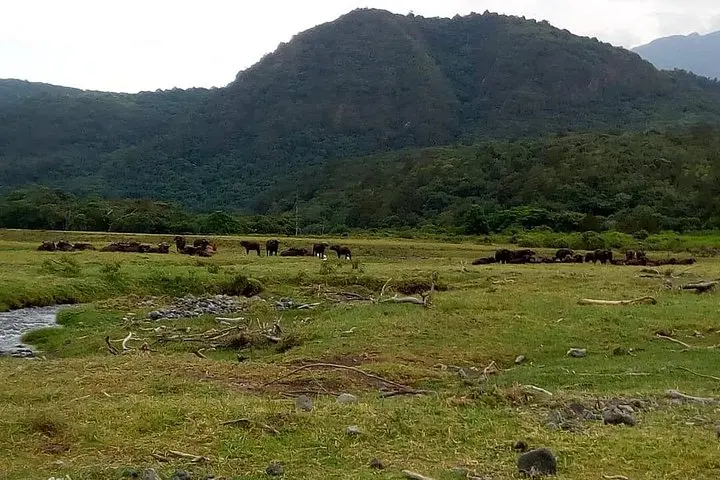
Wildlife is one of the trek’s unusual bonuses. From the park road to Momella Gate you can spot elephant herds, giraffes browsing acacia, and colobus monkeys in the canopy—animals that sometimes follow the lower slopes where the forest ribbon crosses game paths. The route itself passes streams and parkland, then climbs through montane forest into the exposed moorland and heather that define the upper slopes.
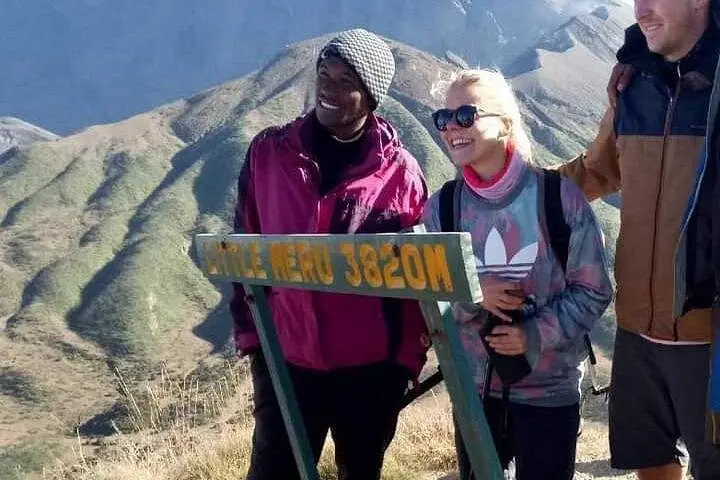
The itinerary on this three-day trek balances acclimatization and ambition: a first night at Miriakamba Hut after a short, wildlife-rich walk from Momella Gate; a shorter but steep push to Saddle Hut with a late-afternoon scramble to Little Meru for alpine views; then the pre-dawn summit assault from Saddle Hut, via Rhino Point and Cobra Point, to the 4,566 m summit. Expect steep switchbacks, rocky sections, and a final narrow ridge where careful footwork matters.
Practical edge: the route is approximately 30–35 km round-trip with roughly 3,100 m of elevation gain from trailhead to summit. Fitness matters—this is a challenging, high-altitude trek where pacing, hydration, and layered clothing are decisive. Start conservatively on day one; use porters to save energy for the summit push. Nights in huts are basic but warm, and the pre-dawn ascent requires a reliable headlamp and windproof layers.
Timing is important: dry-season windows (June–October and December–March) give the best summit odds, while the long rains (March–May) can turn moorland to quagmire. Leave space in your schedule for altitude adjustments and enjoy the quieter rewards—sunrise from Meru’s rim, the chance glance of Kilimanjaro, and the surprisingly bold wildlife below the tree line.
It’s challenging—steep trails and high altitude make it demanding; expect long hiking days, especially the summit day with significant elevation gain.
Prior multi-day hiking experience is strongly recommended to manage pacing, load, and altitude effects.
Yes—the tour includes guides, porters, a cook, and park rangers; porters can carry personal gear for a fee included in the booking details.
Huts are basic, communal sleeping quarters with simple bedding—comfortable for resting but not luxurious; bring a warm sleeping liner.
Dry months (June–October and December–March) offer the most stable weather and best summit chances; long rains (March–May) are less predictable.
Not recommended for people with serious cardiovascular or spinal conditions, or for pregnant travelers—consult a physician before booking.
MERU SLOPES TOURS AND SAFARIS operates guided outdoor trips and adventures with an emphasis on safety, stewardship, and memorable experiences.
At 1:30 a.m., headlamps stitch a thin river of light through the dark as a small group leaves Saddle Hut for the summit. The trail climbs hard from the start—first through damp, shadowed forest, then into a higher world of giant heather and wind-sheared moorland. By first light the ridge opens and the crater’s inner cliffs fall away into a raw ash cone; above the clouds, Kilimanjaro’s peak sometimes appears like a ship on an ocean.
At 1:30 a.m., headlamps stitch a thin river of light through the dark as a small group leaves Saddle Hut for the summit. The trail climbs hard from the start—first through damp, shadowed forest, then into a higher world of giant heather and wind-sheared moorland. By first light the ridge opens and the crater’s inner cliffs fall away into a raw ash cone; above the clouds, Kilimanjaro’s peak sometimes appears like a ship on an ocean.
Mount Meru sits inside Arusha National Park and has long been both a training ground for Kilimanjaro aspirants and a quieter, wilder climb in its own right. Geologically, Meru is a stratovolcano with a collapsed caldera that makes for dramatic inner cliffs and the large Ash Cone at its center. Culturally, the mountain has been a landmark for Chagga and Meru communities for generations; guides and porters from Arusha bring local knowledge of weather patterns, trail behavior, and animal routes.
Wildlife is one of the trek’s unusual bonuses. From the park road to Momella Gate you can spot elephant herds, giraffes browsing acacia, and colobus monkeys in the canopy—animals that sometimes follow the lower slopes where the forest ribbon crosses game paths. The route itself passes streams and parkland, then climbs through montane forest into the exposed moorland and heather that define the upper slopes.
The itinerary on this three-day trek balances acclimatization and ambition: a first night at Miriakamba Hut after a short, wildlife-rich walk from Momella Gate; a shorter but steep push to Saddle Hut with a late-afternoon scramble to Little Meru for alpine views; then the pre-dawn summit assault from Saddle Hut, via Rhino Point and Cobra Point, to the 4,566 m summit. Expect steep switchbacks, rocky sections, and a final narrow ridge where careful footwork matters.
Practical edge: the route is approximately 30–35 km round-trip with roughly 3,100 m of elevation gain from trailhead to summit. Fitness matters—this is a challenging, high-altitude trek where pacing, hydration, and layered clothing are decisive. Start conservatively on day one; use porters to save energy for the summit push. Nights in huts are basic but warm, and the pre-dawn ascent requires a reliable headlamp and windproof layers.
Timing is important: dry-season windows (June–October and December–March) give the best summit odds, while the long rains (March–May) can turn moorland to quagmire. Leave space in your schedule for altitude adjustments and enjoy the quieter rewards—sunrise from Meru’s rim, the chance glance of Kilimanjaro, and the surprisingly bold wildlife below the tree line.