THE ADVENTURE COLLECTIVE® · Independent discovery and booking for outdoor travel

A compact three-day overland trip from Marrakech to Fes that threads the Atlas mountains, Dades and Todra gorges and the Erg Chebbi dunes. Expect long driving days, a camel ride, and an overnight in a nomadic-style desert camp under vivid desert skies.
A compact three-day overland trip from Marrakech to Fes that threads the Atlas mountains, Dades and Todra gorges and the Erg Chebbi dunes. Expect long driving days, a camel ride, and an overnight in a nomadic-style desert camp under vivid desert skies.
The road out of Marrakech tightens into hairpins as the Atlas mountains shoulder the sky; dust and argan scrub slide past the vehicle while light shifts from orchard green to ochre salt flats.
Verified experiences and guided adventures in the surrounding area.
Operated by Snoubi Travelling · Merzouga, Drâa-Tafilalet
The road out of Marrakech tightens into hairpins as the Atlas mountains shoulder the sky; dust and argan scrub slide past the vehicle while light shifts from orchard green to ochre salt flats.
On day one the group crosses the Tizi n'Tichka pass (about 2,260 m), stops at Ait Ben Haddou — a fortified kasbah and UNESCO site — then follows a winding route through Ouarzazate toward the Dades Valley. By day two the landscape opens into the carved walls of the Dades and Todra gorges, limestone canyons where brief walks give a sense of scale before the road drops toward the Sahara.
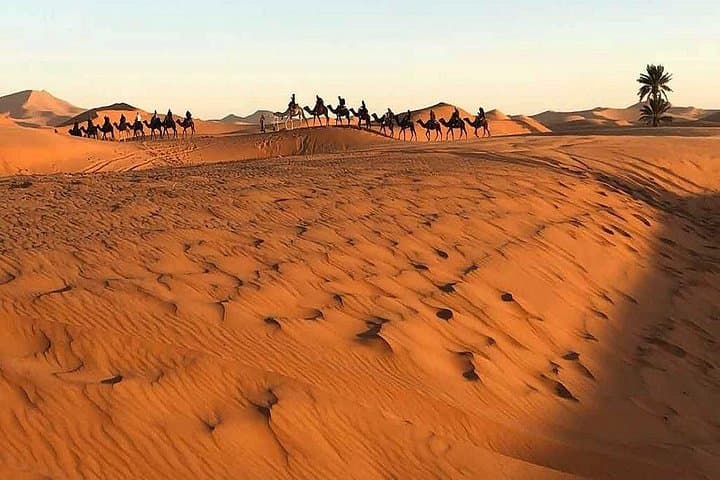
Merzouga's Erg Chebbi is the trip's heart: dunes that can rise more than 100–150 m, a short camel trek across rippled sand, and an overnight in a nomadic-style camp under star-sliced sky. The region blends Berber traditions, caravan-era architecture, and a modern film-industry footprint around Ouarzazate — a cultural crossroad shaped by trade routes and geology.
Practical side: the tour covers roughly 500–650 km over three days with long driving stretches and multiple short walks; expect 6–8 hour transit blocks on some days. Bring layered clothing for large temperature swings, reliable footwear for canyon walking and camp terrain, sun protection and at least 2–3 liters of water per person for dune visits. Group size is modest (up to 17) with hotel pickup, guide/driver and basic desert-camp accommodations included. Plan for early starts to catch sunrise on the dunes and carry cash for small local purchases at cooperatives and cafes.
The tour typically includes two dinners, two breakfasts and overnight accommodation in hotels and one desert camp night in a nomadic-style tent.
Camel treks are short (often 30–60 minutes) and suitable for beginners; handlers lead the camels and provide basic guidance.
Yes — bring Moroccan dirham for small purchases, cooperatives, tips and any optional activities; card acceptance is limited in remote areas.
Expect several long driving blocks (6–8 hours on some days) in an air-conditioned vehicle; stops are scheduled for photos and short walks.
Snoubi Travelling operates guided outdoor trips and adventures with an emphasis on safety, stewardship, and memorable experiences.


The road out of Marrakech tightens into hairpins as the Atlas mountains shoulder the sky; dust and argan scrub slide past the vehicle while light shifts from orchard green to ochre salt flats.
The road out of Marrakech tightens into hairpins as the Atlas mountains shoulder the sky; dust and argan scrub slide past the vehicle while light shifts from orchard green to ochre salt flats.
On day one the group crosses the Tizi n'Tichka pass (about 2,260 m), stops at Ait Ben Haddou — a fortified kasbah and UNESCO site — then follows a winding route through Ouarzazate toward the Dades Valley. By day two the landscape opens into the carved walls of the Dades and Todra gorges, limestone canyons where brief walks give a sense of scale before the road drops toward the Sahara.
Merzouga's Erg Chebbi is the trip's heart: dunes that can rise more than 100–150 m, a short camel trek across rippled sand, and an overnight in a nomadic-style camp under star-sliced sky. The region blends Berber traditions, caravan-era architecture, and a modern film-industry footprint around Ouarzazate — a cultural crossroad shaped by trade routes and geology.
Practical side: the tour covers roughly 500–650 km over three days with long driving stretches and multiple short walks; expect 6–8 hour transit blocks on some days. Bring layered clothing for large temperature swings, reliable footwear for canyon walking and camp terrain, sun protection and at least 2–3 liters of water per person for dune visits. Group size is modest (up to 17) with hotel pickup, guide/driver and basic desert-camp accommodations included. Plan for early starts to catch sunrise on the dunes and carry cash for small local purchases at cooperatives and cafes.