THE ADVENTURE COLLECTIVE® · Independent discovery and booking for outdoor travel

Four days of Sinai-adjacent desert travel take you from Fayoum’s lakes to the fossil fields of Wadi Hitan and the surreal chalk formations of the White Desert. Expect long drives, 4x4 crossings and camp nights under wide, chilly skies.
Four days of Sinai-adjacent desert travel take you from Fayoum’s lakes to the fossil fields of Wadi Hitan and the surreal chalk formations of the White Desert. Expect long drives, 4x4 crossings and camp nights under wide, chilly skies.
A dawn convoy leaves Cairo and the city’s haze falls away: by late morning the road opens to ochre flats and the slow curve of Lake Qarun. On day one the trip moves through Wadi Rayan — a natural depression 42 meters below sea level — and then into Wadi Hitan, where whale skeletons laid down 40 million years ago arrest the eye and rewrite the coastline of time.
Verified experiences and guided adventures in the surrounding area.
Operated by Sun Pyramids Tours · Cairo, Cairo Governorate
A dawn convoy leaves Cairo and the city’s haze falls away: by late morning the road opens to ochre flats and the slow curve of Lake Qarun. On day one the trip moves through Wadi Rayan — a natural depression 42 meters below sea level — and then into Wadi Hitan, where whale skeletons laid down 40 million years ago arrest the eye and rewrite the coastline of time.
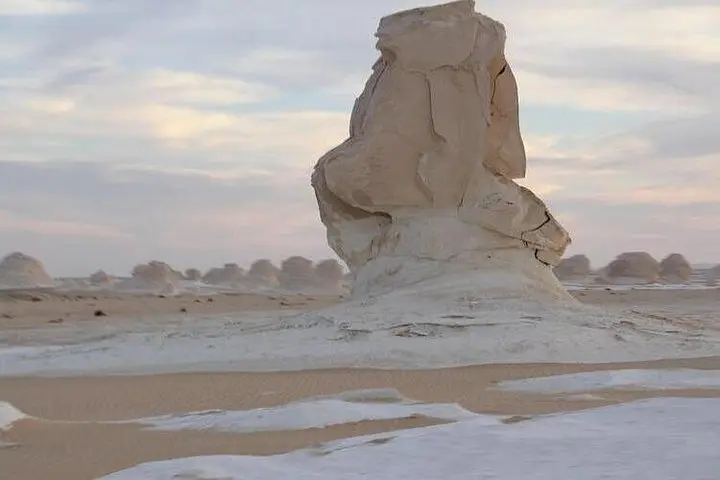
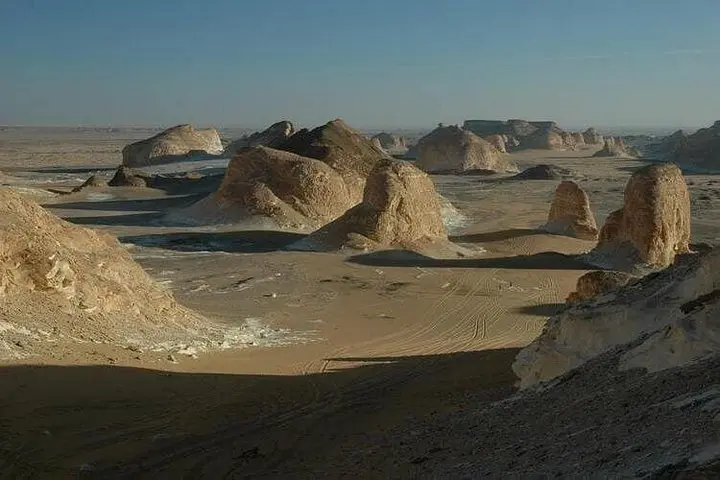
Geology here reads like a field guide: chalky dunes that turn wind into sculpture, black basalt outcrops stained with iron, and silica-crystalline ridges that catch the sun. The Bahariya and White Desert landscapes were shaped by shifting seas and millennia of wind; small Bedouin settlements and hot springs at El Hez punctuate the emptiness with human scale. Cultural notes are simple: local guides speak Arabic and the area retains a strong Bedouin presence; meals and camps are straightforward and centered around hospitality.
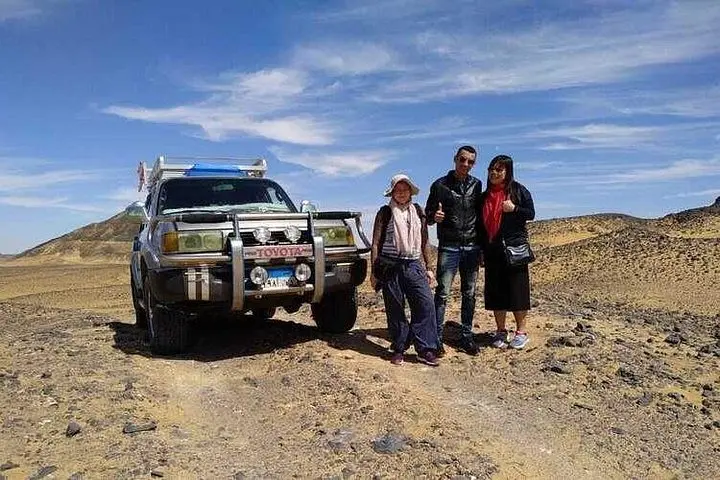
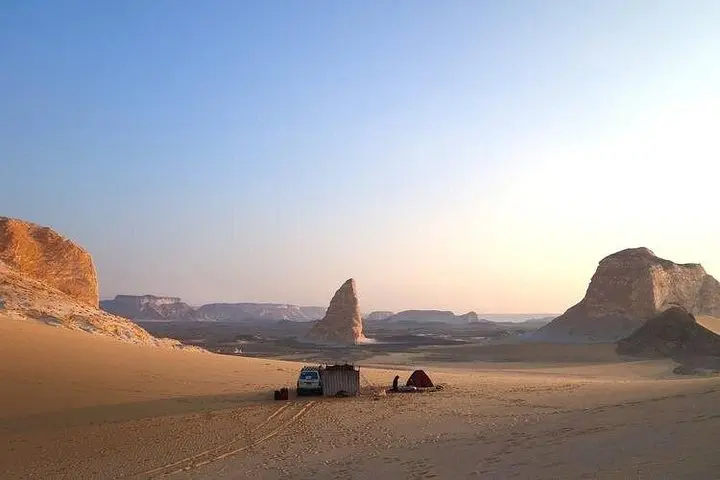
Practically, expect long drives — the itinerary notes a roughly 440 km, six-hour transfer when moving between oases — and extensive off-road travel (up to 160 km of on/off track between Bahariya and White Desert). Nights are cold, days can be intensely hot; camps provide basic shelter and meals. Vehicles are 4x4 Toyota Land Cruisers, and bottled water is typically supplied.
Pack layered clothing for temperature swings, sun protection, sturdy footwear for chalk and gravel, and a small daypack for short walks to viewpoints. Plan for limited facilities in the park, leave no trace, and allow extra time for photography and slow walks among the mushroom-shaped formations that give the desert its uncanny shapes.
Some transfers are long — expect up to six hours and roughly 440 km on one transfer; much of the route includes on/off-road driving in 4x4 vehicles.
Camps are basic with sheltered sleeping and meals provided; running water and facilities are limited compared with hotels.
The operator lists the tour as suitable for all fitness levels, but it involves long drives and uneven ground; those with limited mobility should check vehicle access and campsite arrangements in advance.
The route is a standard tourist circuit; guides handle local access and national park fees. Follow guide instructions and avoid climbing fragile formations.
Sun Pyramids Tours operates guided outdoor trips and adventures with an emphasis on safety, stewardship, and memorable experiences.
A dawn convoy leaves Cairo and the city’s haze falls away: by late morning the road opens to ochre flats and the slow curve of Lake Qarun. On day one the trip moves through Wadi Rayan — a natural depression 42 meters below sea level — and then into Wadi Hitan, where whale skeletons laid down 40 million years ago arrest the eye and rewrite the coastline of time.
A dawn convoy leaves Cairo and the city’s haze falls away: by late morning the road opens to ochre flats and the slow curve of Lake Qarun. On day one the trip moves through Wadi Rayan — a natural depression 42 meters below sea level — and then into Wadi Hitan, where whale skeletons laid down 40 million years ago arrest the eye and rewrite the coastline of time.
Geology here reads like a field guide: chalky dunes that turn wind into sculpture, black basalt outcrops stained with iron, and silica-crystalline ridges that catch the sun. The Bahariya and White Desert landscapes were shaped by shifting seas and millennia of wind; small Bedouin settlements and hot springs at El Hez punctuate the emptiness with human scale. Cultural notes are simple: local guides speak Arabic and the area retains a strong Bedouin presence; meals and camps are straightforward and centered around hospitality.
Practically, expect long drives — the itinerary notes a roughly 440 km, six-hour transfer when moving between oases — and extensive off-road travel (up to 160 km of on/off track between Bahariya and White Desert). Nights are cold, days can be intensely hot; camps provide basic shelter and meals. Vehicles are 4x4 Toyota Land Cruisers, and bottled water is typically supplied.
Pack layered clothing for temperature swings, sun protection, sturdy footwear for chalk and gravel, and a small daypack for short walks to viewpoints. Plan for limited facilities in the park, leave no trace, and allow extra time for photography and slow walks among the mushroom-shaped formations that give the desert its uncanny shapes.