
4-Day Private Bhutan Tour: Hike to Tiger's Nest & Cultural Highlights
Climb through pine-scented switchbacks to the cliffside Tiger’s Nest, then trade mountain views for fortress-dzongs and farmhouse warmth. This four-day private tour blends accessible high-elevation hiking with Bhutan’s living Buddhist culture.
An Adventure In Paro.
Climb through pine-scented switchbacks to the cliffside Tiger’s Nest, then trade mountain views for fortress-dzongs and farmhouse warmth. This four-day private tour blends accessible high-elevation hiking with Bhutan’s living Buddhist culture.
Read the full experience
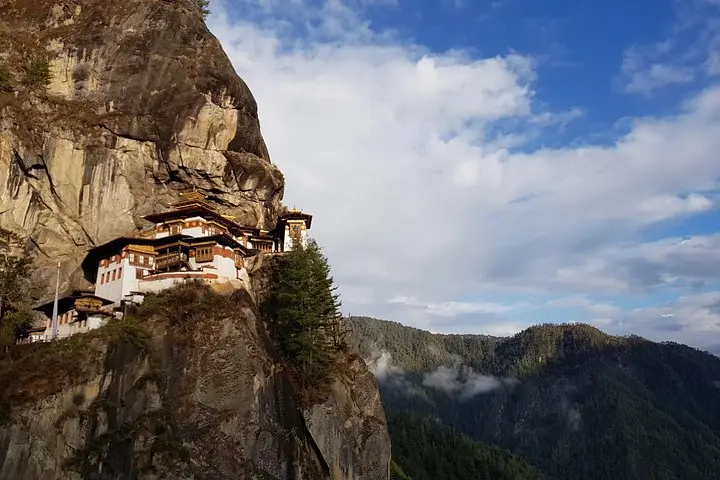
Morning clouds lift like a curtain over the Paro valley as you step from the hotel into cool mountain air. The road to Taktsang—Tiger’s Nest—winds past rice terraces and pines; the monastery perches on a cliff, daring you onward.
Morning clouds lift like a curtain over the Paro valley as you step from the hotel into cool mountain air. The road to Taktsang—Tiger’s Nest—winds past rice terraces and pines; the monastery perches on a cliff, daring you onward.
Bhutan’s landscape is young Himalaya: steep river-cut valleys, quartzite ridges and pockets of blue pine and rhododendron. Paro’s cultural heartbeat shows in fortress-dzongs, butter lamps and the intricate paintings of Dumtseg Lhakhang. The Tiger’s Nest, founded in the 17th century on a site associated with Guru Rinpoche, is as much a cultural pilgrimage as a hike.
Across four days you’ll move between valley temples, the colossal Buddha Dordenma, local farmhouse evenings and the two- to four-hour ascent to Taktsang. Expect narrow stone steps, switchbacks through mixed forest, and viewpoints that open suddenly—the monastery a living, quiet presence against the cliff.
Practical guide: plan for altitude (Paro ~2,200 m; Taktsang ~3,120 m), moderate-to-steep hiking with roughly 700–900 m of elevation gain over a 4–6 km round-trip, and uneven trail surfaces. Start early to avoid crowds and mid-day haze, pack layers for temperature swings, and keep hydrated; there’s a cafeteria mid-route but limited services otherwise. Visas and the government SDF fee are handled in advance through your operator—carry copies and some local currency for small purchases. The trip balances cultural immersion with accessible alpine trekking: steady steps, respectful dress at temples, and a willingness to slow down will make the days memorable and manageable.
Frequently asked questions
Yes—foreign visitors require a visa and a daily Sustainable Development Fee (SDF); your tour operator typically arranges visa processing and collects the SDF as part of the package.
Expect about 2–4 hours to ascend and 1–2 hours to descend depending on pace, acclimatization and rest stops.
There is a cafeteria/stall partway up offering simple meals and drinks, but limited services beyond that—carry snacks and small cash.
The multi-day itinerary is family-friendly but the Tiger’s Nest hike includes steep sections at altitude; assess stamina and consult guides—horses may be available for part of the ascent but are limited.
About This Experience
Bhutan Best InBound Tour operates guided outdoor trips and adventures with an emphasis on safety, stewardship, and memorable experiences.
Adventure tips
Recommended gear
- Sturdy hiking shoes: Required for rocky, uneven trail sections and variable footing on the ascent to Taktsang.
- Layered clothing (base, insulating, shell): Temperatures vary with elevation and time of day—layers keep you comfortable during the climb and at temple stops.
- 1–2L water bottle or hydration bladder: Hydration is important at altitude; refill at the mid-route cafeteria if needed.
- Lightweight trekking poles: Helpful for knee support on descent and on steeper switchbacks, especially if trails are wet.
Photos of the experience

Related adventures & guides
Read the full experience
Morning clouds lift like a curtain over the Paro valley as you step from the hotel into cool mountain air. The road to Taktsang—Tiger’s Nest—winds past rice terraces and pines; the monastery perches on a cliff, daring you onward.
Morning clouds lift like a curtain over the Paro valley as you step from the hotel into cool mountain air. The road to Taktsang—Tiger’s Nest—winds past rice terraces and pines; the monastery perches on a cliff, daring you onward.
Bhutan’s landscape is young Himalaya: steep river-cut valleys, quartzite ridges and pockets of blue pine and rhododendron. Paro’s cultural heartbeat shows in fortress-dzongs, butter lamps and the intricate paintings of Dumtseg Lhakhang. The Tiger’s Nest, founded in the 17th century on a site associated with Guru Rinpoche, is as much a cultural pilgrimage as a hike.
Across four days you’ll move between valley temples, the colossal Buddha Dordenma, local farmhouse evenings and the two- to four-hour ascent to Taktsang. Expect narrow stone steps, switchbacks through mixed forest, and viewpoints that open suddenly—the monastery a living, quiet presence against the cliff.
Practical guide: plan for altitude (Paro ~2,200 m; Taktsang ~3,120 m), moderate-to-steep hiking with roughly 700–900 m of elevation gain over a 4–6 km round-trip, and uneven trail surfaces. Start early to avoid crowds and mid-day haze, pack layers for temperature swings, and keep hydrated; there’s a cafeteria mid-route but limited services otherwise. Visas and the government SDF fee are handled in advance through your operator—carry copies and some local currency for small purchases. The trip balances cultural immersion with accessible alpine trekking: steady steps, respectful dress at temples, and a willingness to slow down will make the days memorable and manageable.
Make a day of it nearby.
Verified experiences and guided adventures in the surrounding area.