THE ADVENTURE COLLECTIVE® · Independent discovery and booking for outdoor travel

A four-day, three-night trek across Ethiopia’s Simien Mountains follows old footpaths over high plateaus, cliffs and valleys. Expect gelada baboons, endemic Walia ibex, dramatic waterfalls and cold nights under big highland skies.
A four-day, three-night trek across Ethiopia’s Simien Mountains follows old footpaths over high plateaus, cliffs and valleys. Expect gelada baboons, endemic Walia ibex, dramatic waterfalls and cold nights under big highland skies.
Dawn breaks over a serrated skyline of basalt cliffs and pillared domes as your 4-day trek begins. The first steps leave the parked 4x4 and enter a high plateau where the wind seems to push you forward, unrolling views into the plains below. Gelada troops forage on the grasses while distant waterfalls roar into the abyss.
Verified experiences and guided adventures in the surrounding area.
Operated by Danakil Depression Tours · Debark, Amhara Region
Dawn breaks over a serrated skyline of basalt cliffs and pillared domes as your 4-day trek begins. The first steps leave the parked 4x4 and enter a high plateau where the wind seems to push you forward, unrolling views into the plains below. Gelada troops forage on the grasses while distant waterfalls roar into the abyss.
The Simien Mountains National Park, a UNESCO site, preserves Ethiopia’s highest escarpment and volcanic tablelands carved by ancient lava flows and glaciers. The route tracks historic local footpaths that link villages like Gich and Chennek, passing giant lobelia fields and steep basalt cliffs such as Imet-Gogo (≈3,926 m) and the summit of Buwahit (≈4,430 m). The Jinbar River drops roughly 500 m where you’ll pause for lunch; on clear days Ras Dejen (4,543 m) punctuates the horizon.
Cultural notes: shepherding communities still move livestock across these high pastures, and an afternoon coffee ceremony in Gich offers a quiet window into local hospitality. Ecologically the park supports endemic species—Walia ibex and gelada baboons dominate the story here.
Practical guidance: expect 3–8 hour walking days, uneven rocky and grassy trails, and strong sun amplified by altitude. Camping is provided with mule support and a guide/scout; pack layered insulation for cold nights, sturdy boots, sunscreen, and water treatment. Acclimatize in Gondar or Debark before ascent, watch for altitude symptoms, and plan dry-season travel (Oct–Mar) for the clearest trails. With sensible preparation this trek is a compact but intense introduction to one of Africa’s most dramatic highland landscapes.
The itinerary is demanding due to altitude and daily walking time; newcomers should allow time to acclimatize and choose the tour only if they have good fitness and prior multi-day hike experience.
Common sightings include gelada baboons and Walia ibex; lammergeier and thick-billed raven are typical raptors. Sightings aren’t guaranteed but are frequent along cliffs and pastures.
Yes—this trip includes camping accommodation, all meals listed, mule support for gear, and an experienced guide and scout; bring personal sleeping liners as recommended.
Park entrance fees and permits are included by this tour operator, but always confirm before travel and carry identification for check-in at park headquarters.
Danakil Depression Tours operates guided outdoor trips and adventures with an emphasis on safety, stewardship, and memorable experiences.
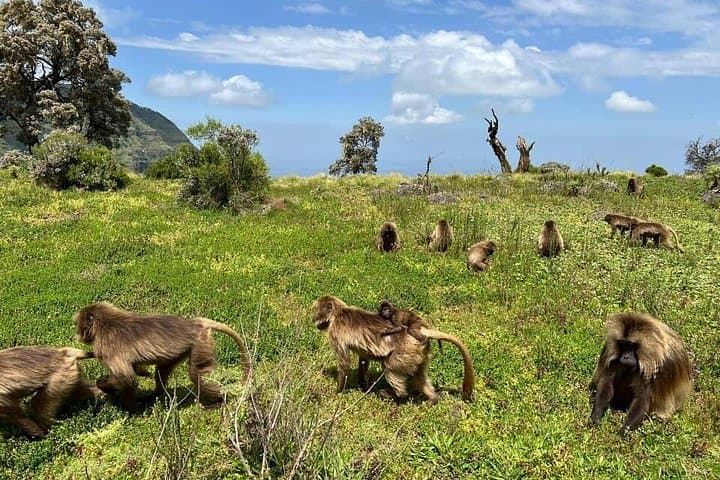


Dawn breaks over a serrated skyline of basalt cliffs and pillared domes as your 4-day trek begins. The first steps leave the parked 4x4 and enter a high plateau where the wind seems to push you forward, unrolling views into the plains below. Gelada troops forage on the grasses while distant waterfalls roar into the abyss.
Dawn breaks over a serrated skyline of basalt cliffs and pillared domes as your 4-day trek begins. The first steps leave the parked 4x4 and enter a high plateau where the wind seems to push you forward, unrolling views into the plains below. Gelada troops forage on the grasses while distant waterfalls roar into the abyss.
The Simien Mountains National Park, a UNESCO site, preserves Ethiopia’s highest escarpment and volcanic tablelands carved by ancient lava flows and glaciers. The route tracks historic local footpaths that link villages like Gich and Chennek, passing giant lobelia fields and steep basalt cliffs such as Imet-Gogo (≈3,926 m) and the summit of Buwahit (≈4,430 m). The Jinbar River drops roughly 500 m where you’ll pause for lunch; on clear days Ras Dejen (4,543 m) punctuates the horizon.
Cultural notes: shepherding communities still move livestock across these high pastures, and an afternoon coffee ceremony in Gich offers a quiet window into local hospitality. Ecologically the park supports endemic species—Walia ibex and gelada baboons dominate the story here.
Practical guidance: expect 3–8 hour walking days, uneven rocky and grassy trails, and strong sun amplified by altitude. Camping is provided with mule support and a guide/scout; pack layered insulation for cold nights, sturdy boots, sunscreen, and water treatment. Acclimatize in Gondar or Debark before ascent, watch for altitude symptoms, and plan dry-season travel (Oct–Mar) for the clearest trails. With sensible preparation this trek is a compact but intense introduction to one of Africa’s most dramatic highland landscapes.