THE ADVENTURE COLLECTIVE® · Independent discovery and booking for outdoor travel

A five-day private trek from Pokhara into the lesser-traveled Mardi Himal corridor. Expect dense rhododendron forests, steep ridges to High Camp (≈3,550 m), and clear views of Machhapuchhre and the Annapurna range.
A five-day private trek from Pokhara into the lesser-traveled Mardi Himal corridor. Expect dense rhododendron forests, steep ridges to High Camp (≈3,550 m), and clear views of Machhapuchhre and the Annapurna range.
Morning in Pokhara, and the road to Phedi slips away beneath the jeep’s tires. The trek begins with terraced fields and village lanes, then pulls you into a tunnel of rhododendron and oak that smells of damp earth and resin.
Verified experiences and guided adventures in the surrounding area.
Operated by Guru Pahari · Pokhara, Gandaki Province
Morning in Pokhara, and the road to Phedi slips away beneath the jeep’s tires. The trek begins with terraced fields and village lanes, then pulls you into a tunnel of rhododendron and oak that smells of damp earth and resin.
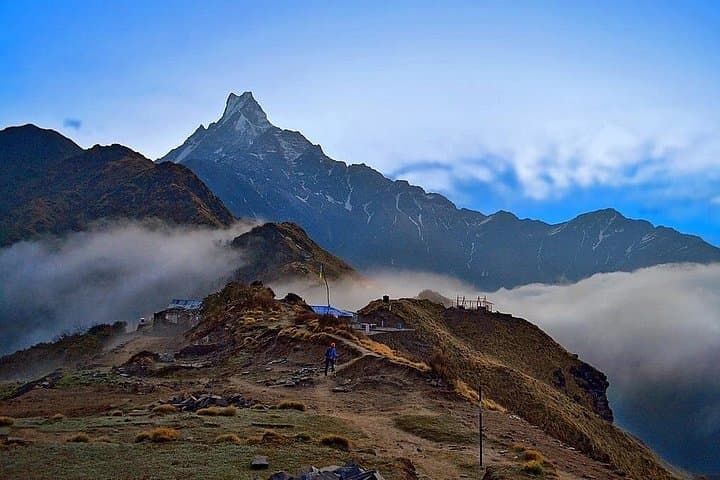
By the second day the forest thickens: orchids cling to trunks, streams dare you to cross on slick stones, and the trail steepens toward the alpine meadows above Kokar. High Camp (≈3,550 m) opens a stage of rim-like ridges where Machhapuchhre’s sharp profile and the long sweep of the Annapurna range dominate the horizon. Local shepherds and small Gurung and Brahmin settlements give the route a lived-in, low-traffic feel.
Geology here is Himalayan: folded metamorphic rock, steep gullies carved by monsoon runoff, and glacially sculpted valleys visible at a distance. Culturally the area is traditional—tea houses are basic, solar hot water is hit-or-miss, and you’ll encounter small households practicing subsistence agriculture.
Practical edge: expect 4–6 hours of walking most days with sustained uphill sections and loose scree near High Camp. Hydrate early, pace for altitude, and pack warm layers for pre-dawn viewpoints. Footwear with good ankle support and trekking poles make steep descents easier. Permits include TIMS and the Annapurna Conservation Area permit; guides handle logistics for a private group.
The reward is clean air, sweeping mountain panoramas and quiet trails away from the busier Annapurna corridors—an accessible, non-touristy alpine escape for hikers comfortable with basic lodges and steady climbs.
Yes—Trek Information Management System (TIMS) and the Annapurna Conservation Area Permit (ACAP) are required; your operator usually arranges them.
Basic teahouse/guesthouse lodging with simple rooms; hot water is solar-dependent and not guaranteed each night.
Physically fit beginners can do it with proper pacing and an experienced guide, but be prepared for sustained uphill days and altitude up to ~3,550 m.
Spring (Mar–May) and autumn (Sept–Nov) offer the best weather and clear mountain views, with spring also showcasing rhododendron blooms.
Guru Pahari operates guided outdoor trips and adventures with an emphasis on safety, stewardship, and memorable experiences.

Morning in Pokhara, and the road to Phedi slips away beneath the jeep’s tires. The trek begins with terraced fields and village lanes, then pulls you into a tunnel of rhododendron and oak that smells of damp earth and resin.
Morning in Pokhara, and the road to Phedi slips away beneath the jeep’s tires. The trek begins with terraced fields and village lanes, then pulls you into a tunnel of rhododendron and oak that smells of damp earth and resin.
By the second day the forest thickens: orchids cling to trunks, streams dare you to cross on slick stones, and the trail steepens toward the alpine meadows above Kokar. High Camp (≈3,550 m) opens a stage of rim-like ridges where Machhapuchhre’s sharp profile and the long sweep of the Annapurna range dominate the horizon. Local shepherds and small Gurung and Brahmin settlements give the route a lived-in, low-traffic feel.
Geology here is Himalayan: folded metamorphic rock, steep gullies carved by monsoon runoff, and glacially sculpted valleys visible at a distance. Culturally the area is traditional—tea houses are basic, solar hot water is hit-or-miss, and you’ll encounter small households practicing subsistence agriculture.
Practical edge: expect 4–6 hours of walking most days with sustained uphill sections and loose scree near High Camp. Hydrate early, pace for altitude, and pack warm layers for pre-dawn viewpoints. Footwear with good ankle support and trekking poles make steep descents easier. Permits include TIMS and the Annapurna Conservation Area permit; guides handle logistics for a private group.
The reward is clean air, sweeping mountain panoramas and quiet trails away from the busier Annapurna corridors—an accessible, non-touristy alpine escape for hikers comfortable with basic lodges and steady climbs.