THE ADVENTURE COLLECTIVE® · Independent discovery and booking for outdoor travel

A private, 6-day guided ascent of Mount Kilimanjaro via the Marangu Route that balances steady daily gains with an acclimatization day and hut stays. Expect rainforest, alpine desert, a midnight summit push, and a summit certificate at the end.
A private, 6-day guided ascent of Mount Kilimanjaro via the Marangu Route that balances steady daily gains with an acclimatization day and hut stays. Expect rainforest, alpine desert, a midnight summit push, and a summit certificate at the end.
Dawn in Moshi is humid and bright; drivers collect you from small hotels and the road climbs toward the park gate under palms and banana plots. By the time you reach Marangu Gate the rainforest is breathing around you—ferns dripping, colobus monkeys calling from the canopy—and the guides run a final kit check before the trail swallows the group. The first day's walk finishes at Mandara Hut with the mountain already changing the air: heavier, colder, and more honest.
Verified experiences and guided adventures in the surrounding area.
Operated by Africa Exhibition Safari Agency · Moshi, Kilimanjaro Region
Dawn in Moshi is humid and bright; drivers collect you from small hotels and the road climbs toward the park gate under palms and banana plots. By the time you reach Marangu Gate the rainforest is breathing around you—ferns dripping, colobus monkeys calling from the canopy—and the guides run a final kit check before the trail swallows the group. The first day's walk finishes at Mandara Hut with the mountain already changing the air: heavier, colder, and more honest.
Marangu is the classic approach to Kilimanjaro: a steady, ridge-following route that moves climbers from dense montane forest into heathland, through giant lobelias, and finally into the high, wind-swept alpine desert below Kibo. Geologically, Kilimanjaro is a three-peaked volcano—Shira, Mawenzi, and Kibo—built from successive lava flows and capped by a crater that holds Uhuru Peak at roughly 5,895 meters. Climbers witness a rapid ecological shift over just a few days, and the mountain's retreating glaciers are a visible reminder of regional climate change.
The route is woven into local history. The slopes are the traditional land of the Chagga people, who farm lower terraces and historically guided early explorers. Porters and hut wardens keep the Marangu corridor functioning; tipping and respectful interaction are part of the expedition etiquette.
Practical reality shapes the experience. This private 6-day itinerary spreads ascent to prioritize acclimatization: Day 1 to Mandara Hut (1,860–2,700 m, ~8 km), Day 2 to Horombo Hut (2,700–3,700 m, ~12 km), Day 3 acclimatization at Horombo, Day 4 to Kibo Hut (3,700–4,700 m, ~9 km), Day 5 summit push from Kibo to Uhuru Peak (4,700–5,895 m) and descend back to Horombo, and Day 6 down to Marangu Gate. Expect long hours on Day 5: a predawn start around 2:00 a.m., headlamps cutting the dark, steep scree and the thin air testing every step.
Huts offer mattress space and hot meals included in the tour, but evenings are simple and cold; the summit night is the hardest. Hydration, slow pacing, and listening to your guide for early signs of acute altitude sickness are non-negotiable. Footwear should be broken-in, waterproof, and paired with good socks; gaiters help on scree.
Logistics are straightforward: pickup from Moshi, park fees and guide services included, and a summit certificate delivered after descent. Best windows for clearer conditions are July–October and late December–February, though weather is changeable year-round. Respect the mountain: pack out waste where requested, follow guide directions, and tip your crew fairly—many livelihoods depend on the climb.
The Marangu route is not merely a hike; it is a measured sequence of terrain, weather, and human support that hands you a chance to stand on Africa's rooftop. When the sun finally turns the crater rim to gold at Uhuru, you realize the reward is as much about endured discipline as it is about the view.
No technical climbing skills are required; however, prior multi-day hiking experience and good fitness are important due to altitude and long summit day.
Meals (as listed), hut accommodations, guide services, park fees, and transfers as described; confirm pickup details when booking.
July–October and late December–February offer more stable, drier weather; conditions can vary, so prepare for sun, wind, and cold.
Huts provide shared dormitory-style bunks; bring a liner and small fast-dry towel for hygiene and comfort.
Altitude sickness can occur despite fitness; symptoms include headache, nausea, dizziness—communicate early with your guide and descend if advised.
Yes; climbers who reach Uhuru Peak receive an official summit certificate after descent, typically issued at Marangu Gate or via your operator.
Africa Exhibition Safari Agency operates guided outdoor trips and adventures with an emphasis on safety, stewardship, and memorable experiences.

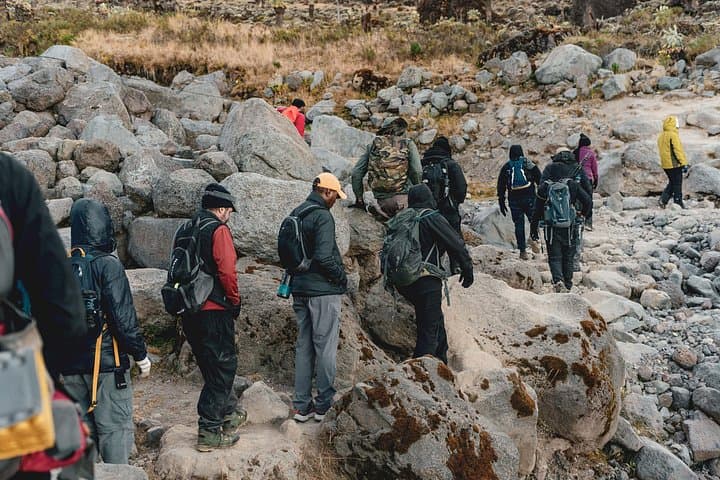

Dawn in Moshi is humid and bright; drivers collect you from small hotels and the road climbs toward the park gate under palms and banana plots. By the time you reach Marangu Gate the rainforest is breathing around you—ferns dripping, colobus monkeys calling from the canopy—and the guides run a final kit check before the trail swallows the group. The first day's walk finishes at Mandara Hut with the mountain already changing the air: heavier, colder, and more honest.
Dawn in Moshi is humid and bright; drivers collect you from small hotels and the road climbs toward the park gate under palms and banana plots. By the time you reach Marangu Gate the rainforest is breathing around you—ferns dripping, colobus monkeys calling from the canopy—and the guides run a final kit check before the trail swallows the group. The first day's walk finishes at Mandara Hut with the mountain already changing the air: heavier, colder, and more honest.
Marangu is the classic approach to Kilimanjaro: a steady, ridge-following route that moves climbers from dense montane forest into heathland, through giant lobelias, and finally into the high, wind-swept alpine desert below Kibo. Geologically, Kilimanjaro is a three-peaked volcano—Shira, Mawenzi, and Kibo—built from successive lava flows and capped by a crater that holds Uhuru Peak at roughly 5,895 meters. Climbers witness a rapid ecological shift over just a few days, and the mountain's retreating glaciers are a visible reminder of regional climate change.
The route is woven into local history. The slopes are the traditional land of the Chagga people, who farm lower terraces and historically guided early explorers. Porters and hut wardens keep the Marangu corridor functioning; tipping and respectful interaction are part of the expedition etiquette.
Practical reality shapes the experience. This private 6-day itinerary spreads ascent to prioritize acclimatization: Day 1 to Mandara Hut (1,860–2,700 m, ~8 km), Day 2 to Horombo Hut (2,700–3,700 m, ~12 km), Day 3 acclimatization at Horombo, Day 4 to Kibo Hut (3,700–4,700 m, ~9 km), Day 5 summit push from Kibo to Uhuru Peak (4,700–5,895 m) and descend back to Horombo, and Day 6 down to Marangu Gate. Expect long hours on Day 5: a predawn start around 2:00 a.m., headlamps cutting the dark, steep scree and the thin air testing every step.
Huts offer mattress space and hot meals included in the tour, but evenings are simple and cold; the summit night is the hardest. Hydration, slow pacing, and listening to your guide for early signs of acute altitude sickness are non-negotiable. Footwear should be broken-in, waterproof, and paired with good socks; gaiters help on scree.
Logistics are straightforward: pickup from Moshi, park fees and guide services included, and a summit certificate delivered after descent. Best windows for clearer conditions are July–October and late December–February, though weather is changeable year-round. Respect the mountain: pack out waste where requested, follow guide directions, and tip your crew fairly—many livelihoods depend on the climb.
The Marangu route is not merely a hike; it is a measured sequence of terrain, weather, and human support that hands you a chance to stand on Africa's rooftop. When the sun finally turns the crater rim to gold at Uhuru, you realize the reward is as much about endured discipline as it is about the view.