THE ADVENTURE COLLECTIVE® · Independent discovery and booking for outdoor travel

Wake before sunrise and climb to Poon Hill for a commanding Himalayan panorama of Annapurna and Dhaulagiri. This compact 6‑day trek mixes steep stone steps, rhododendron forests, and village teahouse nights with a sunrise reward that defines the Annapurna foothills.
Wake before sunrise and climb to Poon Hill for a commanding Himalayan panorama of Annapurna and Dhaulagiri. This compact 6‑day trek mixes steep stone steps, rhododendron forests, and village teahouse nights with a sunrise reward that defines the Annapurna foothills.
Dawn arrives at Poon Hill like a rehearsal: silhouettes of jagged peaks sharpen, and the first light pushes across Annapurna and Dhaulagiri as if staking a claim on the sky. You leave Ghorepani before most teahouses stir, climbing stone steps through rhododendron that lean in and scent the path with resin. The summit at 3,210 m gives a sweeping, close-up view of eight- and seven-thousand-meter giants — Dhaulagiri, Annapurna South, Hiunchuli and Machhapuchhre — while cold air steadies your breath.
Verified experiences and guided adventures in the surrounding area.
Operated by Yak Ru Adventure · Ghorepani, Gandaki Province
Dawn arrives at Poon Hill like a rehearsal: silhouettes of jagged peaks sharpen, and the first light pushes across Annapurna and Dhaulagiri as if staking a claim on the sky. You leave Ghorepani before most teahouses stir, climbing stone steps through rhododendron that lean in and scent the path with resin. The summit at 3,210 m gives a sweeping, close-up view of eight- and seven-thousand-meter giants — Dhaulagiri, Annapurna South, Hiunchuli and Machhapuchhre — while cold air steadies your breath.
This short multi-day trek follows trails used for centuries by the Gurung and Magar communities, connecting hill villages to trade routes along the Pokhara valley. Geologically you move from low river terraces into metamorphic foothills of the Greater Himalaya; terraces, suspension bridges, and stony switchbacks mark the ascent. Cultural highlights include homestay-style teahouses in Ulleri and Ghandruk where local crafts and Gurung hospitality are on display.
Expect varied terrain: long stair sections, forested ridgelines, and moderate altitude gain between nights (approx. 2,020–3,210 m). Typical days range from 2–7 hours on the trail with early starts for sunrise views.
Practical guidance: pack layered insulation, a headlamp for pre-dawn climbs, and a water filter or purification tablets since reliable potable water isn’t guaranteed en route. Walk conservatively on steep stone steps and allow time at Ghorepani to acclimatize. Cash is useful in teahouses; charging and hot showers may incur fees. Plan this trek in spring or fall for the clearest views and fullest rhododendron blooms.
Yes — trekkers usually need the TIMS card and Annapurna Conservation Area Permit (ACAP); guides typically arrange these before departure.
Moderate: daily walking time is short to medium but includes steep stone stair climbs and altitude changes, so basic fitness and endurance are important.
Teahouses offer basic beds, communal meals, and hot drinks; expect simple facilities and limited hot showers at additional cost.
Fall (Sept–Nov) and spring (Mar–May) provide the clearest views and best weather for the Poon Hill sunrise.
Yak Ru Adventure operates guided outdoor trips and adventures with an emphasis on safety, stewardship, and memorable experiences.
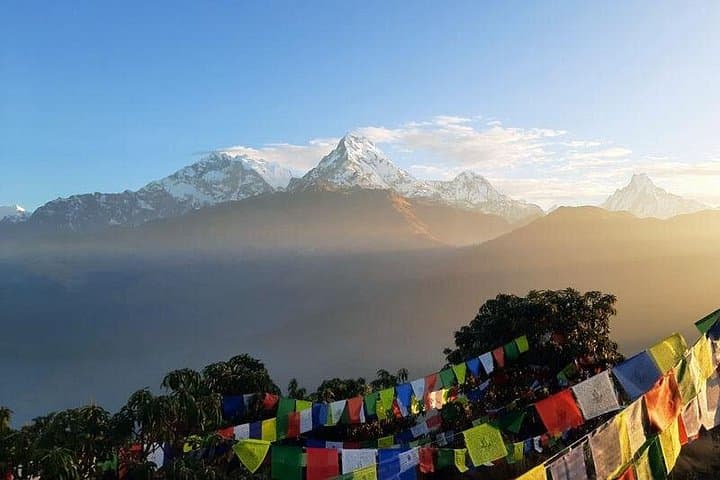


Dawn arrives at Poon Hill like a rehearsal: silhouettes of jagged peaks sharpen, and the first light pushes across Annapurna and Dhaulagiri as if staking a claim on the sky. You leave Ghorepani before most teahouses stir, climbing stone steps through rhododendron that lean in and scent the path with resin. The summit at 3,210 m gives a sweeping, close-up view of eight- and seven-thousand-meter giants — Dhaulagiri, Annapurna South, Hiunchuli and Machhapuchhre — while cold air steadies your breath.
Dawn arrives at Poon Hill like a rehearsal: silhouettes of jagged peaks sharpen, and the first light pushes across Annapurna and Dhaulagiri as if staking a claim on the sky. You leave Ghorepani before most teahouses stir, climbing stone steps through rhododendron that lean in and scent the path with resin. The summit at 3,210 m gives a sweeping, close-up view of eight- and seven-thousand-meter giants — Dhaulagiri, Annapurna South, Hiunchuli and Machhapuchhre — while cold air steadies your breath.
This short multi-day trek follows trails used for centuries by the Gurung and Magar communities, connecting hill villages to trade routes along the Pokhara valley. Geologically you move from low river terraces into metamorphic foothills of the Greater Himalaya; terraces, suspension bridges, and stony switchbacks mark the ascent. Cultural highlights include homestay-style teahouses in Ulleri and Ghandruk where local crafts and Gurung hospitality are on display.
Expect varied terrain: long stair sections, forested ridgelines, and moderate altitude gain between nights (approx. 2,020–3,210 m). Typical days range from 2–7 hours on the trail with early starts for sunrise views.
Practical guidance: pack layered insulation, a headlamp for pre-dawn climbs, and a water filter or purification tablets since reliable potable water isn’t guaranteed en route. Walk conservatively on steep stone steps and allow time at Ghorepani to acclimatize. Cash is useful in teahouses; charging and hot showers may incur fees. Plan this trek in spring or fall for the clearest views and fullest rhododendron blooms.