THE ADVENTURE COLLECTIVE® · Independent discovery and booking for outdoor travel

A compact week that moves from Tunisian medina life through Roman ruins to Saharan oases and Djerba beaches. Expect a mix of guided history, short walks, one desert bivouac night, and comfortable hotel stays.
A compact week that moves from Tunisian medina life through Roman ruins to Saharan oases and Djerba beaches. Expect a mix of guided history, short walks, one desert bivouac night, and comfortable hotel stays.
The day begins in the cool alleys of Tunis’ medina where spice-scented stalls and the call to prayer shape the tempo of the city. You’ll move from mosaic-filled halls of the Bardo Museum to windswept Roman stones at Carthage, then trade Mediterranean breeze for the wide, dry light of the Sahara as the itinerary arcs south toward Tozeur, the mountain oases of Tamerza and Chebika, and the salt flats of Chott el Jerid.
Verified experiences and guided adventures in the surrounding area.
Operated by Tunisia Travel Guide · Tunis, Tunis
The day begins in the cool alleys of Tunis’ medina where spice-scented stalls and the call to prayer shape the tempo of the city. You’ll move from mosaic-filled halls of the Bardo Museum to windswept Roman stones at Carthage, then trade Mediterranean breeze for the wide, dry light of the Sahara as the itinerary arcs south toward Tozeur, the mountain oases of Tamerza and Chebika, and the salt flats of Chott el Jerid.
This route threads together millennia: Punic and Roman ruins around Tunis and El Jem, the Islamic learning center of Kairouan, and Berber villages carved into soft rock at Matmata. Geology is on display as well — limestone amphitheatres, palm-fringed oases founded on groundwater, and the mirror-like salt crusts of Chott el Jerid that play with late-afternoon color.
Culturally the trip spans markets, craft workshops in Djerba and the fortified ksour near Tataouine, giving a sense of regional life and desert survival. Nature exerts a quiet force here: the oasis palms hold water like a promise, and dunes push light across the horizon with relentless clarity.
Practical guidance: pack layered clothing for sharp diurnal swings, bring a refillable water bottle and sunscreen, and expect mostly vehicle travel with short guided walks at sites. Accommodation ranges from 4-star hotels to a desert bivouac night in Douz and a rural guesthouse in Douiret. Plan for long drives between highlights, and allow time to acclimate to heat and uneven surfaces when exploring ruins and medina alleys.
Pickup point is required on booking; transfer options are requested at checkout—confirm your arrival details so the operator can schedule pickup.
The itinerary is classified easy: most travel is by vehicle with short, low-impact walks at historical sites and oases.
You’ll stay in a designated desert camp with basic tent accommodation and dining; it’s simple but organized, with mattresses and communal facilities.
Many meals are included (breakfasts and most lunches/dinners as listed); some museum admissions are included per itinerary notes while others may require local tickets.
Tunisia Travel Guide operates guided outdoor trips and adventures with an emphasis on safety, stewardship, and memorable experiences.
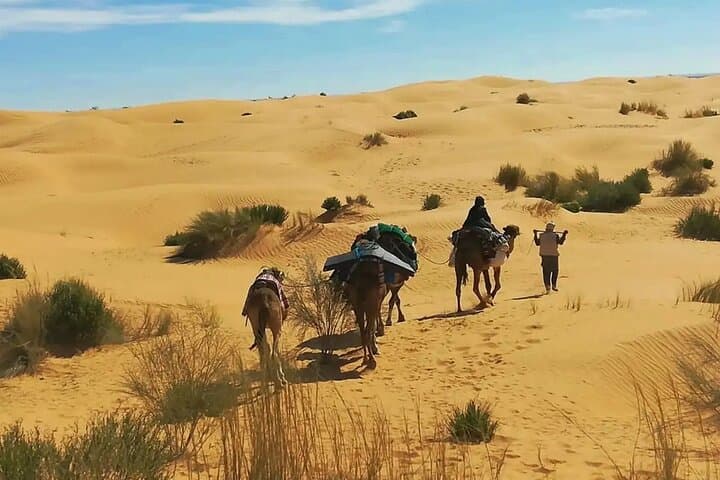


The day begins in the cool alleys of Tunis’ medina where spice-scented stalls and the call to prayer shape the tempo of the city. You’ll move from mosaic-filled halls of the Bardo Museum to windswept Roman stones at Carthage, then trade Mediterranean breeze for the wide, dry light of the Sahara as the itinerary arcs south toward Tozeur, the mountain oases of Tamerza and Chebika, and the salt flats of Chott el Jerid.
The day begins in the cool alleys of Tunis’ medina where spice-scented stalls and the call to prayer shape the tempo of the city. You’ll move from mosaic-filled halls of the Bardo Museum to windswept Roman stones at Carthage, then trade Mediterranean breeze for the wide, dry light of the Sahara as the itinerary arcs south toward Tozeur, the mountain oases of Tamerza and Chebika, and the salt flats of Chott el Jerid.
This route threads together millennia: Punic and Roman ruins around Tunis and El Jem, the Islamic learning center of Kairouan, and Berber villages carved into soft rock at Matmata. Geology is on display as well — limestone amphitheatres, palm-fringed oases founded on groundwater, and the mirror-like salt crusts of Chott el Jerid that play with late-afternoon color.
Culturally the trip spans markets, craft workshops in Djerba and the fortified ksour near Tataouine, giving a sense of regional life and desert survival. Nature exerts a quiet force here: the oasis palms hold water like a promise, and dunes push light across the horizon with relentless clarity.
Practical guidance: pack layered clothing for sharp diurnal swings, bring a refillable water bottle and sunscreen, and expect mostly vehicle travel with short guided walks at sites. Accommodation ranges from 4-star hotels to a desert bivouac night in Douz and a rural guesthouse in Douiret. Plan for long drives between highlights, and allow time to acclimate to heat and uneven surfaces when exploring ruins and medina alleys.