THE ADVENTURE COLLECTIVE® · Independent discovery and booking for outdoor travel

Traverse the Atlas and follow camel-led caravans into the Sahara on a seven-day trek from Marrakech to M'Hamid. Expect dunes, palm groves, ruined kasbahs, and clear night skies with experienced local guides handling logistics.
Traverse the Atlas and follow camel-led caravans into the Sahara on a seven-day trek from Marrakech to M'Hamid. Expect dunes, palm groves, ruined kasbahs, and clear night skies with experienced local guides handling logistics.
The caravan moves at a measured pace: camels creak, sand sighs, and the horizon keeps rearranging itself into ridgelines and gold. You leave Marrakech before dawn, cross the Atlas Mountains, and by evening find yourself beneath a sky so clear the Milky Way feels like an old road leading out of town.
Verified experiences and guided adventures in the surrounding area.
Operated by Sahara Dreams · M'Hamid El Ghizlane, Drâa-Tafilalet
The caravan moves at a measured pace: camels creak, sand sighs, and the horizon keeps rearranging itself into ridgelines and gold. You leave Marrakech before dawn, cross the Atlas Mountains, and by evening find yourself beneath a sky so clear the Milky Way feels like an old road leading out of town.
This seven-day trek follows ancient caravan corridors that once linked Marrakech to Timbuktu. Geologically the route shifts from folded metamorphic peaks of the High Atlas to plateaus of weathered stone and finally to wind-sculpted dunes of the Erg near M'Hamid. Along the Draa Valley, ruined kasbahs and palm groves mark centuries of human adaptation; in Tamgroute, a Koranic library preserves manuscripts that map the region's learning and trade.
Nomadic culture informs the pace: guides raised in the Sahara set camp, read stars, and coax camels through hummock and hardpan. Wildlife is discreet — gazelles watch from distance; the fennec fox slips away at dusk. The dunes themselves assert their character: some sing underfoot, others hold their shape for days.
Practical guidance: this is remote, multi-day trekking with daily walking of 4–6 hours on sand, stone, and plateaux. Expect basic desert camps (one eco-lodge night included), communal meals, and guides who handle navigation and logistics. Pack layered clothing, sun protection, sturdy boots for sand and rocks, and a daylight daypack with water and snacks. Start early to avoid peak heat, and trust your guides: they know where the water is, when the wind will shift, and which dunes are best for sunset photos.
You should be comfortable walking 4–6 hours a day over sand and rocky ground; training walks and sand-slope practice help but technical climbing skills are not required.
Camels are included for the caravan and to carry equipment; you may also ride for stretches depending on the day's plan and guide decisions.
One night is in an eco-lodge; the remaining nights are in desert camps with basic bedding and communal facilities—comfort is simple and authentic.
Yes, if you travel with experienced guides supplied by the operator; they handle navigation, water logistics, and safety in this remote environment.
Sahara Dreams operates guided outdoor trips and adventures with an emphasis on safety, stewardship, and memorable experiences.
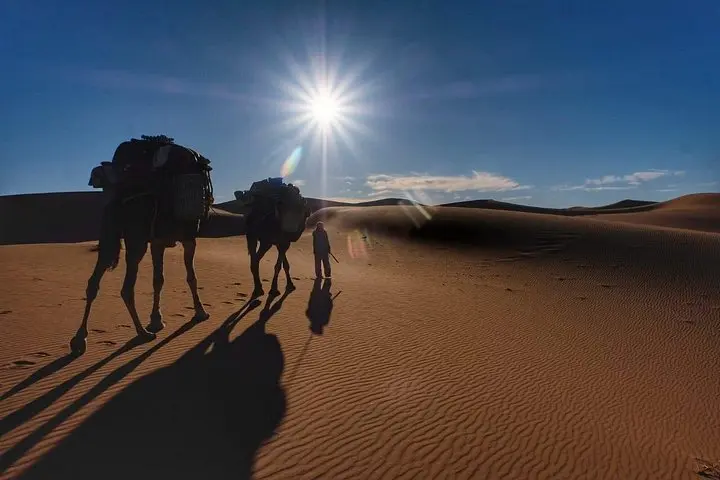
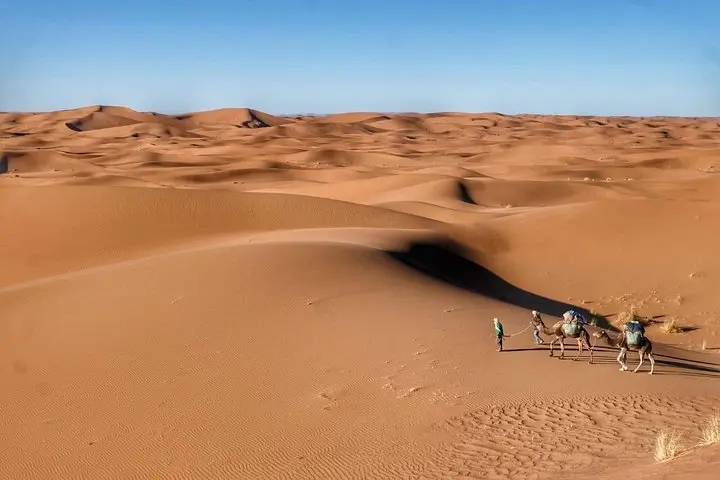
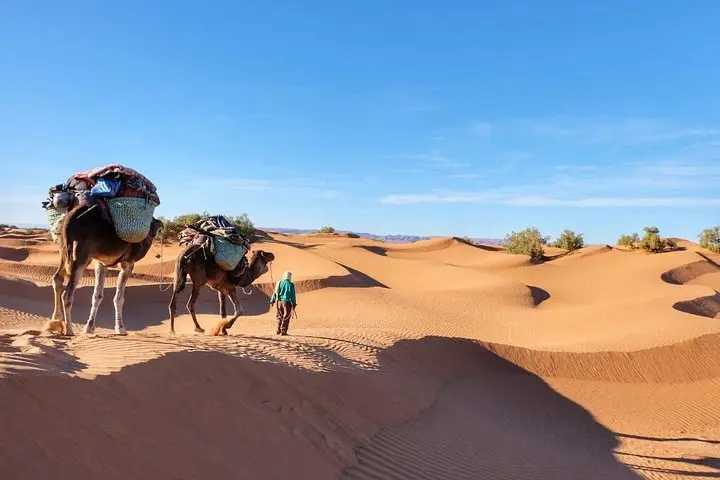
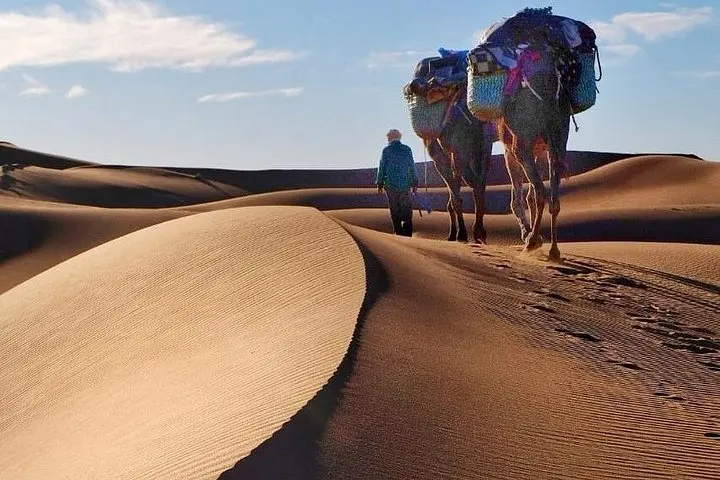
The caravan moves at a measured pace: camels creak, sand sighs, and the horizon keeps rearranging itself into ridgelines and gold. You leave Marrakech before dawn, cross the Atlas Mountains, and by evening find yourself beneath a sky so clear the Milky Way feels like an old road leading out of town.
The caravan moves at a measured pace: camels creak, sand sighs, and the horizon keeps rearranging itself into ridgelines and gold. You leave Marrakech before dawn, cross the Atlas Mountains, and by evening find yourself beneath a sky so clear the Milky Way feels like an old road leading out of town.
This seven-day trek follows ancient caravan corridors that once linked Marrakech to Timbuktu. Geologically the route shifts from folded metamorphic peaks of the High Atlas to plateaus of weathered stone and finally to wind-sculpted dunes of the Erg near M'Hamid. Along the Draa Valley, ruined kasbahs and palm groves mark centuries of human adaptation; in Tamgroute, a Koranic library preserves manuscripts that map the region's learning and trade.
Nomadic culture informs the pace: guides raised in the Sahara set camp, read stars, and coax camels through hummock and hardpan. Wildlife is discreet — gazelles watch from distance; the fennec fox slips away at dusk. The dunes themselves assert their character: some sing underfoot, others hold their shape for days.
Practical guidance: this is remote, multi-day trekking with daily walking of 4–6 hours on sand, stone, and plateaux. Expect basic desert camps (one eco-lodge night included), communal meals, and guides who handle navigation and logistics. Pack layered clothing, sun protection, sturdy boots for sand and rocks, and a daylight daypack with water and snacks. Start early to avoid peak heat, and trust your guides: they know where the water is, when the wind will shift, and which dunes are best for sunset photos.