THE ADVENTURE COLLECTIVE® · Independent discovery and booking for outdoor travel

An eight-day private circuit that pairs Jordan’s highlights — Jerash, the Dead Sea, Petra and Wadi Rum — with two days in Jerusalem. Expect salt-slick baths, narrow canyon approaches, desert nights and layered history, all with private transfers and curated overnight stays.
An eight-day private circuit that pairs Jordan’s highlights — Jerash, the Dead Sea, Petra and Wadi Rum — with two days in Jerusalem. Expect salt-slick baths, narrow canyon approaches, desert nights and layered history, all with private transfers and curated overnight stays.
You step from the terminal into a warm, citrus-scented night and a driver holds a cardboard sign with your name — the first courtesy in a trip that moves at the comfortable pace of the region: long drives broken by decisive, unforgettable stops.
Verified experiences and guided adventures in the surrounding area.
Operated by Tour Experts · Amman, Amman Governorate
You step from the terminal into a warm, citrus-scented night and a driver holds a cardboard sign with your name — the first courtesy in a trip that moves at the comfortable pace of the region: long drives broken by decisive, unforgettable stops.
Over eight days you’ll trade modern asphalt for Roman colonnades, mineral-slick shores, red-rock gorges and a desert that keeps its own time. In Jerash, columns lean against the sky and the cardo marches you into a city still measured by its Roman grid. At the Dead Sea you’ll float with a newspaper and salt crusting your fingers while the shoreline — about 430 meters below sea level — seems to defy gravity.
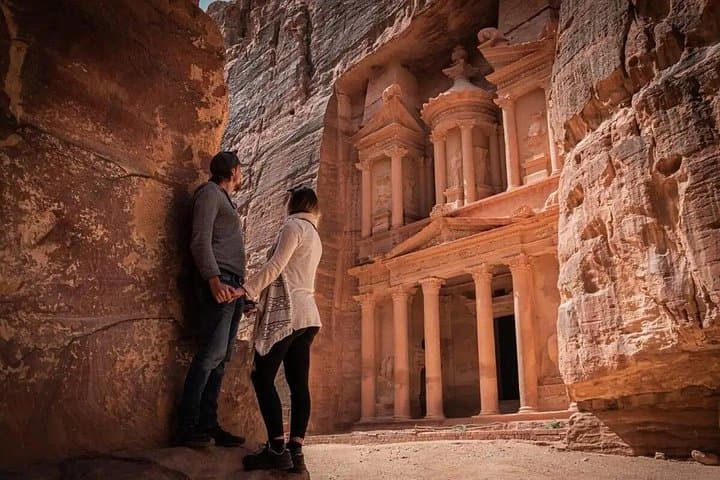
Petra arrives like a revelation: the Siq, a narrow 1.2 km slot canyon, funnels you through shadow and finally opens on the Treasury’s rose-lit facade. Expect uneven cobbles and steps—plan for multiple kilometers of walking if you want to reach the Monastery or higher vistas. Wadi Rum’s sandstone and granite spires throw long shadows at sunset; the desert’s silence presses in like a slow exhale, and the stars are unapologetically bright from a Bedouin tent.
History threads every stop. Nabataean engineers carved Petra into trade-route rock, Byzantine and Islamic mosaics color Madaba, and Jerusalem’s Old City stitches together millennia of faith and architecture from the Mount of Olives to the Church of the Holy Sepulchre. Geology is equally literal here: the Dead Sea’s saline shelves, Petra’s sandstone strata striped by wind, Wadi Rum’s exfoliated towers — each place is a lesson in time.
Practical notes. This is a private, largely accessible tour with door-to-door transfers and hotel nights in Amman, Dead Sea, Jerusalem, Petra and Wadi Rum. Border crossings (King Hussein/Allenby Bridge) require passports and processing time—your operator handles logistics but expect at least an hour for immigration. Wear broken-in walking shoes for Petra and a sun hat and SPF for the Dead Sea; pack a lightweight warm layer for desert nights where temperatures can drop dramatically.
Food and pace are straightforward: breakfasts daily, some dinners included, bottled water provided. If mobility is a concern, communicate needs ahead — hotels and many sites can accommodate, though Petra’s upper routes are steep. Bring a rechargeable battery for camera gear; many of the most memorable views come in low light.
This itinerary suits travelers who want historical depth with low-impact adventure: easy travel days punctuated by some rugged walking, intimate cultural encounters, and a string of landscapes that read like consecutive chapters in the same geological novel.
Visa requirements depend on nationality; many nationalities can obtain a Jordanian visa on arrival at Queen Alia Airport, but Israel and Palestinian Authority entry rules vary—check consular guidance and consult your operator for border specifics.
Yes—floating is safe but avoid submerging your face and keep any open cuts covered; the water’s high salinity can sting.
Plan for 3–6 km of walking within Petra for key sights; reaching the Monastery and high viewpoints adds steep climbs and steps.
Many hotels and some sites offer accessibility, and transport can be arranged, but Petra’s Siq and many archaeological paths are not fully wheelchair-friendly—discuss needs with the operator before booking.
Jordanian dinar is used in Jordan; Israeli shekel is common in Jerusalem—ATMs are widely available in cities but carry small amounts of local cash for markets and tips.
Yes—options range from simple to luxury VIP tents; check amenities (bathroom type, heating) and whether family tents or adjoining rooms are available.
Tour Experts operates guided outdoor trips and adventures with an emphasis on safety, stewardship, and memorable experiences.


You step from the terminal into a warm, citrus-scented night and a driver holds a cardboard sign with your name — the first courtesy in a trip that moves at the comfortable pace of the region: long drives broken by decisive, unforgettable stops.
You step from the terminal into a warm, citrus-scented night and a driver holds a cardboard sign with your name — the first courtesy in a trip that moves at the comfortable pace of the region: long drives broken by decisive, unforgettable stops.
Over eight days you’ll trade modern asphalt for Roman colonnades, mineral-slick shores, red-rock gorges and a desert that keeps its own time. In Jerash, columns lean against the sky and the cardo marches you into a city still measured by its Roman grid. At the Dead Sea you’ll float with a newspaper and salt crusting your fingers while the shoreline — about 430 meters below sea level — seems to defy gravity.
Petra arrives like a revelation: the Siq, a narrow 1.2 km slot canyon, funnels you through shadow and finally opens on the Treasury’s rose-lit facade. Expect uneven cobbles and steps—plan for multiple kilometers of walking if you want to reach the Monastery or higher vistas. Wadi Rum’s sandstone and granite spires throw long shadows at sunset; the desert’s silence presses in like a slow exhale, and the stars are unapologetically bright from a Bedouin tent.
History threads every stop. Nabataean engineers carved Petra into trade-route rock, Byzantine and Islamic mosaics color Madaba, and Jerusalem’s Old City stitches together millennia of faith and architecture from the Mount of Olives to the Church of the Holy Sepulchre. Geology is equally literal here: the Dead Sea’s saline shelves, Petra’s sandstone strata striped by wind, Wadi Rum’s exfoliated towers — each place is a lesson in time.
Practical notes. This is a private, largely accessible tour with door-to-door transfers and hotel nights in Amman, Dead Sea, Jerusalem, Petra and Wadi Rum. Border crossings (King Hussein/Allenby Bridge) require passports and processing time—your operator handles logistics but expect at least an hour for immigration. Wear broken-in walking shoes for Petra and a sun hat and SPF for the Dead Sea; pack a lightweight warm layer for desert nights where temperatures can drop dramatically.
Food and pace are straightforward: breakfasts daily, some dinners included, bottled water provided. If mobility is a concern, communicate needs ahead — hotels and many sites can accommodate, though Petra’s upper routes are steep. Bring a rechargeable battery for camera gear; many of the most memorable views come in low light.
This itinerary suits travelers who want historical depth with low-impact adventure: easy travel days punctuated by some rugged walking, intimate cultural encounters, and a string of landscapes that read like consecutive chapters in the same geological novel.