THE ADVENTURE COLLECTIVE® · Independent discovery and booking for outdoor travel

Catch Abu Dhabi in its most flattering light: a four-hour guided tour that pairs the gilded halls of Qasr Al Watan with the marble glow of Sheikh Zayed Grand Mosque at sunset. Expect cultural context, easy walking, and prime photo moments.
Catch Abu Dhabi in its most flattering light: a four-hour guided tour that pairs the gilded halls of Qasr Al Watan with the marble glow of Sheikh Zayed Grand Mosque at sunset. Expect cultural context, easy walking, and prime photo moments.
The tour begins as the day softens and the city exhales—late afternoon light pools across sand-colored facades while the sea breeze carries a faint salt line from the Corniche. You arrive at Qasr Al Watan first, where carved arches and polished courtyards catch the low sun and throw geometric shadows across the forecourt.
Verified experiences and guided adventures in the surrounding area.
Operated by Desert Voyagers Tourism · Abu Dhabi, Abu Dhabi
The tour begins as the day softens and the city exhales—late afternoon light pools across sand-colored facades while the sea breeze carries a faint salt line from the Corniche. You arrive at Qasr Al Watan first, where carved arches and polished courtyards catch the low sun and throw geometric shadows across the forecourt.
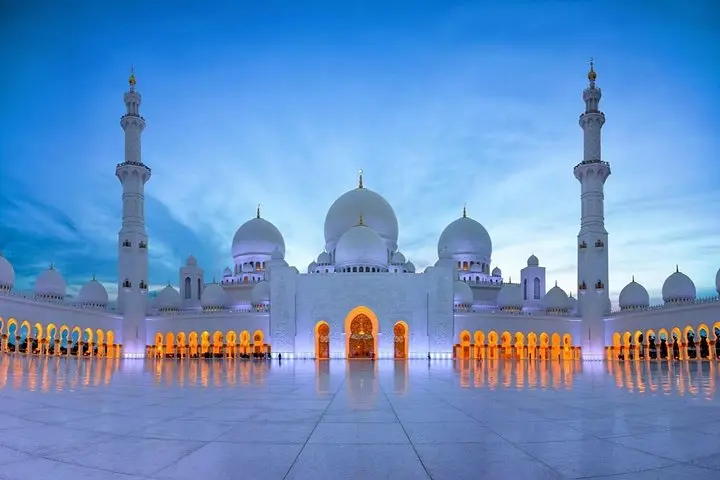
Qasr Al Watan opened to the public in 2019 as part presidential palace, designed to showcase Emirati heritage and statecraft. Its architecture borrows classical Arabian forms—domes, mashrabiya screens and tiled water features—set against modern engineering. Later, at Sheikh Zayed Grand Mosque (completed 2007), the white marble and reflective pools turn from warm ochre to cool silver as dusk settles, offering expansive sightlines to its domes and four minarets.
Cultural context matters: both sites are active symbols of the UAE’s identity, emphasizing hospitality, scholarship and religious practice. Expect interpretive displays at Qasr Al Watan and guided explanations of Islamic art at the mosque.
Practical side: the guided itinerary lasts about four hours and includes admission and air-conditioned transfers. Dress conservatively—long sleeves and covered legs; women should have a headscarf available. Photography is welcome in most exterior spaces but observe signage and guided restrictions indoors. Plan hydration and sun protection for transit between sites; sunset timing makes the light worth the short wait. Wheelchair access is available at both stops, and groups are typically small, making this a focused, low-effort way to see two of Abu Dhabi’s most photogenic and culturally significant landmarks.
Yes—both sites require modest dress: covered shoulders and legs; women should have a headscarf for mosque interiors.
Yes. The tour notes wheelchair-accessible transport and surfaces; advise the operator of needs when booking.
Photography is generally allowed in many exterior and designated interior areas, but follow on-site signage and your guide’s instructions for restricted zones.
Tours can be canceled for severe weather; in practice, light rain rarely shuts activity down, but check cancellation terms and local advisories.
Desert Voyagers Tourism operates guided outdoor trips and adventures with an emphasis on safety, stewardship, and memorable experiences.



The tour begins as the day softens and the city exhales—late afternoon light pools across sand-colored facades while the sea breeze carries a faint salt line from the Corniche. You arrive at Qasr Al Watan first, where carved arches and polished courtyards catch the low sun and throw geometric shadows across the forecourt.
The tour begins as the day softens and the city exhales—late afternoon light pools across sand-colored facades while the sea breeze carries a faint salt line from the Corniche. You arrive at Qasr Al Watan first, where carved arches and polished courtyards catch the low sun and throw geometric shadows across the forecourt.
Qasr Al Watan opened to the public in 2019 as part presidential palace, designed to showcase Emirati heritage and statecraft. Its architecture borrows classical Arabian forms—domes, mashrabiya screens and tiled water features—set against modern engineering. Later, at Sheikh Zayed Grand Mosque (completed 2007), the white marble and reflective pools turn from warm ochre to cool silver as dusk settles, offering expansive sightlines to its domes and four minarets.
Cultural context matters: both sites are active symbols of the UAE’s identity, emphasizing hospitality, scholarship and religious practice. Expect interpretive displays at Qasr Al Watan and guided explanations of Islamic art at the mosque.
Practical side: the guided itinerary lasts about four hours and includes admission and air-conditioned transfers. Dress conservatively—long sleeves and covered legs; women should have a headscarf available. Photography is welcome in most exterior spaces but observe signage and guided restrictions indoors. Plan hydration and sun protection for transit between sites; sunset timing makes the light worth the short wait. Wheelchair access is available at both stops, and groups are typically small, making this a focused, low-effort way to see two of Abu Dhabi’s most photogenic and culturally significant landmarks.