THE ADVENTURE COLLECTIVE® · Independent discovery and booking for outdoor travel

Trade the tour bus for a relaxed, small-group day into Aconcagua Provincial Park. Walk the easy Horcones Lagoon trail beneath the highest peak in the Americas, then cap it with a classic Argentine asado in Uspallata.
Trade the tour bus for a relaxed, small-group day into Aconcagua Provincial Park. Walk the easy Horcones Lagoon trail beneath the highest peak in the Americas, then cap it with a classic Argentine asado in Uspallata.
Dawn breaks over Mendoza as the Andes draw a hard blue line against the sky, inviting and a little intimidating. The road threads west up Route 7, past poplar windbreaks and vineyards giving way to rock and river. At Potrerillos Dam the water goes electric-turquoise, a still mirror that dares you to linger. Higher still, Uspallata offers a warm stop—coffee, a croissant, a last breath of low-elevation comfort—before the mountains take over the conversation.
Verified experiences and guided adventures in the surrounding area.
Operated by Destino Montaña · Puente del Inca, Mendoza
Dawn breaks over Mendoza as the Andes draw a hard blue line against the sky, inviting and a little intimidating. The road threads west up Route 7, past poplar windbreaks and vineyards giving way to rock and river. At Potrerillos Dam the water goes electric-turquoise, a still mirror that dares you to linger. Higher still, Uspallata offers a warm stop—coffee, a croissant, a last breath of low-elevation comfort—before the mountains take over the conversation.
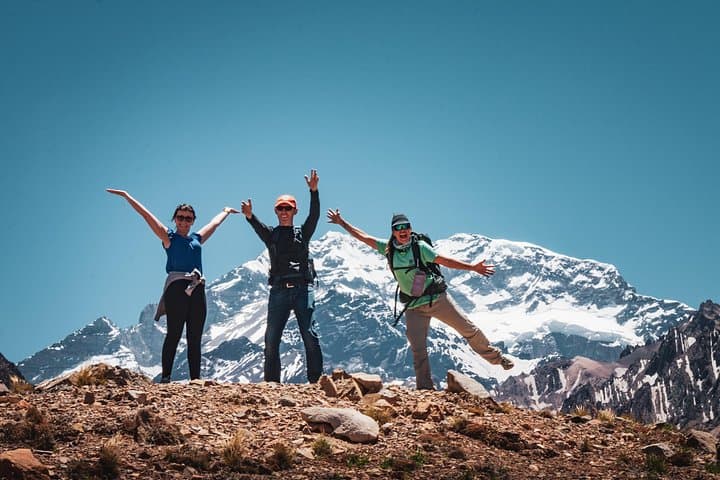
This full-day outing trades the tour-bus routine for a slow approach into Aconcagua Provincial Park, where a short, easy walk delivers big-mountain drama. The Horcones Valley opens wide, gravel underfoot and thin air edging each step. Aconcagua’s south face holds court, its glaciers and buttresses pushing forward even when the wind is quiet. The loop to Horcones Lagoon is gentle—about 1–2 km on a well-marked path—but altitude around 2,900–3,100 meters keeps everyone honest. Pace is easy, eyes up: condors surf thermals, guanaco tracks stitch the sand, and the lagoon throws back a near-perfect reflection when the breeze relaxes.
Between viewpoints, guides thread in the story of this corridor: how the Andes were lifted and folded, the minerals that paint these hills, the Inca routes that once crossed these passes, and General San Martín’s army marching toward independence in 1817. Down the road, Puente del Inca appears like a natural dare—an ochre arch formed by mineral-rich hot springs encrusting rock over centuries, flanked by the crumbling shell of a historic spa. At Picheuta’s small stone bridge, history feels close and uncomplicated: a river, a crossing, a way west.
Lunch brings the day back to earth. Back in Uspallata, grills hiss and smoke, and an Argentine asado makes quick work of mountain appetite—empanadas, beef kissed by coals, salad or fries, and a bottle of local wine opened with the easy pride of a region that knows how to feed travelers. Stories circle the table: gusts that pushed, peaks that loomed, the moment Aconcagua filled the frame.
It’s a trip built for comfort without skimping on scale: hotel pickup in Mendoza, small group transport, park entry handled, and a hike that favors views over vert. Bring broken-in shoes, layers for a moody mountain sun, and respect for altitude; the Andes will set the pace. By late afternoon, the road unwinds back toward the city, dust swirling in the wake as the range settles into evening—quiet, massive, and already pulling you back.
Expect 45–90 minutes of easy walking on a well-marked, mostly flat gravel path with minor undulations.
The Horcones area sits around 2,900–3,100 meters (9,500–10,200 feet); you won’t approach the summit zone on this tour.
Yes. A traditional Argentine asado in Uspallata is included, with starter, sides, dessert, and drinks (wine, soda, or water).
Yes. Facilities are available during roadside stops, in Uspallata, and at park control points, though they can be basic.
The tour runs in varied mountain conditions, but authorities may close the road or park during storms; in that case, the tour can be modified or canceled for safety.
No. The walk is beginner-friendly, guided, and designed for comfort—just be mindful of altitude and wear appropriate footwear.
Destino Montaña operates guided outdoor trips and adventures with an emphasis on safety, stewardship, and memorable experiences.


Dawn breaks over Mendoza as the Andes draw a hard blue line against the sky, inviting and a little intimidating. The road threads west up Route 7, past poplar windbreaks and vineyards giving way to rock and river. At Potrerillos Dam the water goes electric-turquoise, a still mirror that dares you to linger. Higher still, Uspallata offers a warm stop—coffee, a croissant, a last breath of low-elevation comfort—before the mountains take over the conversation.
Dawn breaks over Mendoza as the Andes draw a hard blue line against the sky, inviting and a little intimidating. The road threads west up Route 7, past poplar windbreaks and vineyards giving way to rock and river. At Potrerillos Dam the water goes electric-turquoise, a still mirror that dares you to linger. Higher still, Uspallata offers a warm stop—coffee, a croissant, a last breath of low-elevation comfort—before the mountains take over the conversation.
This full-day outing trades the tour-bus routine for a slow approach into Aconcagua Provincial Park, where a short, easy walk delivers big-mountain drama. The Horcones Valley opens wide, gravel underfoot and thin air edging each step. Aconcagua’s south face holds court, its glaciers and buttresses pushing forward even when the wind is quiet. The loop to Horcones Lagoon is gentle—about 1–2 km on a well-marked path—but altitude around 2,900–3,100 meters keeps everyone honest. Pace is easy, eyes up: condors surf thermals, guanaco tracks stitch the sand, and the lagoon throws back a near-perfect reflection when the breeze relaxes.
Between viewpoints, guides thread in the story of this corridor: how the Andes were lifted and folded, the minerals that paint these hills, the Inca routes that once crossed these passes, and General San Martín’s army marching toward independence in 1817. Down the road, Puente del Inca appears like a natural dare—an ochre arch formed by mineral-rich hot springs encrusting rock over centuries, flanked by the crumbling shell of a historic spa. At Picheuta’s small stone bridge, history feels close and uncomplicated: a river, a crossing, a way west.
Lunch brings the day back to earth. Back in Uspallata, grills hiss and smoke, and an Argentine asado makes quick work of mountain appetite—empanadas, beef kissed by coals, salad or fries, and a bottle of local wine opened with the easy pride of a region that knows how to feed travelers. Stories circle the table: gusts that pushed, peaks that loomed, the moment Aconcagua filled the frame.
It’s a trip built for comfort without skimping on scale: hotel pickup in Mendoza, small group transport, park entry handled, and a hike that favors views over vert. Bring broken-in shoes, layers for a moody mountain sun, and respect for altitude; the Andes will set the pace. By late afternoon, the road unwinds back toward the city, dust swirling in the wake as the range settles into evening—quiet, massive, and already pulling you back.