THE ADVENTURE COLLECTIVE® · Independent discovery and booking for outdoor travel

Spend a half-day from Port Elizabeth exploring Addo Elephant National Park with experienced guides. This closed-vehicle, family-friendly safari offers high chances of seeing elephants, black rhino, lions, and other Big 5 species in a malaria-free setting.
Spend a half-day from Port Elizabeth exploring Addo Elephant National Park with experienced guides. This closed-vehicle, family-friendly safari offers high chances of seeing elephants, black rhino, lions, and other Big 5 species in a malaria-free setting.
Early light catches the sides of a family herd as the vehicle cuts through low scrub; trunks reach out like slow hands, testing the morning air. The road is dusty and the rhythm of the ride is patient—this is animal time, not tourist time. Addo’s thick-bodied elephants move across open plains and gully shadows while guides scan termite mounds and watering holes for movement.
Verified experiences and guided adventures in the surrounding area.
Operated by Ubuntu Sunshine Tours and Shuttle services and shore excursions · Addo, Eastern Cape
Early light catches the sides of a family herd as the vehicle cuts through low scrub; trunks reach out like slow hands, testing the morning air. The road is dusty and the rhythm of the ride is patient—this is animal time, not tourist time. Addo’s thick-bodied elephants move across open plains and gully shadows while guides scan termite mounds and watering holes for movement.
The park’s core was set aside in 1931 when just eleven elephants remained; today Addo preserves one of the densest elephant populations on Earth and, uniquely, protects the “Big 7” — terrestrial megafauna plus the southern right whale and great white shark off the nearby coast. Geologically the region sits on Beaufort Group shales and sandstones, carved into ridges and valleys that funnel game and shape vegetation zones from thornveld to coastal bush. Culturally, the Eastern Cape’s Xhosa communities and colonial farming history overlap here, visible in small towns and roadside memorials outside the park.
Practical guide: this half-day, closed-vehicle safari runs out of Port Elizabeth (Gqeberha) and is roughly a 40–60 minute transfer each way depending on traffic. Expect bumpy, dusty tracks; bring binoculars, layered clothing, and a windproof layer for early mornings. Photography is best during golden hours—dawn or late afternoon—when animals concentrate at water. Keep a safe distance and follow the guide’s instructions; animals set the pace and the limits. There’s a restaurant at main rest areas if time allows. For families and first-time safari-goers, Addo is an accessible, malaria-free introduction to South African wildlife.
Most departures include a 40–60 minute transfer each way depending on the pickup location and traffic.
Yes—Addo is considered a malaria-free area, which makes it a good option for families and travelers avoiding prophylaxis.
Guides maximize sightings by choosing productive routes, but wildlife is wild—sightings are common for elephants and antelope, while predators and black rhino are less guaranteed.
Yes; the tour is family-friendly, wheelchair accessible, and runs in closed vehicles; confirm specific pickup and seating needs with the operator when booking.
Ubuntu Sunshine Tours and Shuttle services and shore excursions operates guided outdoor trips and adventures with an emphasis on safety, stewardship, and memorable experiences.
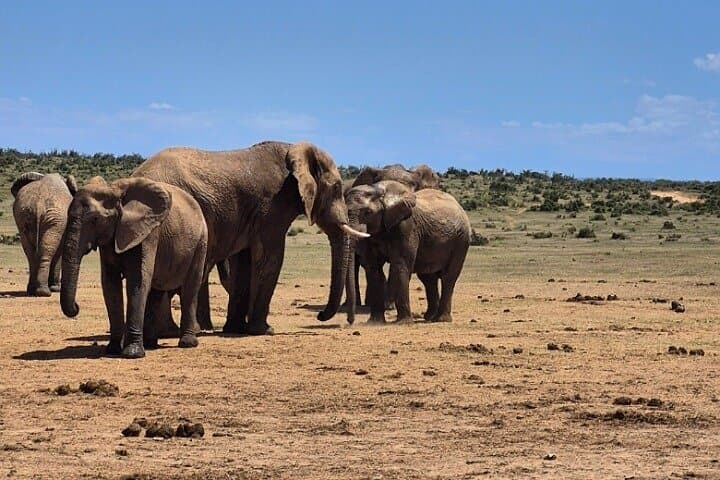


Early light catches the sides of a family herd as the vehicle cuts through low scrub; trunks reach out like slow hands, testing the morning air. The road is dusty and the rhythm of the ride is patient—this is animal time, not tourist time. Addo’s thick-bodied elephants move across open plains and gully shadows while guides scan termite mounds and watering holes for movement.
Early light catches the sides of a family herd as the vehicle cuts through low scrub; trunks reach out like slow hands, testing the morning air. The road is dusty and the rhythm of the ride is patient—this is animal time, not tourist time. Addo’s thick-bodied elephants move across open plains and gully shadows while guides scan termite mounds and watering holes for movement.
The park’s core was set aside in 1931 when just eleven elephants remained; today Addo preserves one of the densest elephant populations on Earth and, uniquely, protects the “Big 7” — terrestrial megafauna plus the southern right whale and great white shark off the nearby coast. Geologically the region sits on Beaufort Group shales and sandstones, carved into ridges and valleys that funnel game and shape vegetation zones from thornveld to coastal bush. Culturally, the Eastern Cape’s Xhosa communities and colonial farming history overlap here, visible in small towns and roadside memorials outside the park.
Practical guide: this half-day, closed-vehicle safari runs out of Port Elizabeth (Gqeberha) and is roughly a 40–60 minute transfer each way depending on traffic. Expect bumpy, dusty tracks; bring binoculars, layered clothing, and a windproof layer for early mornings. Photography is best during golden hours—dawn or late afternoon—when animals concentrate at water. Keep a safe distance and follow the guide’s instructions; animals set the pace and the limits. There’s a restaurant at main rest areas if time allows. For families and first-time safari-goers, Addo is an accessible, malaria-free introduction to South African wildlife.