THE ADVENTURE COLLECTIVE® · Independent discovery and booking for outdoor travel

Ride the morning train from Ella, hike along quiet railway tracks through tea country, and tour the early-1900s Adisham Bungalow before picnicking in a plantation. Expect cool ridge-top air, easy walking, and wide-open views.
Ride the morning train from Ella, hike along quiet railway tracks through tea country, and tour the early-1900s Adisham Bungalow before picnicking in a plantation. Expect cool ridge-top air, easy walking, and wide-open views.
Morning mist clings to the rails as the 9:00 train slips out of Ella, windows framing tiers of tea bushes and knife-edged ridgelines. By the time you disembark in Haputale, the landscape has shifted from bright cloud forest to cool, wind-scoured slopes; the old railway track becomes a narrow ribbon guiding you toward Adisham Bungalow.
Verified experiences and guided adventures in the surrounding area.
Operated by Lakpura LLC · Ella, Uva Province
Morning mist clings to the rails as the 9:00 train slips out of Ella, windows framing tiers of tea bushes and knife-edged ridgelines. By the time you disembark in Haputale, the landscape has shifted from bright cloud forest to cool, wind-scoured slopes; the old railway track becomes a narrow ribbon guiding you toward Adisham Bungalow.
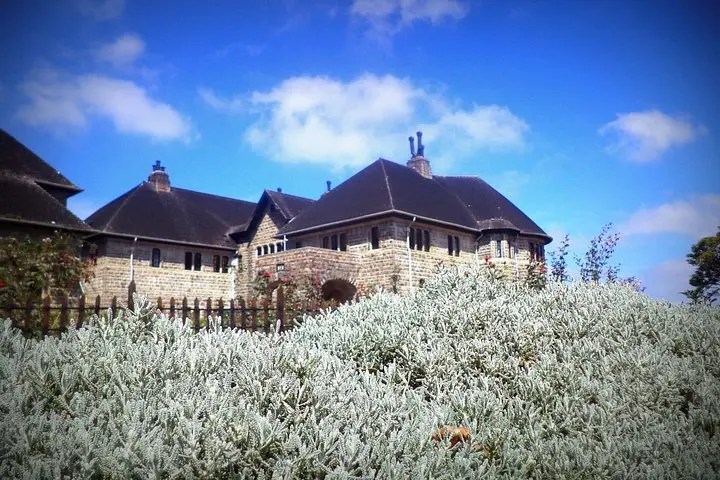
Adisham is an English-style stone manor built in the early 1900s by Sir Thomas Lister Villiers and modeled on Leeds Castle. Geologically the route cuts through the Sri Lankan hill country—ancient Precambrian rock sculpted into steep valleys and plateaus—so expect packed-earth paths, scattered boulders, and railway sleepers that make an uneven but straightforward trail. Culture here is rooted in tea: estates dot the route and workers’ cottages punctuate the hills, offering a living view of plantation life and colonial-era architecture.
The bungalow’s polished wood floors, formal gardens and resident birds reward the short, guided house tour. Lunch is a simple picnic among the tea rows; the scent of crushed leaves will prod you to linger. The return walk along the tracks is leisurely, with long sightlines letting you hear trains well in advance.
Practical guidance: the full outing runs about 9–10 hours including transport; wear sturdy walking shoes and a light rain layer, carry water and insect repellent, and follow your guide when crossing active rails. Trains and weather dictate timing—book morning departures and leave phones charged for photos and navigation.
The walking sections are short to moderate—individual legs are roughly 30–60 minutes each along the railway with mostly gentle grades.
Guided walks use quieter windows in the schedule and guides monitor train movements; always follow the guide’s instructions and keep to one side of the sleepers.
Yes—guided tours of the bungalow and gardens are included in the typical itinerary, but access can vary with private events or monastery activities.
Yes—the operator offers pickups from Ella or Bandarawela, and tuk-tuk transfers connect hotels to the train station as part of the service.
Lakpura LLC operates guided outdoor trips and adventures with an emphasis on safety, stewardship, and memorable experiences.



Morning mist clings to the rails as the 9:00 train slips out of Ella, windows framing tiers of tea bushes and knife-edged ridgelines. By the time you disembark in Haputale, the landscape has shifted from bright cloud forest to cool, wind-scoured slopes; the old railway track becomes a narrow ribbon guiding you toward Adisham Bungalow.
Morning mist clings to the rails as the 9:00 train slips out of Ella, windows framing tiers of tea bushes and knife-edged ridgelines. By the time you disembark in Haputale, the landscape has shifted from bright cloud forest to cool, wind-scoured slopes; the old railway track becomes a narrow ribbon guiding you toward Adisham Bungalow.
Adisham is an English-style stone manor built in the early 1900s by Sir Thomas Lister Villiers and modeled on Leeds Castle. Geologically the route cuts through the Sri Lankan hill country—ancient Precambrian rock sculpted into steep valleys and plateaus—so expect packed-earth paths, scattered boulders, and railway sleepers that make an uneven but straightforward trail. Culture here is rooted in tea: estates dot the route and workers’ cottages punctuate the hills, offering a living view of plantation life and colonial-era architecture.
The bungalow’s polished wood floors, formal gardens and resident birds reward the short, guided house tour. Lunch is a simple picnic among the tea rows; the scent of crushed leaves will prod you to linger. The return walk along the tracks is leisurely, with long sightlines letting you hear trains well in advance.
Practical guidance: the full outing runs about 9–10 hours including transport; wear sturdy walking shoes and a light rain layer, carry water and insect repellent, and follow your guide when crossing active rails. Trains and weather dictate timing—book morning departures and leave phones charged for photos and navigation.