THE ADVENTURE COLLECTIVE® · Independent discovery and booking for outdoor travel

Stand at one of South Korea's closest civilian viewpoints to North Korea and learn the layered history of Hill 154. This half-day tour combines clear vistas, Cold War history, and practical access notes—passports required.
Stand at one of South Korea's closest civilian viewpoints to North Korea and learn the layered history of Hill 154. This half-day tour combines clear vistas, Cold War history, and practical access notes—passports required.
You step off the bus into wind that seems to push history forward — the river below pulls the eye north, and the concrete observatory perches like an answer to a long question. At Aegibong Peace Ecopark the view across the Han estuary to the opposite bank is stark: fields and a single-rowed village, then a buffer of empty land and the nearest visible lights of North Korea just 1.4 km away from the Jogang observatory.
Verified experiences and guided adventures in the surrounding area.
Operated by I Love Seoul Tour · Gimpo, Gyeonggi-do
You step off the bus into wind that seems to push history forward — the river below pulls the eye north, and the concrete observatory perches like an answer to a long question. At Aegibong Peace Ecopark the view across the Han estuary to the opposite bank is stark: fields and a single-rowed village, then a buffer of empty land and the nearest visible lights of North Korea just 1.4 km away from the Jogang observatory.
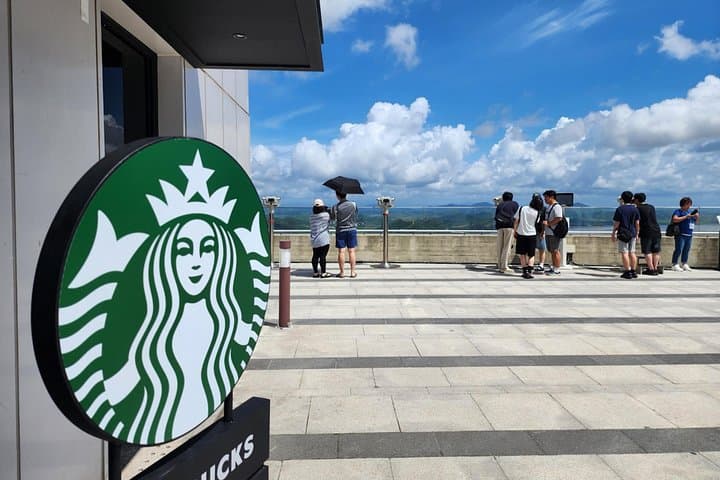
The site began as Hill 154, a contested ridge in the Korean War where civilians and soldiers crossed paths in the fight for the river mouth. The observatory traces that history: an original 1978 platform replaced by the modern Jogang deck, and a unique Starbucks that now occupies the lookout, a civilian-facing symbol inside the Civilian Control Zone. Bridges shaped like a removed Christmas tree recall earlier tensions over broadcast lights and illuminate the cultural effort to reframe the place as peace and remembrance.
On a typical tour from Seoul (about 4.75 hours total), expect short guided walks, curated viewpoints, and clear explanations of military geography and displaced communities who returned here to look for lost hometowns. The terrain is paved park paths and metal observation platforms; wind can be severe so layers matter. Practicalities: passports are mandatory for access to the CCZ, groups require a minimum of two people, and guides will brief you on prohibited behavior and photography limits. Bring a water bottle, sturdy shoes for uneven park paths, and plan for mid-afternoon light for the best visibility toward the north.
Yes — passports are mandatory for all participants to enter the Civilian Control Zone and will be checked before departure.
From Jogang observatory you can see North Korean territory roughly 1.4 kilometers across the Han estuary under clear conditions.
The tour is family-friendly but requires a moderate level of mobility; infants must sit on laps and people with serious heart conditions are advised not to join.
Tours often require a minimum of two participants and offer free cancellation up to 24 hours before departure; check the operator’s policy when booking.
I Love Seoul Tour operates guided outdoor trips and adventures with an emphasis on safety, stewardship, and memorable experiences.


You step off the bus into wind that seems to push history forward — the river below pulls the eye north, and the concrete observatory perches like an answer to a long question. At Aegibong Peace Ecopark the view across the Han estuary to the opposite bank is stark: fields and a single-rowed village, then a buffer of empty land and the nearest visible lights of North Korea just 1.4 km away from the Jogang observatory.
You step off the bus into wind that seems to push history forward — the river below pulls the eye north, and the concrete observatory perches like an answer to a long question. At Aegibong Peace Ecopark the view across the Han estuary to the opposite bank is stark: fields and a single-rowed village, then a buffer of empty land and the nearest visible lights of North Korea just 1.4 km away from the Jogang observatory.
The site began as Hill 154, a contested ridge in the Korean War where civilians and soldiers crossed paths in the fight for the river mouth. The observatory traces that history: an original 1978 platform replaced by the modern Jogang deck, and a unique Starbucks that now occupies the lookout, a civilian-facing symbol inside the Civilian Control Zone. Bridges shaped like a removed Christmas tree recall earlier tensions over broadcast lights and illuminate the cultural effort to reframe the place as peace and remembrance.
On a typical tour from Seoul (about 4.75 hours total), expect short guided walks, curated viewpoints, and clear explanations of military geography and displaced communities who returned here to look for lost hometowns. The terrain is paved park paths and metal observation platforms; wind can be severe so layers matter. Practicalities: passports are mandatory for access to the CCZ, groups require a minimum of two people, and guides will brief you on prohibited behavior and photography limits. Bring a water bottle, sturdy shoes for uneven park paths, and plan for mid-afternoon light for the best visibility toward the north.