THE ADVENTURE COLLECTIVE® · Independent discovery and booking for outdoor travel

Explore Agadir’s hilltop kasbah, bustling Souk El Had, and oceanfront panorama on this 2–3 hour guided city tour. Expect easy walking, rich local history, and practical tips for beating the heat and the crowds.
Explore Agadir’s hilltop kasbah, bustling Souk El Had, and oceanfront panorama on this 2–3 hour guided city tour. Expect easy walking, rich local history, and practical tips for beating the heat and the crowds.
You step from the shaded, air-conditioned vehicle onto a sun-washed esplanade and the Atlantic immediately answers with a cool, salt-bright breeze that pushes inland. The Kasbah of Agadir Oufella looms above—stone ruins holding the city’s view like an old map—while below the modern beachfront stretches westward, punctuated by fishing boats and the steady motion of seabirds.
Verified experiences and guided adventures in the surrounding area.
Operated by Agatrips · Agadir, Souss-Massa
You step from the shaded, air-conditioned vehicle onto a sun-washed esplanade and the Atlantic immediately answers with a cool, salt-bright breeze that pushes inland. The Kasbah of Agadir Oufella looms above—stone ruins holding the city’s view like an old map—while below the modern beachfront stretches westward, punctuated by fishing boats and the steady motion of seabirds.
Agadir’s recent shape was forged as much by geology and disaster as by trade: an earthquake in 1960 leveled much of the city, and the rebuilt grid meets the older hilltop kasbah that dates back to the 16th century. The souk rhythm—Souk El Had—traces a longer history of Berber craft, spice trade and Atlantic commerce. Architecture here mixes straightforward post‑quake concrete with ornate mosque façades and recycled tilework from earlier eras. Local guides tie those threads together, explaining argan oil production nearby, traditional craftsmanship, and daily life in Talborjt.
Practical route: expect 2–3 hours of mostly easy walking, short stairs at the kasbah and crowded alleys at the souk. Wear grippy shoes for uneven cobbles, bring sunscreen and a refillable water bottle, and time the visit early morning or late afternoon to avoid peak heat and crowds. Be ready to haggle gently at stalls, and follow your guide’s cues near busy intersections. If you want a quieter moment, request a stop at a rooftop café for a panoramic pause—views are the payoff here.
Entrance to Kasbah Oufella is typically not included; the tour covers guided stops and views, so confirm specific admission fees when booking.
Tours are commonly offered in English and French; check the booking page or request a preferred language at reservation.
The tour notes stroller accessibility for flat sections, but steep steps at the kasbah may require carrying infants—ask about infant seats and stroller-friendly routing.
Pickup is usually offered from central Agadir hotels; you’ll be asked to select a pickup point when booking—confirm exact pickup times.
Agatrips operates guided outdoor trips and adventures with an emphasis on safety, stewardship, and memorable experiences.
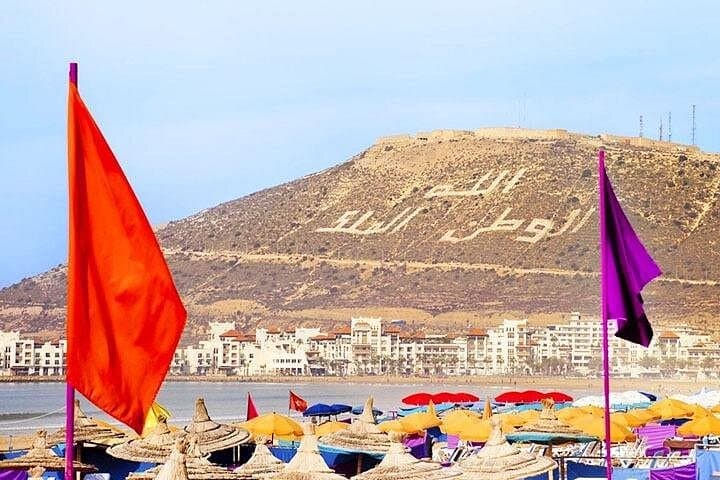


You step from the shaded, air-conditioned vehicle onto a sun-washed esplanade and the Atlantic immediately answers with a cool, salt-bright breeze that pushes inland. The Kasbah of Agadir Oufella looms above—stone ruins holding the city’s view like an old map—while below the modern beachfront stretches westward, punctuated by fishing boats and the steady motion of seabirds.
You step from the shaded, air-conditioned vehicle onto a sun-washed esplanade and the Atlantic immediately answers with a cool, salt-bright breeze that pushes inland. The Kasbah of Agadir Oufella looms above—stone ruins holding the city’s view like an old map—while below the modern beachfront stretches westward, punctuated by fishing boats and the steady motion of seabirds.
Agadir’s recent shape was forged as much by geology and disaster as by trade: an earthquake in 1960 leveled much of the city, and the rebuilt grid meets the older hilltop kasbah that dates back to the 16th century. The souk rhythm—Souk El Had—traces a longer history of Berber craft, spice trade and Atlantic commerce. Architecture here mixes straightforward post‑quake concrete with ornate mosque façades and recycled tilework from earlier eras. Local guides tie those threads together, explaining argan oil production nearby, traditional craftsmanship, and daily life in Talborjt.
Practical route: expect 2–3 hours of mostly easy walking, short stairs at the kasbah and crowded alleys at the souk. Wear grippy shoes for uneven cobbles, bring sunscreen and a refillable water bottle, and time the visit early morning or late afternoon to avoid peak heat and crowds. Be ready to haggle gently at stalls, and follow your guide’s cues near busy intersections. If you want a quieter moment, request a stop at a rooftop café for a panoramic pause—views are the payoff here.