THE ADVENTURE COLLECTIVE® · Independent discovery and booking for outdoor travel

Trade Marrakech’s bustle for a half-day camel trek across the Agafay’s stone plains and the shoreline of Lake Takerkoust. Expect 45 minutes atop a gentle caravan, a Berber lunch in a tented camp, and sweeping views of the Atlas foothills.
Trade Marrakech’s bustle for a half-day camel trek across the Agafay’s stone plains and the shoreline of Lake Takerkoust. Expect 45 minutes atop a gentle caravan, a Berber lunch in a tented camp, and sweeping views of the Atlas foothills.
A wind-worn plain unfurls south of Marrakech where the Agafay’s stony ridges catch morning light like a rough sea. Drivers thread a lane past Lake Takerkoust, its flat water daring the heat, and then the road drops you onto a landscape of pale, sand-colored hummocks. Camels wait in a small caravan—patient, low-slung ships ready to carry riders across a lunar sweep of rock and dust.
Verified experiences and guided adventures in the surrounding area.
Operated by Toubkal Guide · Marrakech, Marrakesh-Safi
A wind-worn plain unfurls south of Marrakech where the Agafay’s stony ridges catch morning light like a rough sea. Drivers thread a lane past Lake Takerkoust, its flat water daring the heat, and then the road drops you onto a landscape of pale, sand-colored hummocks. Camels wait in a small caravan—patient, low-slung ships ready to carry riders across a lunar sweep of rock and dust.
The Agafay is not Sahara sand but a reg: compacted gravels and eroded volcanic rock shaped against the Atlas. Historically the area sat on transhumance routes used by Berber herders moving flocks between plains and High Atlas pastures; today traditional tent camps offer a modern echo of that hospitality, often serving tagine and mint tea after a ride.
Geology here reads like a pared-down map: basalt and limestone beds tilted toward the Atlas, with Takerkoust dam collecting runoff from the foothills. Birdlife concentrates near the lake while the plateau hosts lizards and small mammals adapted to scarce water.
Practical notes: the program is a half-day loop—hotel pickup in Marrakech, a 45-minute camel ride, then a traditional Berber lunch at a tented camp and return in about four hours. Expect dusty ground underfoot and a low, swinging saddle—bring closed-toe shoes, sun protection, and a water bottle. Morning departures avoid peak heat; if you’re sensitive to motion or need support mounting, request assistance when booking. Tipping camel handlers, staying on marked paths, and carrying out waste keeps this fragile landscape open to future riders.
The camel caravan ride lasts about 45 minutes as part of a four-hour half-day tour including transfers and lunch.
Yes; the tour is advertised as suitable for all fitness levels, but children should be supervised and handlers can assist mounting.
Hotel pickup and drop-off from Marrakech, a 45-minute camel ride, traditional Berber lunch at a tented camp, air-conditioned transfer, and professional driver.
Bring sun protection, a water bottle, closed-toe shoes, and a light layer for morning or late-season chills; cameras are welcome.
Toubkal Guide operates guided outdoor trips and adventures with an emphasis on safety, stewardship, and memorable experiences.
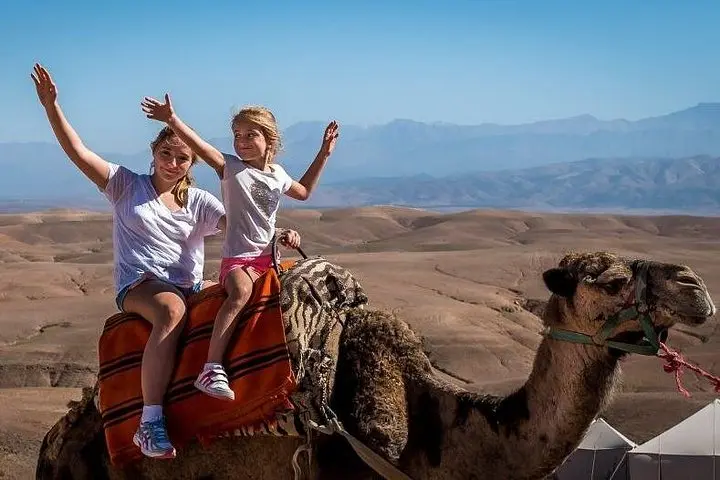
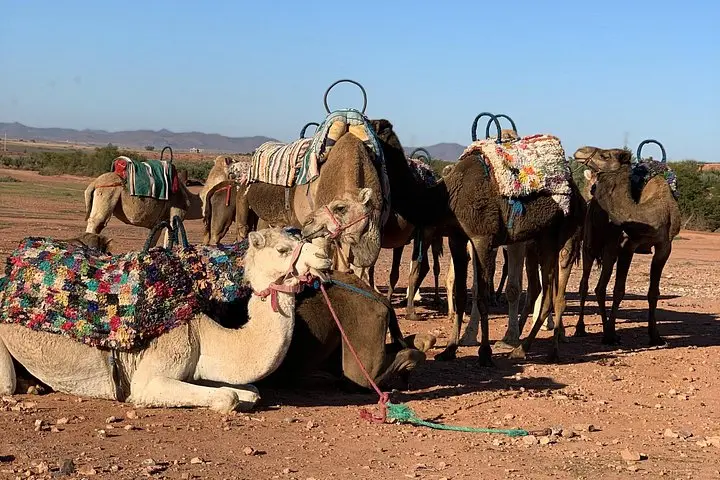
A wind-worn plain unfurls south of Marrakech where the Agafay’s stony ridges catch morning light like a rough sea. Drivers thread a lane past Lake Takerkoust, its flat water daring the heat, and then the road drops you onto a landscape of pale, sand-colored hummocks. Camels wait in a small caravan—patient, low-slung ships ready to carry riders across a lunar sweep of rock and dust.
A wind-worn plain unfurls south of Marrakech where the Agafay’s stony ridges catch morning light like a rough sea. Drivers thread a lane past Lake Takerkoust, its flat water daring the heat, and then the road drops you onto a landscape of pale, sand-colored hummocks. Camels wait in a small caravan—patient, low-slung ships ready to carry riders across a lunar sweep of rock and dust.
The Agafay is not Sahara sand but a reg: compacted gravels and eroded volcanic rock shaped against the Atlas. Historically the area sat on transhumance routes used by Berber herders moving flocks between plains and High Atlas pastures; today traditional tent camps offer a modern echo of that hospitality, often serving tagine and mint tea after a ride.
Geology here reads like a pared-down map: basalt and limestone beds tilted toward the Atlas, with Takerkoust dam collecting runoff from the foothills. Birdlife concentrates near the lake while the plateau hosts lizards and small mammals adapted to scarce water.
Practical notes: the program is a half-day loop—hotel pickup in Marrakech, a 45-minute camel ride, then a traditional Berber lunch at a tented camp and return in about four hours. Expect dusty ground underfoot and a low, swinging saddle—bring closed-toe shoes, sun protection, and a water bottle. Morning departures avoid peak heat; if you’re sensitive to motion or need support mounting, request assistance when booking. Tipping camel handlers, staying on marked paths, and carrying out waste keeps this fragile landscape open to future riders.