THE ADVENTURE COLLECTIVE® · Independent discovery and booking for outdoor travel

Walk 11 km through Tenerife’s almond-blossom season: a four-hour trail that threads farm terraces, 1909 Chinyero lava flows and sweeping sea views. This moderate outing pairs local agricultural history with geology and reliable winter blooms.
Walk 11 km through Tenerife’s almond-blossom season: a four-hour trail that threads farm terraces, 1909 Chinyero lava flows and sweeping sea views. This moderate outing pairs local agricultural history with geology and reliable winter blooms.
A cool January sun lifts through low clouds as you step off the minibus into a valley painted with pale pink and white — almond trees pushing buds out of short, volcanic soil. The trail climbs through farmland terraces and along old farm tracks, each bend giving a wider view: the black scars of hardened lava below the Chinyero vent, the serrated spine of Tenerife’s peaks and the blue Atlantic far beneath.
Verified experiences and guided adventures in the surrounding area.
Operated by Tenerife guided walks · Santiago del Teide, Santa Cruz de Tenerife
A cool January sun lifts through low clouds as you step off the minibus into a valley painted with pale pink and white — almond trees pushing buds out of short, volcanic soil. The trail climbs through farmland terraces and along old farm tracks, each bend giving a wider view: the black scars of hardened lava below the Chinyero vent, the serrated spine of Tenerife’s peaks and the blue Atlantic far beneath.
Human history here is close to the earth: smallholder agriculture has shaped these slopes for generations, and the 1909 Chinyero eruption left recent basalt flows that still break into raw, blocky textures. Geology and farming meet in the high valley above Santiago del Teide, where microclimates let almond groves flower early and guides explain local cultivation, place names and how lava redirected paths centuries ago.
Practically, expect an 11 km route, roughly 350 m of ascent and a maximum altitude near 1,100 m. The pace is moderate over mixed dirt tracks, farm roads and hardened lava; the group size is small and transport is by air-conditioned vehicle. Bring layered clothing for cool mornings that warm quickly, sun protection for exposed sections and steady shoes for uneven volcanic rock.
The season — typically January into mid-February — is the point: come for the bloom, stay for the coastal views and the geological lessons. Respect farm gates, keep to the trail to protect young trees, and plan for a relaxed four-hour outing with occasional stops for explanation, photos and the shift of light over the sea.
Blossom season typically begins in early January and runs through mid-February, with peak displays often in late January depending on winter weather.
Yes — the tour provides air-conditioned vehicle transport from pickup points to the high valley start and return at the end of the walk.
Infants can travel on the vehicle and may be carried for the walk; some sections are stroller-accessible but much of the route has uneven ground, so it’s best for older children who can walk.
Moderate fitness is required: expect rolling terrain and a 350 m ascent; regular walkers and those used to multi-kilometre hikes will be comfortable.
Tenerife guided walks operates guided outdoor trips and adventures with an emphasis on safety, stewardship, and memorable experiences.
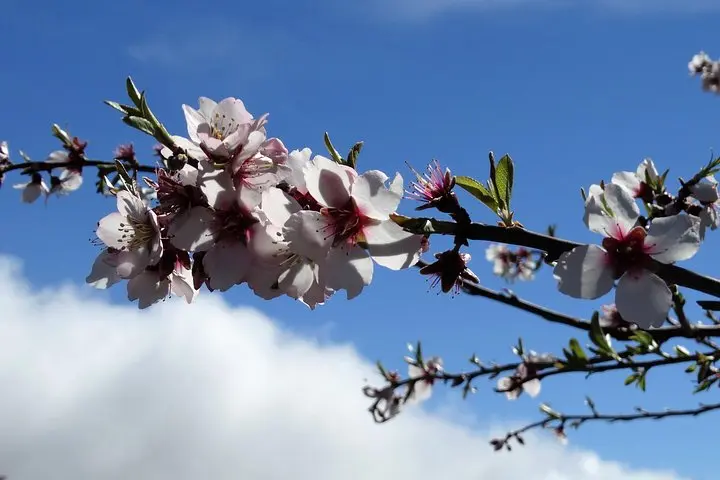
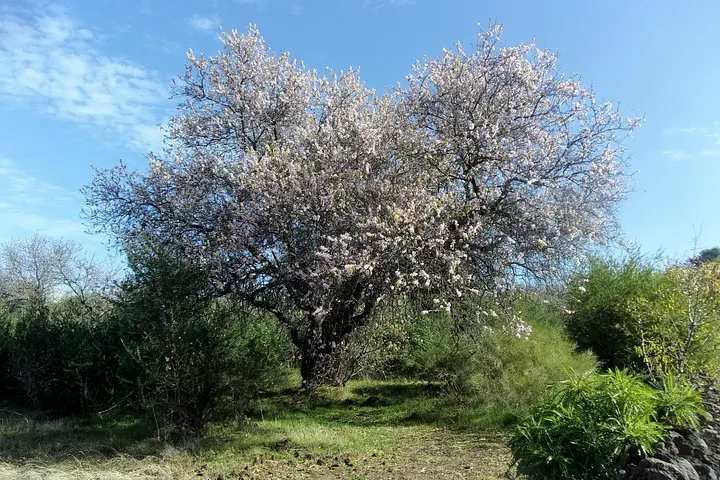
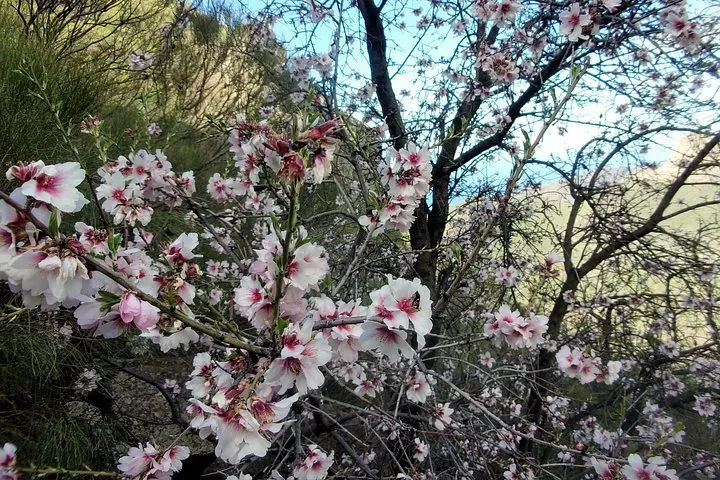
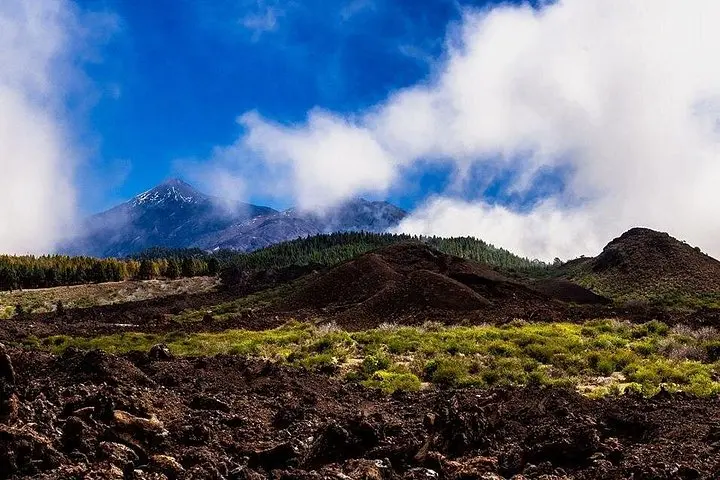
A cool January sun lifts through low clouds as you step off the minibus into a valley painted with pale pink and white — almond trees pushing buds out of short, volcanic soil. The trail climbs through farmland terraces and along old farm tracks, each bend giving a wider view: the black scars of hardened lava below the Chinyero vent, the serrated spine of Tenerife’s peaks and the blue Atlantic far beneath.
A cool January sun lifts through low clouds as you step off the minibus into a valley painted with pale pink and white — almond trees pushing buds out of short, volcanic soil. The trail climbs through farmland terraces and along old farm tracks, each bend giving a wider view: the black scars of hardened lava below the Chinyero vent, the serrated spine of Tenerife’s peaks and the blue Atlantic far beneath.
Human history here is close to the earth: smallholder agriculture has shaped these slopes for generations, and the 1909 Chinyero eruption left recent basalt flows that still break into raw, blocky textures. Geology and farming meet in the high valley above Santiago del Teide, where microclimates let almond groves flower early and guides explain local cultivation, place names and how lava redirected paths centuries ago.
Practically, expect an 11 km route, roughly 350 m of ascent and a maximum altitude near 1,100 m. The pace is moderate over mixed dirt tracks, farm roads and hardened lava; the group size is small and transport is by air-conditioned vehicle. Bring layered clothing for cool mornings that warm quickly, sun protection for exposed sections and steady shoes for uneven volcanic rock.
The season — typically January into mid-February — is the point: come for the bloom, stay for the coastal views and the geological lessons. Respect farm gates, keep to the trail to protect young trees, and plan for a relaxed four-hour outing with occasional stops for explanation, photos and the shift of light over the sea.