THE ADVENTURE COLLECTIVE® · Independent discovery and booking for outdoor travel

Explore AlUla with a local guide on a private six‑hour route that weaves Hegra’s Nabataean tombs, the mirrored Maraya, Elephant Rock, and Old Town. Practical, paced, and rich in local history—this experience pairs archaeology with contemporary culture.
Explore AlUla with a local guide on a private six‑hour route that weaves Hegra’s Nabataean tombs, the mirrored Maraya, Elephant Rock, and Old Town. Practical, paced, and rich in local history—this experience pairs archaeology with contemporary culture.
You step out of an air‑conditioned private vehicle into a wide, sunlit valley where carved tomb facades stare back like watchful doors. Sandstone walls, warm to the touch, flank a narrow lane that leads toward Hegra’s Nabataean tombs; wind scours the rock into ribs and hollows while palms beside the oasis rustle like a local chorus.
Verified experiences and guided adventures in the surrounding area.
Operated by Abdullah Guide · AlUla, Al Madinah Region
You step out of an air‑conditioned private vehicle into a wide, sunlit valley where carved tomb facades stare back like watchful doors. Sandstone walls, warm to the touch, flank a narrow lane that leads toward Hegra’s Nabataean tombs; wind scours the rock into ribs and hollows while palms beside the oasis rustle like a local chorus.
Hegra (Madain Salih) is Saudi Arabia’s first UNESCO World Heritage Site, a necropolis of the Nabataeans who made the region a caravan hub more than 2,000 years ago. The geology here is primarily sandstone sculpted by wind and infrequent seasonal floods, producing the dramatic arches and freestanding forms like Elephant Rock. Maraya, by contrast, is a modern mirrored building that frames the desert—an architectural counterpoint to millennia of stonework. Old Town and the palms of the AlUla Oasis reveal the living culture: mudbrick lanes, date farms, and workshops where traditional crafts continue.
This private, six‑hour cultural route stitches together timed stops—shuttle transport inside Hegra, a photo pause at Maraya, sunset at Elephant Rock, and walks through Old Town and the oasis. Practicalities matter: bring sun protection and at least 1.5–2 liters of water, wear sturdy shoes for uneven rock and paved old‑town alleys, and allow longer for photography or relaxed meals. Guides explain site rules—stay on paths around fragile tombs—and will adapt the pace to heat and interest. Expect a balance of archaeology, living culture, and striking desert panoramas on a day that’s both scenic and quietly instructive.
Yes—this tour includes the Hegra entry ticket and shuttle transportation inside the archaeological site.
Expect multiple short walks (10–30 minutes) across uneven surfaces and market lanes; total on‑foot time is moderate and paced by the guide.
This is a private tour and flexible—guides can spend more time at stops you prefer, within the six‑hour schedule.
Children and infants can join; stroller access is possible in parts of the route but some historic areas have steps and uneven ground.
Abdullah Guide operates guided outdoor trips and adventures with an emphasis on safety, stewardship, and memorable experiences.
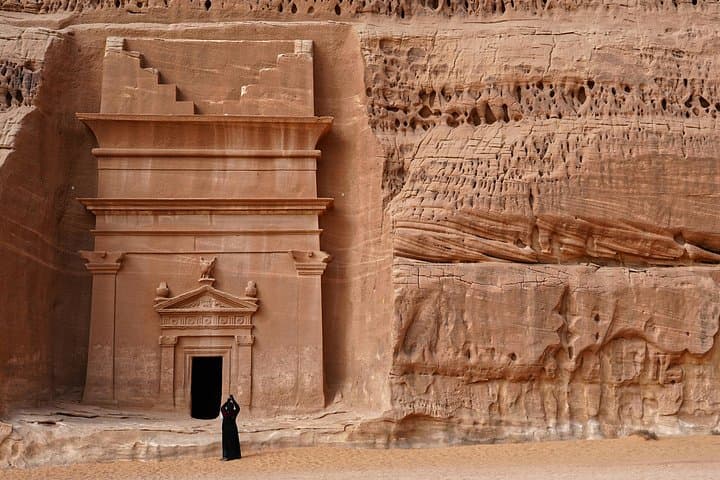


You step out of an air‑conditioned private vehicle into a wide, sunlit valley where carved tomb facades stare back like watchful doors. Sandstone walls, warm to the touch, flank a narrow lane that leads toward Hegra’s Nabataean tombs; wind scours the rock into ribs and hollows while palms beside the oasis rustle like a local chorus.
You step out of an air‑conditioned private vehicle into a wide, sunlit valley where carved tomb facades stare back like watchful doors. Sandstone walls, warm to the touch, flank a narrow lane that leads toward Hegra’s Nabataean tombs; wind scours the rock into ribs and hollows while palms beside the oasis rustle like a local chorus.
Hegra (Madain Salih) is Saudi Arabia’s first UNESCO World Heritage Site, a necropolis of the Nabataeans who made the region a caravan hub more than 2,000 years ago. The geology here is primarily sandstone sculpted by wind and infrequent seasonal floods, producing the dramatic arches and freestanding forms like Elephant Rock. Maraya, by contrast, is a modern mirrored building that frames the desert—an architectural counterpoint to millennia of stonework. Old Town and the palms of the AlUla Oasis reveal the living culture: mudbrick lanes, date farms, and workshops where traditional crafts continue.
This private, six‑hour cultural route stitches together timed stops—shuttle transport inside Hegra, a photo pause at Maraya, sunset at Elephant Rock, and walks through Old Town and the oasis. Practicalities matter: bring sun protection and at least 1.5–2 liters of water, wear sturdy shoes for uneven rock and paved old‑town alleys, and allow longer for photography or relaxed meals. Guides explain site rules—stay on paths around fragile tombs—and will adapt the pace to heat and interest. Expect a balance of archaeology, living culture, and striking desert panoramas on a day that’s both scenic and quietly instructive.