THE ADVENTURE COLLECTIVE® · Independent discovery and booking for outdoor travel

Walk a jungle path to a river carved with thousands of lingas, explore Beng Mealea’s overgrown galleries, and inspect the quarry where Angkor’s stones were cut—all on a private six‑hour tour from Siem Reap.
Walk a jungle path to a river carved with thousands of lingas, explore Beng Mealea’s overgrown galleries, and inspect the quarry where Angkor’s stones were cut—all on a private six‑hour tour from Siem Reap.
The morning drive leaves Siem Reap’s bustle behind and climbs toward the Kulen foothills, air cooling as the road narrows and palms press close. At Kbal Spean the trail slips into shade: a 1.5‑kilometre uphill walk through mixed deciduous forest that takes about 40–45 minutes, ending where the river reveals its carvings — thousands of lingas and reclining Vishnu cut into sandstone that the current now slowly polishes.
Verified experiences and guided adventures in the surrounding area.
Operated by Journey2 Angkor · Siem Reap, Siem Reap Province
The morning drive leaves Siem Reap’s bustle behind and climbs toward the Kulen foothills, air cooling as the road narrows and palms press close. At Kbal Spean the trail slips into shade: a 1.5‑kilometre uphill walk through mixed deciduous forest that takes about 40–45 minutes, ending where the river reveals its carvings — thousands of lingas and reclining Vishnu cut into sandstone that the current now slowly polishes.
History here is tangible. The carvings date to Angkor’s classical era while Suryavarman II’s aesthetic echoes at Beng Mealea, a deliberately crumbled prototype of Angkor Wat. Geology matters: the sandstone beds of the Kulen range were quarried nearby and floated downstream to the temple plain, leaving abandoned blocks and saw marks at the Ancient Quarry that explain the mechanics behind the empire’s megastructures.
Culturally the region feels lived‑in and layered — small villages, roadside Buddhist shrines, and temple guardians half‑swallowed by fig roots. The tour pairs that context with practical logistics: an air‑conditioned vehicle, English guide, bottled water, and included admissions to the listed sites.
Plan on sturdy shoes and sun protection for uneven trails and exposed temple courtyards, start early to avoid midday heat, and bring insect repellent for the jungle approaches. Move deliberately around carved riverbeds—avoid stepping on protected reliefs—and give yourself time to listen: water, wind through leaves, and the distant call of kingfishers all tell the same story the stones began.
Expect roughly 1.5 km of walking that takes about 40–45 minutes uphill from the trailhead; the path is shaded but uneven.
According to the itinerary, admissions to Kbal Spean and Beng Mealea are included; the guide will confirm what’s covered at booking.
The tour is private and suitable for a wide range of fitness levels, but the Kbal Spean approach involves an uphill trail and uneven surfaces that may be challenging for people with limited mobility.
Early morning is best to avoid heat and crowds; late afternoon can be hot and more humid, especially during the rainy season.
Journey2 Angkor operates guided outdoor trips and adventures with an emphasis on safety, stewardship, and memorable experiences.
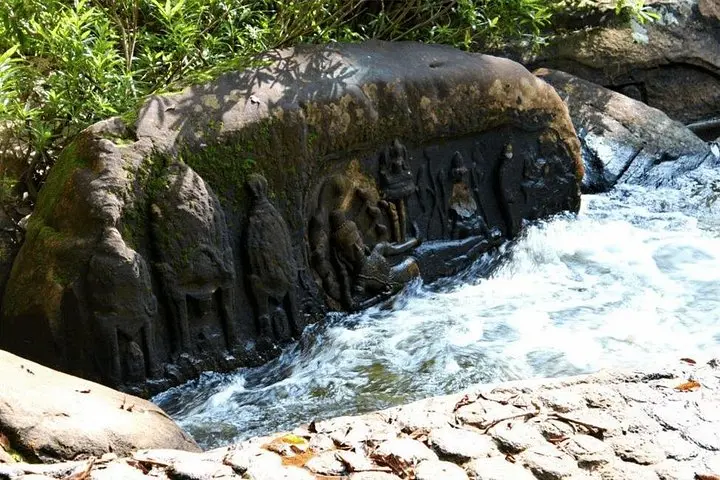
The morning drive leaves Siem Reap’s bustle behind and climbs toward the Kulen foothills, air cooling as the road narrows and palms press close. At Kbal Spean the trail slips into shade: a 1.5‑kilometre uphill walk through mixed deciduous forest that takes about 40–45 minutes, ending where the river reveals its carvings — thousands of lingas and reclining Vishnu cut into sandstone that the current now slowly polishes.
The morning drive leaves Siem Reap’s bustle behind and climbs toward the Kulen foothills, air cooling as the road narrows and palms press close. At Kbal Spean the trail slips into shade: a 1.5‑kilometre uphill walk through mixed deciduous forest that takes about 40–45 minutes, ending where the river reveals its carvings — thousands of lingas and reclining Vishnu cut into sandstone that the current now slowly polishes.
History here is tangible. The carvings date to Angkor’s classical era while Suryavarman II’s aesthetic echoes at Beng Mealea, a deliberately crumbled prototype of Angkor Wat. Geology matters: the sandstone beds of the Kulen range were quarried nearby and floated downstream to the temple plain, leaving abandoned blocks and saw marks at the Ancient Quarry that explain the mechanics behind the empire’s megastructures.
Culturally the region feels lived‑in and layered — small villages, roadside Buddhist shrines, and temple guardians half‑swallowed by fig roots. The tour pairs that context with practical logistics: an air‑conditioned vehicle, English guide, bottled water, and included admissions to the listed sites.
Plan on sturdy shoes and sun protection for uneven trails and exposed temple courtyards, start early to avoid midday heat, and bring insect repellent for the jungle approaches. Move deliberately around carved riverbeds—avoid stepping on protected reliefs—and give yourself time to listen: water, wind through leaves, and the distant call of kingfishers all tell the same story the stones began.