THE ADVENTURE COLLECTIVE® · Independent discovery and booking for outdoor travel

Watch sunrise at Angkor Wat, explore Angkor Thom and Ta Prohm, and catch sunset from a temple ridge on this two-day small-group circuit. Ideal for first-time visitors who want highlights at a measured, insightful pace.
Watch sunrise at Angkor Wat, explore Angkor Thom and Ta Prohm, and catch sunset from a temple ridge on this two-day small-group circuit. Ideal for first-time visitors who want highlights at a measured, insightful pace.
Before dawn the pools outside Angkor Wat hold the sky like a sheet of muted metal, and the temple’s towers loom as dark teeth against a first slice of light. This two-day small-group tour pulls you through that hour of hush, then into the heat and hum of the Grand Circuit — Bayon’s hundred-faced towers, Ta Prohm’s roots clasping stone, and the fine-carved pink sandstone of Banteay Srei.
Verified experiences and guided adventures in the surrounding area.
Operated by Angkor Happy Tour · Siem Reap, Siem Reap Province
Before dawn the pools outside Angkor Wat hold the sky like a sheet of muted metal, and the temple’s towers loom as dark teeth against a first slice of light. This two-day small-group tour pulls you through that hour of hush, then into the heat and hum of the Grand Circuit — Bayon’s hundred-faced towers, Ta Prohm’s roots clasping stone, and the fine-carved pink sandstone of Banteay Srei.
These monuments are products of the Khmer Empire (9th–13th centuries), built of laterite and sandstone and aligned with cosmology and irrigation systems that reshaped the plain. Ta Prohm reads like an archaeological novel: trees continue to pry blocks apart while moss and lichen write new textures into the bas-reliefs. The route also skirts artificial barays and island temples that reveal an engineered landscape once designed for ritual and rice irrigation.
Practically: sunrise entry at 4:10–4:30 am means an early start and minimal crowds; sunset options move to Pre Rup or Phnom Bakheng depending on season. Expect uneven stone, steep terraces, and dusty tracks between sites. Entrance fees and temple conservation surcharges are not included, and guide-led explanations make the bas-reliefs come alive.
Bring sun protection, a refillable bottle, and clothes that cover shoulders and knees for respect and access. Pace your walk — water and wet towels are often provided by the operator, but hydration is your responsibility. Move deliberately through the temples: photograph the angles, listen for macaques in the trees, and leave only footprints on pathways that have carried pilgrims for a thousand years.
No — Angkor Park entry tickets are purchased separately on arrival or online and are not included in the tour price.
Yes — air-conditioned vehicle transfer with hotel pickup and drop-off is included; tuk‑tuk transfer may be used for 1–2 pax in shared tours.
The tour lists wheelchair-accessible options, but many temple areas have steps and uneven surfaces; check accessibility for specific sites in advance.
A take-away breakfast is provided after sunrise at Angkor Wat; other meals and snacks are typically not included so plan accordingly.
Angkor Happy Tour operates guided outdoor trips and adventures with an emphasis on safety, stewardship, and memorable experiences.
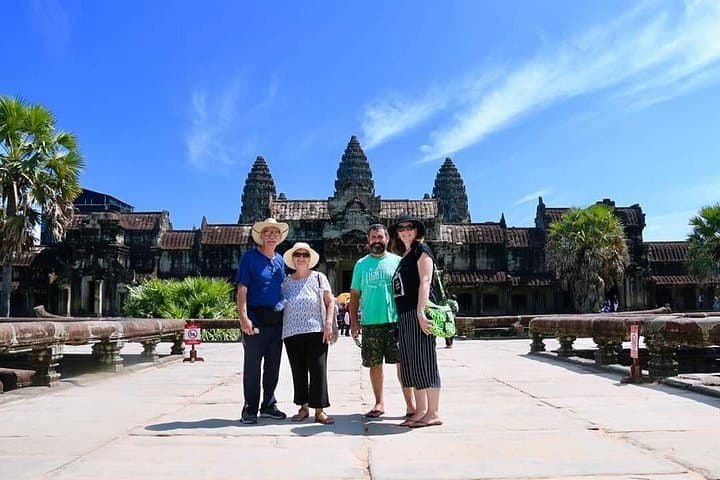


Before dawn the pools outside Angkor Wat hold the sky like a sheet of muted metal, and the temple’s towers loom as dark teeth against a first slice of light. This two-day small-group tour pulls you through that hour of hush, then into the heat and hum of the Grand Circuit — Bayon’s hundred-faced towers, Ta Prohm’s roots clasping stone, and the fine-carved pink sandstone of Banteay Srei.
Before dawn the pools outside Angkor Wat hold the sky like a sheet of muted metal, and the temple’s towers loom as dark teeth against a first slice of light. This two-day small-group tour pulls you through that hour of hush, then into the heat and hum of the Grand Circuit — Bayon’s hundred-faced towers, Ta Prohm’s roots clasping stone, and the fine-carved pink sandstone of Banteay Srei.
These monuments are products of the Khmer Empire (9th–13th centuries), built of laterite and sandstone and aligned with cosmology and irrigation systems that reshaped the plain. Ta Prohm reads like an archaeological novel: trees continue to pry blocks apart while moss and lichen write new textures into the bas-reliefs. The route also skirts artificial barays and island temples that reveal an engineered landscape once designed for ritual and rice irrigation.
Practically: sunrise entry at 4:10–4:30 am means an early start and minimal crowds; sunset options move to Pre Rup or Phnom Bakheng depending on season. Expect uneven stone, steep terraces, and dusty tracks between sites. Entrance fees and temple conservation surcharges are not included, and guide-led explanations make the bas-reliefs come alive.
Bring sun protection, a refillable bottle, and clothes that cover shoulders and knees for respect and access. Pace your walk — water and wet towels are often provided by the operator, but hydration is your responsibility. Move deliberately through the temples: photograph the angles, listen for macaques in the trees, and leave only footprints on pathways that have carried pilgrims for a thousand years.