THE ADVENTURE COLLECTIVE® · Independent discovery and booking for outdoor travel

An 11-day trekking route from Pokhara into the Annapurna Sanctuary, this trek combines high-mountain panoramas, rhododendron forests, and village culture. Ideal in spring and autumn, it balances dramatic alpine scenery with accessible teahouse support.
An 11-day trekking route from Pokhara into the Annapurna Sanctuary, this trek combines high-mountain panoramas, rhododendron forests, and village culture. Ideal in spring and autumn, it balances dramatic alpine scenery with accessible teahouse support.
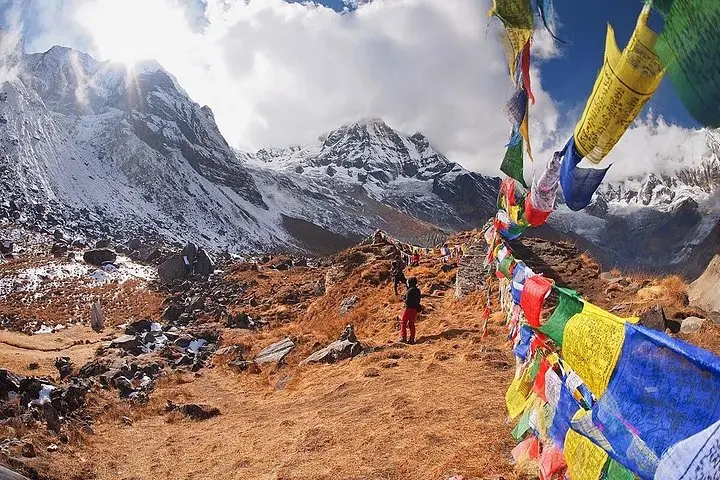
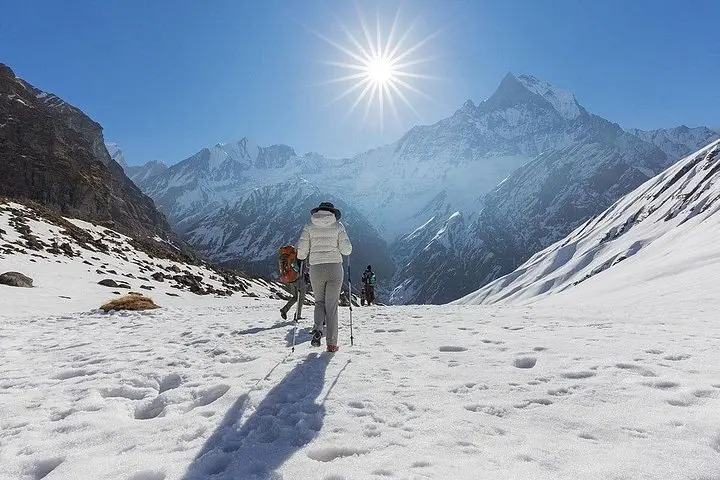
The trail opens on a humming road to Pokhara, then narrows into a river-cut corridor where Modi Khola dares you forward and rhododendron forests press close. By the third day the stone staircases near Ulleri make the legs work and the air thins; by Machhapuchhre Base Camp the peaks appear as a ring of ice that frames the camp like an amphitheater.
Verified experiences and guided adventures in the surrounding area.
Operated by Great Vision Treks & Expedition · Pokhara, Gandaki Province
The trail opens on a humming road to Pokhara, then narrows into a river-cut corridor where Modi Khola dares you forward and rhododendron forests press close. By the third day the stone staircases near Ulleri make the legs work and the air thins; by Machhapuchhre Base Camp the peaks appear as a ring of ice that frames the camp like an amphitheater.
This route runs through the Annapurna Conservation Area, the first protected landscape in Nepal managed with community-based conservation. Geologically the Annapurna massif is part of the young Himalaya—steep uplifted granites and gneiss carved into jagged ridges and glaciated bowls. Culturally the trek passes Gurung and Magar villages where terraces, prayer flags, and teahouse hospitality shape the pace.
Expect varied terrain: river valleys, long stone staircases, steep forested climbs, and open moraine near ABC. Nights are in teahouses and lodges, with basic facilities above 3,000 m. Permit checks (ACAP & TIMS) are routine and guides or porters are commonly hired for comfort and safety.
Practical guidance: acclimatize gradually—Poon Hill (3,210 m) makes a good mid-trek acclimatization point and sunrise there rewards the effort. Start light: pack layers for alpine nights, waterproofs for monsoon season, and a warm sleeping bag for high-altitude teahouses. Hydrate often and watch altitude symptoms—descend if headaches persist. Travel windows: pre-monsoon (spring) and post-monsoon (autumn) offer the most stable weather and clearest views. With steady fitness, basic trekking skills, and respect for mountain weather, the Annapurna Base Camp trek delivers high-altitude views without technical climbing.
Yes. You must have ACAP and TIMS permits; these are typically arranged before or at the start of the trek through your operator.
No technical climbing skills are needed, but trekkers should have prior multi-day hiking experience and be prepared for long uphill days and high altitude.
Independent trekkers can complete the route, but many choose guides or porters for navigation, permit handling, and altitude safety—especially if unfamiliar with the region.
Pre-monsoon (March–May) and post-monsoon (September–November) offer the most stable weather and clearest views; winter is colder and monsoon brings heavy rain.
Great Vision Treks & Expedition operates guided outdoor trips and adventures with an emphasis on safety, stewardship, and memorable experiences.
The trail opens on a humming road to Pokhara, then narrows into a river-cut corridor where Modi Khola dares you forward and rhododendron forests press close. By the third day the stone staircases near Ulleri make the legs work and the air thins; by Machhapuchhre Base Camp the peaks appear as a ring of ice that frames the camp like an amphitheater.
The trail opens on a humming road to Pokhara, then narrows into a river-cut corridor where Modi Khola dares you forward and rhododendron forests press close. By the third day the stone staircases near Ulleri make the legs work and the air thins; by Machhapuchhre Base Camp the peaks appear as a ring of ice that frames the camp like an amphitheater.
This route runs through the Annapurna Conservation Area, the first protected landscape in Nepal managed with community-based conservation. Geologically the Annapurna massif is part of the young Himalaya—steep uplifted granites and gneiss carved into jagged ridges and glaciated bowls. Culturally the trek passes Gurung and Magar villages where terraces, prayer flags, and teahouse hospitality shape the pace.
Expect varied terrain: river valleys, long stone staircases, steep forested climbs, and open moraine near ABC. Nights are in teahouses and lodges, with basic facilities above 3,000 m. Permit checks (ACAP & TIMS) are routine and guides or porters are commonly hired for comfort and safety.
Practical guidance: acclimatize gradually—Poon Hill (3,210 m) makes a good mid-trek acclimatization point and sunrise there rewards the effort. Start light: pack layers for alpine nights, waterproofs for monsoon season, and a warm sleeping bag for high-altitude teahouses. Hydrate often and watch altitude symptoms—descend if headaches persist. Travel windows: pre-monsoon (spring) and post-monsoon (autumn) offer the most stable weather and clearest views. With steady fitness, basic trekking skills, and respect for mountain weather, the Annapurna Base Camp trek delivers high-altitude views without technical climbing.