THE ADVENTURE COLLECTIVE® · Independent discovery and booking for outdoor travel

Walk the classic Annapurna Circuit from river valleys to Thorong La pass, crossing living villages, high pastures and panoramic Himalayan summits. This 15–16 day trek balances acclimatization with sustained mountain days and lodge-based comforts.
Walk the classic Annapurna Circuit from river valleys to Thorong La pass, crossing living villages, high pastures and panoramic Himalayan summits. This 15–16 day trek balances acclimatization with sustained mountain days and lodge-based comforts.
Dawn breaks cold on a stony ridge and the first light scrubs the Annapurna summits bright white; prayer flags snap and the valley exhales below. You begin in terraced foothills and walk through rhododendron-scented forest, cross the braided Kali Gandaki and move up into wind-scoured high pastures where yaks graze like punctuation on the landscape.
Verified experiences and guided adventures in the surrounding area.
Operated by Himalayan Social Journey · Manang, Gandaki Province
Dawn breaks cold on a stony ridge and the first light scrubs the Annapurna summits bright white; prayer flags snap and the valley exhales below. You begin in terraced foothills and walk through rhododendron-scented forest, cross the braided Kali Gandaki and move up into wind-scoured high pastures where yaks graze like punctuation on the landscape.
The route threads centuries of culture and geology: old mule tracks that once carried salt and grain between Mustang and the lowlands, villages where Gurung and Thakali traditions remain visible in carved doorframes and mani stones, and Muktinath – a compact pilgrimage site framed by the cold, yellow face of Dhaulagiri. Geologically the circuit tours deep gorges and dramatic fault lines; Annapurna and Dhaulagiri rise from a narrow band of uplifted rock, shaped by glaciers that still hollow cirques and feed high-altitude lakes.
Expect days of 5–7 hours on varied terrain: dusty jeep tracks, stone staircases, steep scree and narrow ridge walks like the approach to Thorong La (5,416 m). Altitude is the limiting factor, so the itinerary builds acclimatization in Manang and uses gradual gain to reduce risk. Lodges (tea-houses) provide meals and basic rooms; hot water is solar-dependent and electronic charging often costs extra.
Practical essentials: hold valid TIMS/ACAP permits, plan for layered clothing and a warm sleeping bag, drink 3+ liters daily, and allow at least one acclimatization day above 3,000 m. Flights Jomsom–Pokhara shorten return travel but are weather-dependent. With stamina and respect for altitude, the circuit delivers sweeping Himalayan panoramas, living mountain culture and a genuine long-distance trekking experience.
Yes—ACAP and TIMS permits are required for this region; operators normally arrange them before you start but keep copies with you.
The highest point is Thorong La at 5,416 m; altitude sickness risk increases above 3,000 m, so acclimatization days and conservative ascent are essential.
Tea-houses offer basic twin rooms and meals; expect simple beds, shared or outdoor toilets in some places, and limited hot-water availability dependent on solar.
Spring (March–May) and autumn (late September–November) offer the most stable weather and clear views; monsoon months are wet and winter can bring deep snow on passes.
Himalayan Social Journey operates guided outdoor trips and adventures with an emphasis on safety, stewardship, and memorable experiences.
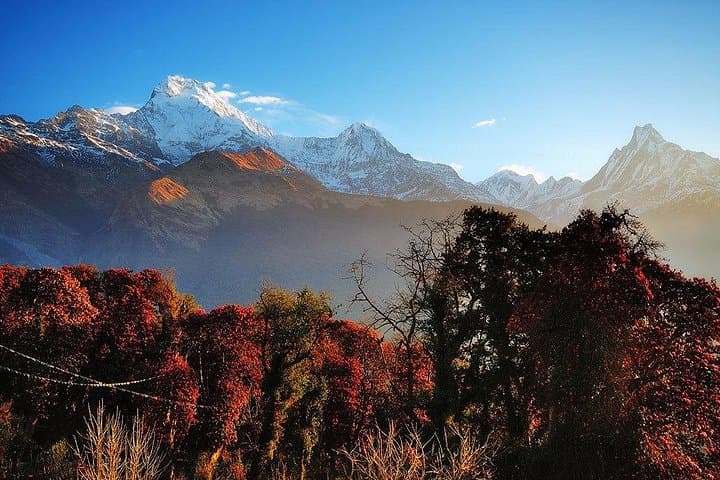


Dawn breaks cold on a stony ridge and the first light scrubs the Annapurna summits bright white; prayer flags snap and the valley exhales below. You begin in terraced foothills and walk through rhododendron-scented forest, cross the braided Kali Gandaki and move up into wind-scoured high pastures where yaks graze like punctuation on the landscape.
Dawn breaks cold on a stony ridge and the first light scrubs the Annapurna summits bright white; prayer flags snap and the valley exhales below. You begin in terraced foothills and walk through rhododendron-scented forest, cross the braided Kali Gandaki and move up into wind-scoured high pastures where yaks graze like punctuation on the landscape.
The route threads centuries of culture and geology: old mule tracks that once carried salt and grain between Mustang and the lowlands, villages where Gurung and Thakali traditions remain visible in carved doorframes and mani stones, and Muktinath – a compact pilgrimage site framed by the cold, yellow face of Dhaulagiri. Geologically the circuit tours deep gorges and dramatic fault lines; Annapurna and Dhaulagiri rise from a narrow band of uplifted rock, shaped by glaciers that still hollow cirques and feed high-altitude lakes.
Expect days of 5–7 hours on varied terrain: dusty jeep tracks, stone staircases, steep scree and narrow ridge walks like the approach to Thorong La (5,416 m). Altitude is the limiting factor, so the itinerary builds acclimatization in Manang and uses gradual gain to reduce risk. Lodges (tea-houses) provide meals and basic rooms; hot water is solar-dependent and electronic charging often costs extra.
Practical essentials: hold valid TIMS/ACAP permits, plan for layered clothing and a warm sleeping bag, drink 3+ liters daily, and allow at least one acclimatization day above 3,000 m. Flights Jomsom–Pokhara shorten return travel but are weather-dependent. With stamina and respect for altitude, the circuit delivers sweeping Himalayan panoramas, living mountain culture and a genuine long-distance trekking experience.