THE ADVENTURE COLLECTIVE® · Independent discovery and booking for outdoor travel

A short, classic teahouse trek in the Annapurna foothills that delivers a Himalayan sunrise from Poon Hill. Expect rhododendron forests, stone staircases, village teahouses and panoramic views of Annapurna and Dhaulagiri.
A short, classic teahouse trek in the Annapurna foothills that delivers a Himalayan sunrise from Poon Hill. Expect rhododendron forests, stone staircases, village teahouses and panoramic views of Annapurna and Dhaulagiri.
A cold, early Himalayan sky splits open as you climb the final switchbacks to Poon Hill. Headlamps wink out; the ridge ahead brightens first with pink light that slides across the serrated crowns of Annapurna and Dhaulagiri. You stand on grass and loose rock at 3,210 m, watching a long mountain chain ignite while valleys below roll in mist.
Verified experiences and guided adventures in the surrounding area.
Operated by Nepal Horizon Treks and Expedition Pvt. Ltd. · Pokhara, Gandaki Province
A cold, early Himalayan sky splits open as you climb the final switchbacks to Poon Hill. Headlamps wink out; the ridge ahead brightens first with pink light that slides across the serrated crowns of Annapurna and Dhaulagiri. You stand on grass and loose rock at 3,210 m, watching a long mountain chain ignite while valleys below roll in mist.
This classic 7–8 day teahouse trek threads rural Nepalese villages, rhododendron and oak forest, and high alpine meadows. Historically a mule and muleteer route between the Annapurna foothills and Western villages, the trail now gives easy access to panoramic geology — sedimentary terraces carved by the Modi and Myagdi rivers and the glacial shoulders of the Annapurna massif. Villages along the way preserve Gurung and Magar culture: terraced fields, prayer flags, and simple teahouses where dal bhat fuels the day.
Expect steady, well-marked stone staircases (not technical climbing) and daily hiking of 3–6 hours between lodges. Key ascents include the Ulleri stair climb and the pre-dawn push to Poon Hill for sunrise. Altitude is the only real variable — the trek tops out above 3,000 m, so pace yourself, hydrate, and respect rest days.
Practical tips: start pre-dawn for summit views, pack a warm hat and headlamp, and choose broken-in boots for stone steps. Guides and porters are widely available and recommended for first-time Himalayan trekkers; permits and TIMS documentation are required. The route is ideal for fit beginners and families seeking a concentrated Himalayan exposure without technical gear.
No — the Ghorepani Poon Hill route is a non-technical teahouse trek on well-marked trails and stone steps; no ropes or crampons required.
Trekkers need Annapurna Conservation Area Permit (ACAP) and a TIMS card; guides or agencies usually arrange these before departure.
The highest point is Poon Hill at about 3,210 m; most trekkers acclimatize well with gradual ascent but monitor for mild AMS symptoms and descend if they worsen.
Teahouses offer simple rooms, shared bathrooms, and hot meals; expect basic bedding and variable heating at higher elevations.
Nepal Horizon Treks and Expedition Pvt. Ltd. operates guided outdoor trips and adventures with an emphasis on safety, stewardship, and memorable experiences.
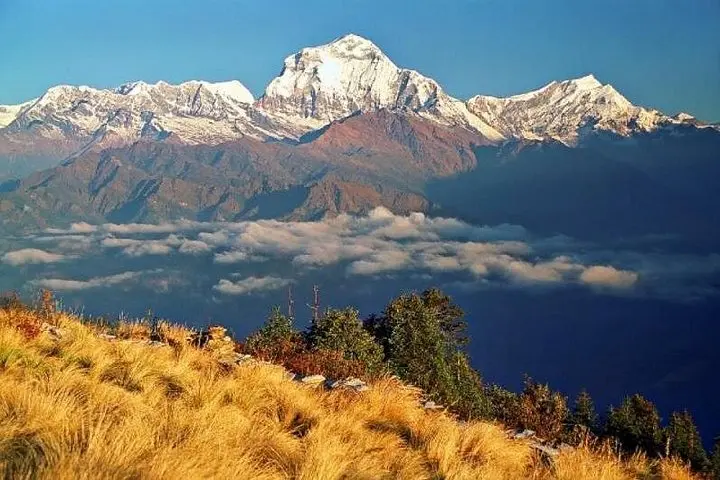

A cold, early Himalayan sky splits open as you climb the final switchbacks to Poon Hill. Headlamps wink out; the ridge ahead brightens first with pink light that slides across the serrated crowns of Annapurna and Dhaulagiri. You stand on grass and loose rock at 3,210 m, watching a long mountain chain ignite while valleys below roll in mist.
A cold, early Himalayan sky splits open as you climb the final switchbacks to Poon Hill. Headlamps wink out; the ridge ahead brightens first with pink light that slides across the serrated crowns of Annapurna and Dhaulagiri. You stand on grass and loose rock at 3,210 m, watching a long mountain chain ignite while valleys below roll in mist.
This classic 7–8 day teahouse trek threads rural Nepalese villages, rhododendron and oak forest, and high alpine meadows. Historically a mule and muleteer route between the Annapurna foothills and Western villages, the trail now gives easy access to panoramic geology — sedimentary terraces carved by the Modi and Myagdi rivers and the glacial shoulders of the Annapurna massif. Villages along the way preserve Gurung and Magar culture: terraced fields, prayer flags, and simple teahouses where dal bhat fuels the day.
Expect steady, well-marked stone staircases (not technical climbing) and daily hiking of 3–6 hours between lodges. Key ascents include the Ulleri stair climb and the pre-dawn push to Poon Hill for sunrise. Altitude is the only real variable — the trek tops out above 3,000 m, so pace yourself, hydrate, and respect rest days.
Practical tips: start pre-dawn for summit views, pack a warm hat and headlamp, and choose broken-in boots for stone steps. Guides and porters are widely available and recommended for first-time Himalayan trekkers; permits and TIMS documentation are required. The route is ideal for fit beginners and families seeking a concentrated Himalayan exposure without technical gear.