THE ADVENTURE COLLECTIVE® · Independent discovery and booking for outdoor travel

Swap Vegas lights for sandstone light wells on a full-day small-group tour to Antelope Canyon, Horseshoe Bend, and Lake Powell. Expect a long travel day, close-up geology, and Navajo-guided interpretation at the slot canyon.
Swap Vegas lights for sandstone light wells on a full-day small-group tour to Antelope Canyon, Horseshoe Bend, and Lake Powell. Expect a long travel day, close-up geology, and Navajo-guided interpretation at the slot canyon.
Morning light pours through a slit in the sandstone and you feel the canyon breathe — cool, stone air that has been carved by water for millennia. On a full-day small-group outing from Las Vegas you trade neon for Navajo land: narrow slot canyons with ribbed walls, a U-shaped river bend that drops away into dizzying red cliffs, and sweeping views over the blue expanse of Lake Powell.
Verified experiences and guided adventures in the surrounding area.
Operated by Hua Li Ying · Page, Arizona
Morning light pours through a slit in the sandstone and you feel the canyon breathe — cool, stone air that has been carved by water for millennia. On a full-day small-group outing from Las Vegas you trade neon for Navajo land: narrow slot canyons with ribbed walls, a U-shaped river bend that drops away into dizzying red cliffs, and sweeping views over the blue expanse of Lake Powell.
Geology here reads like deep time made visible: cross-bedded Navajo Sandstone folded and scoured by flash floods into sinuous shapes and light wells. The Navajo people call this terrain a place shaped by water; local guides add cultural context, explaining traditional relationships to the land and the protocols for visiting areas on Navajo Nation territory.
Expect a long travel day — nearly half the trip is on the road — but the destinations reward the effort. Antelope Canyon (Upper or Lower depending on option) is best seen around midday when shafts of light animate the canyon’s curves. Horseshoe Bend offers a short, exposed walk to a rim viewpoint with a 1,000-foot drop to the Colorado River below. Lake Powell viewpoints give a contrasting, open-water perspective of Glen Canyon’s flooded mesas.
Practicalities: wear sturdy shoes for uneven surfaces and sand, carry layered sun protection, and bring a camera with a wide-angle lens if you want true canyon shots. Be prepared for group logistics, a guided schedule, and Navajo Nation rules — they govern photography, behavior, and where you may walk. Hydrate often and allow time to simply stand and watch the rock shift color as the sun moves.
The tour option you select determines Upper or Lower; operators list the canyon when you book, and both require Navajo-guided entry.
Yes for most, but the day is long and some canyon sections have stairs or tight passages — inform the operator of mobility concerns when booking.
Tripod policies vary by canyon and permit rules; lightweight tripods are sometimes restricted during peak hours — check with your guide on arrival.
This small-group tour typically departs early with a meet point in Las Vegas; the guide will confirm specific pickup details the night before the trip.
Hua Li Ying operates guided outdoor trips and adventures with an emphasis on safety, stewardship, and memorable experiences.

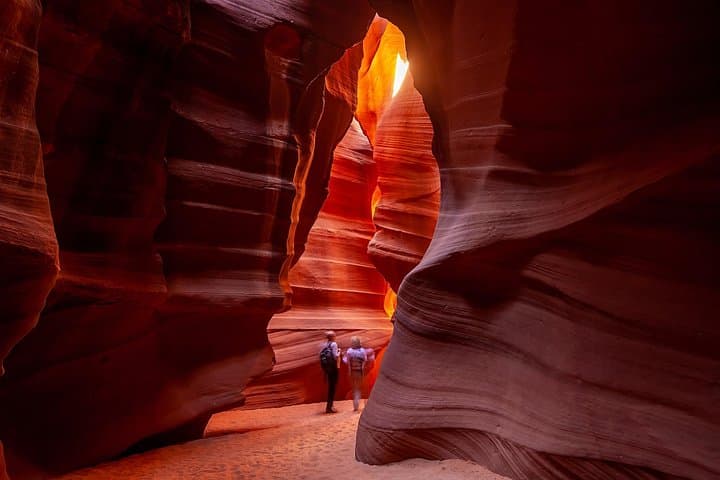


Morning light pours through a slit in the sandstone and you feel the canyon breathe — cool, stone air that has been carved by water for millennia. On a full-day small-group outing from Las Vegas you trade neon for Navajo land: narrow slot canyons with ribbed walls, a U-shaped river bend that drops away into dizzying red cliffs, and sweeping views over the blue expanse of Lake Powell.
Morning light pours through a slit in the sandstone and you feel the canyon breathe — cool, stone air that has been carved by water for millennia. On a full-day small-group outing from Las Vegas you trade neon for Navajo land: narrow slot canyons with ribbed walls, a U-shaped river bend that drops away into dizzying red cliffs, and sweeping views over the blue expanse of Lake Powell.
Geology here reads like deep time made visible: cross-bedded Navajo Sandstone folded and scoured by flash floods into sinuous shapes and light wells. The Navajo people call this terrain a place shaped by water; local guides add cultural context, explaining traditional relationships to the land and the protocols for visiting areas on Navajo Nation territory.
Expect a long travel day — nearly half the trip is on the road — but the destinations reward the effort. Antelope Canyon (Upper or Lower depending on option) is best seen around midday when shafts of light animate the canyon’s curves. Horseshoe Bend offers a short, exposed walk to a rim viewpoint with a 1,000-foot drop to the Colorado River below. Lake Powell viewpoints give a contrasting, open-water perspective of Glen Canyon’s flooded mesas.
Practicalities: wear sturdy shoes for uneven surfaces and sand, carry layered sun protection, and bring a camera with a wide-angle lens if you want true canyon shots. Be prepared for group logistics, a guided schedule, and Navajo Nation rules — they govern photography, behavior, and where you may walk. Hydrate often and allow time to simply stand and watch the rock shift color as the sun moves.