THE ADVENTURE COLLECTIVE® · Independent discovery and booking for outdoor travel

Spend a full day in Ubud harvesting spices, learning Balinese cooking techniques, and visiting the Monkey Forest and Tegenungan Waterfall. This all-inclusive tour mixes market immersion, a local house visit, and hands-on instruction for a practical cultural day.
Spend a full day in Ubud harvesting spices, learning Balinese cooking techniques, and visiting the Monkey Forest and Tegenungan Waterfall. This all-inclusive tour mixes market immersion, a local house visit, and hands-on instruction for a practical cultural day.
Morning light slices through narrow market alleys as the tour begins — vendors call, chilies gleam, and the heady scent of turmeric rises from woven baskets.
Verified experiences and guided adventures in the surrounding area.
Operated by Bali Natural Tours · Ubud, Bali
Morning light slices through narrow market alleys as the tour begins — vendors call, chilies gleam, and the heady scent of turmeric rises from woven baskets.
This full-day experience starts in the west side of Ubud with a traditional market tour (morning class), then moves to a local family compound to learn about Balinese daily life before heading to a small farm where participants harvest spices and prepare an all-inclusive Balinese lunch under a thatched roof.
Along the way you’ll pass through cultural touchpoints: the Ubud Sacred Monkey Forest, where gray macaques move among Hindu shrines, and Tegenungan Waterfall, whose curtain of water has become a popular local landmark. Geologically, this part of central Bali sits on volcanic-rich soils that sustain the spice plots and rice paddies you’ll see; culturally, food preparation here is tied to temple offerings and household ritual.
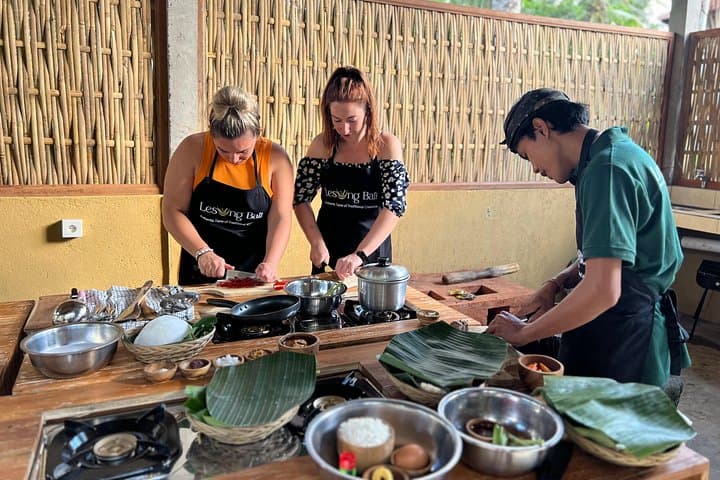
The cooking session covers traditional techniques — pounding spices in a lesung (mortar and pestle), wrapping pepes ikan in banana leaf, and building sambal matah — with vegetarian and vegan options available.
Practical notes: the day is largely low-impact walking on uneven surfaces (market lanes, farm paths, and stone steps near the waterfall). Expect heat and humidity, some short drives by private air-conditioned vehicle, and entrance fees and bottled water included. Wear closed-toe shoes for the waterfall, carry small change for market purchases, and flag dietary needs in advance.
This blend of hands-on cooking, market immersion, and short nature stops gives a grounded snapshot of Ubud’s food culture and countryside rhythm.
Yes — pick up and drop off are provided across many Bali areas (Ubud, Kuta, Seminyak, Sanur, Nusa Dua, Jimbaran, Canggu and Legian).
Yes — vegetarian and vegan options are available; indicate allergies or dietary needs at booking so the chef can prepare alternatives.
Expect short stretches of light walking in the market, a few uneven farm paths, and steps near the waterfall; the day is not strenuous but requires basic mobility.
Children can participate but check age policies at booking; young children may find the market busy and the Monkey Forest unpredictable around macaques.
Bali Natural Tours operates guided outdoor trips and adventures with an emphasis on safety, stewardship, and memorable experiences.
Morning light slices through narrow market alleys as the tour begins — vendors call, chilies gleam, and the heady scent of turmeric rises from woven baskets.
Morning light slices through narrow market alleys as the tour begins — vendors call, chilies gleam, and the heady scent of turmeric rises from woven baskets.
This full-day experience starts in the west side of Ubud with a traditional market tour (morning class), then moves to a local family compound to learn about Balinese daily life before heading to a small farm where participants harvest spices and prepare an all-inclusive Balinese lunch under a thatched roof.
Along the way you’ll pass through cultural touchpoints: the Ubud Sacred Monkey Forest, where gray macaques move among Hindu shrines, and Tegenungan Waterfall, whose curtain of water has become a popular local landmark. Geologically, this part of central Bali sits on volcanic-rich soils that sustain the spice plots and rice paddies you’ll see; culturally, food preparation here is tied to temple offerings and household ritual.
The cooking session covers traditional techniques — pounding spices in a lesung (mortar and pestle), wrapping pepes ikan in banana leaf, and building sambal matah — with vegetarian and vegan options available.
Practical notes: the day is largely low-impact walking on uneven surfaces (market lanes, farm paths, and stone steps near the waterfall). Expect heat and humidity, some short drives by private air-conditioned vehicle, and entrance fees and bottled water included. Wear closed-toe shoes for the waterfall, carry small change for market purchases, and flag dietary needs in advance.
This blend of hands-on cooking, market immersion, and short nature stops gives a grounded snapshot of Ubud’s food culture and countryside rhythm.