THE ADVENTURE COLLECTIVE® · Independent discovery and booking for outdoor travel

A compact, private two-day loop from Bahir Dar that pairs boat visits to Lake Tana’s historic island monasteries with the thunder and spray of the Blue Nile Falls. Ideal for travelers who want cultural depth and nature in a short, accessible trip.
A compact, private two-day loop from Bahir Dar that pairs boat visits to Lake Tana’s historic island monasteries with the thunder and spray of the Blue Nile Falls. Ideal for travelers who want cultural depth and nature in a short, accessible trip.
Morning light slides across Lake Tana and the boat's bow parts a slow, dark surface; monasteries appear as low stony dots, their ochre walls pierced by painted windows. On this two-day private tour, travelers move between calm water, frescoed chapels and the roar of Tissisat — the Blue Nile Falls — where spray dares the sky to hold its color.
Verified experiences and guided adventures in the surrounding area.
Operated by Ethio Target Tours · Bahir Dar, Amhara
Morning light slides across Lake Tana and the boat's bow parts a slow, dark surface; monasteries appear as low stony dots, their ochre walls pierced by painted windows. On this two-day private tour, travelers move between calm water, frescoed chapels and the roar of Tissisat — the Blue Nile Falls — where spray dares the sky to hold its color.
Lake Tana holds thirty-plus island monasteries whose churches preserve liturgical art from the 16th–18th centuries. Ura Kidane Mihret is the stand-out: its icons and painted panels are a living archive of Ethiopian Orthodox devotion. Geologically, the falls trace the Blue Nile’s descent from the Ethiopian Highlands, carving gorges and feeding rich riparian zones that support hippos and riverine birds.
Culturally, the trip is as much about small-scale hospitality and market trade as it is about sights; Bahir Dar’s market and the Hilesilase palace viewpoint give quick windows into local life and history.
Practical guidance: boats are open-sided; sun and spray are constant companions. Modest dress and quiet respect are required at monasteries. The walk to the Blue Nile Falls is roughly a 1-hour round-trip on uneven trails with stone steps and river mud — bring sturdy shoes and a light rain layer. Carry cash for small admissions, tips and market purchases; cell reception can be intermittent.
Timing matters: water flow swells during the rainy months, while the dry season shows more exposed basalt and clearer walking. With private transport and an experienced guide, this short itinerary balances cultural depth and natural spectacle without demanding technical skills.
The footpath to Tissisat is uneven with stone steps and some muddy sections; it’s short (about 1 hour round-trip) and suitable for most people who can handle moderate uneven terrain.
Photography rules vary between islands and churches; modest dress is required and guides will advise which interiors allow photos.
Boats are commonly used and operators provide life jackets, but infants are typically required to sit on laps and supervision is essential; bring motion-sickness measures if needed.
The falls are most dramatic during and shortly after the rainy season (June–September); dry months reveal more exposed rock and easier walking paths.
Ethio Target Tours operates guided outdoor trips and adventures with an emphasis on safety, stewardship, and memorable experiences.
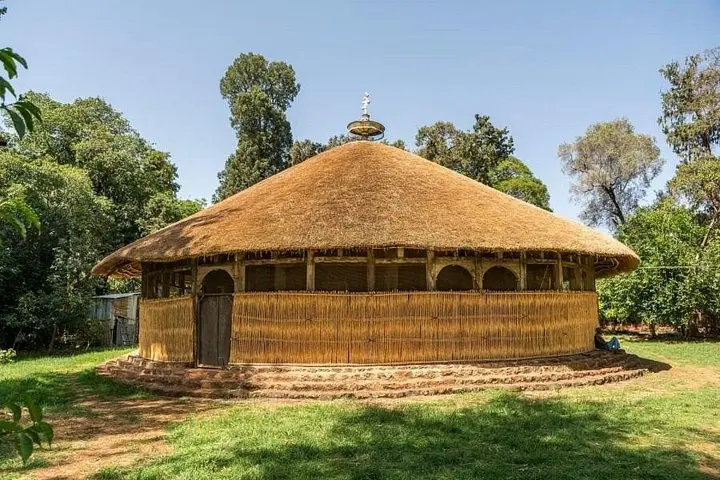



Morning light slides across Lake Tana and the boat's bow parts a slow, dark surface; monasteries appear as low stony dots, their ochre walls pierced by painted windows. On this two-day private tour, travelers move between calm water, frescoed chapels and the roar of Tissisat — the Blue Nile Falls — where spray dares the sky to hold its color.
Morning light slides across Lake Tana and the boat's bow parts a slow, dark surface; monasteries appear as low stony dots, their ochre walls pierced by painted windows. On this two-day private tour, travelers move between calm water, frescoed chapels and the roar of Tissisat — the Blue Nile Falls — where spray dares the sky to hold its color.
Lake Tana holds thirty-plus island monasteries whose churches preserve liturgical art from the 16th–18th centuries. Ura Kidane Mihret is the stand-out: its icons and painted panels are a living archive of Ethiopian Orthodox devotion. Geologically, the falls trace the Blue Nile’s descent from the Ethiopian Highlands, carving gorges and feeding rich riparian zones that support hippos and riverine birds.
Culturally, the trip is as much about small-scale hospitality and market trade as it is about sights; Bahir Dar’s market and the Hilesilase palace viewpoint give quick windows into local life and history.
Practical guidance: boats are open-sided; sun and spray are constant companions. Modest dress and quiet respect are required at monasteries. The walk to the Blue Nile Falls is roughly a 1-hour round-trip on uneven trails with stone steps and river mud — bring sturdy shoes and a light rain layer. Carry cash for small admissions, tips and market purchases; cell reception can be intermittent.
Timing matters: water flow swells during the rainy months, while the dry season shows more exposed basalt and clearer walking. With private transport and an experienced guide, this short itinerary balances cultural depth and natural spectacle without demanding technical skills.