THE ADVENTURE COLLECTIVE® · Independent discovery and booking for outdoor travel

Walk El Prado with a local guide on a two-hour historical tour of Balboa Park. See Spanish Colonial Revival architecture, the Spreckels Organ Pavilion, and serene gardens while learning the park’s exposition-era history and local cultural threads.
Walk El Prado with a local guide on a two-hour historical tour of Balboa Park. See Spanish Colonial Revival architecture, the Spreckels Organ Pavilion, and serene gardens while learning the park’s exposition-era history and local cultural threads.
Stand beneath the wide arches of El Prado and you feel the city slow — fountains chime, tile roofs throw patterned light, and the promenade unspools toward museums and gardens. This two-hour guided walk moves at an easy pace, guiding visitors past the California Tower, the Spreckels Organ Pavilion, and the Moreton Bay fig whose limbs seem to hold decades of park life.
Verified experiences and guided adventures in the surrounding area.
Operated by Another Side Of San Diego Tours · San Diego, California
Stand beneath the wide arches of El Prado and you feel the city slow — fountains chime, tile roofs throw patterned light, and the promenade unspools toward museums and gardens. This two-hour guided walk moves at an easy pace, guiding visitors past the California Tower, the Spreckels Organ Pavilion, and the Moreton Bay fig whose limbs seem to hold decades of park life.
Balboa Park grew from the 1915 Panama–California Exposition and evolved into America’s largest urban cultural park. The park sits on an uplifted coastal mesa of ancient marine terraces; clay and sandstone underlie the planted terraces and cactus beds, explaining why drought-tolerant species dominate the Desert Garden. Culture here is outward-facing — theaters, art studios in the Spanish Village, and museums that document regional, indigenous, and maritime history.
On a walking tour you’ll get concise context: architectural notes on Spanish Colonial Revival buildings, the organ’s weekly public concerts, and small stories about the park’s restoration after mid-century neglect. Guides point out less obvious details — tile makers’ signatures, the footprint of the original exposition, and where local students practice theater tech.
Practicalities: tours begin at the Visitors Center courtyard at El Prado, last about two hours, and are wheelchair accessible. Museum admissions aren’t included, so plan extra time if you want to enter the Museum of Us or the San Diego Museum of Art. Wear comfortable shoes for paved walkways, carry water (the walk includes short stops), and start in the morning or late afternoon to avoid midday heat and catch the warm light on the California Tower.
The tour is approximately two hours and starts at the El Prado Building courtyard at Balboa Park’s Visitors Center fountain.
No; admissions to attractions along the route are not included, though guides often recommend which to visit afterward.
Yes — the route uses paved walkways and is listed as wheelchair and stroller accessible, though some garden areas have steps.
Yes — the tour is family-friendly and suitable for most ages; strollers are allowed and snacks/water are provided.
Another Side Of San Diego Tours operates guided outdoor trips and adventures with an emphasis on safety, stewardship, and memorable experiences.
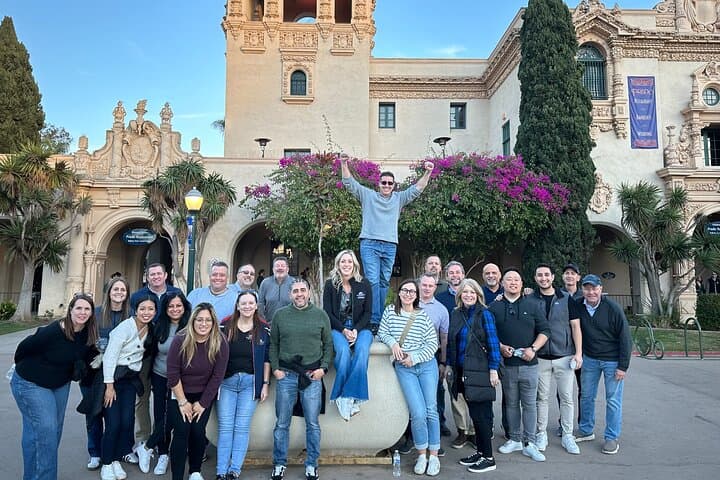


Stand beneath the wide arches of El Prado and you feel the city slow — fountains chime, tile roofs throw patterned light, and the promenade unspools toward museums and gardens. This two-hour guided walk moves at an easy pace, guiding visitors past the California Tower, the Spreckels Organ Pavilion, and the Moreton Bay fig whose limbs seem to hold decades of park life.
Stand beneath the wide arches of El Prado and you feel the city slow — fountains chime, tile roofs throw patterned light, and the promenade unspools toward museums and gardens. This two-hour guided walk moves at an easy pace, guiding visitors past the California Tower, the Spreckels Organ Pavilion, and the Moreton Bay fig whose limbs seem to hold decades of park life.
Balboa Park grew from the 1915 Panama–California Exposition and evolved into America’s largest urban cultural park. The park sits on an uplifted coastal mesa of ancient marine terraces; clay and sandstone underlie the planted terraces and cactus beds, explaining why drought-tolerant species dominate the Desert Garden. Culture here is outward-facing — theaters, art studios in the Spanish Village, and museums that document regional, indigenous, and maritime history.
On a walking tour you’ll get concise context: architectural notes on Spanish Colonial Revival buildings, the organ’s weekly public concerts, and small stories about the park’s restoration after mid-century neglect. Guides point out less obvious details — tile makers’ signatures, the footprint of the original exposition, and where local students practice theater tech.
Practicalities: tours begin at the Visitors Center courtyard at El Prado, last about two hours, and are wheelchair accessible. Museum admissions aren’t included, so plan extra time if you want to enter the Museum of Us or the San Diego Museum of Art. Wear comfortable shoes for paved walkways, carry water (the walk includes short stops), and start in the morning or late afternoon to avoid midday heat and catch the warm light on the California Tower.