THE ADVENTURE COLLECTIVE® · Independent discovery and booking for outdoor travel

Pair a private, local-led walking tour of Bath’s Georgian center with a hands-on falconry session in the surrounding countryside. Spend the morning on the city’s history and architecture, then fly a hawk on a short field walk at a small rescue falconry.
Pair a private, local-led walking tour of Bath’s Georgian center with a hands-on falconry session in the surrounding countryside. Spend the morning on the city’s history and architecture, then fly a hawk on a short field walk at a small rescue falconry.
You start on a compact lane above the city, the morning light stripping the Roman stone of its damp grey and turning it a pale, warm ochre. From the viewpoint your guide — born and raised in Bath — traces the curve of the River Avon as if sketching the city's life: the compact ring of Georgian crescents, the towers of the Abbey, and the low ridge where hot water still pushes from the ground. The city's history is immediate here; the Romans dug these springs for a reason, and the local stone that built Pulteney Bridge feels like a story in your hands.
Verified experiences and guided adventures in the surrounding area.
Operated by Bath Insider Tours · Bath, Somerset
You start on a compact lane above the city, the morning light stripping the Roman stone of its damp grey and turning it a pale, warm ochre. From the viewpoint your guide — born and raised in Bath — traces the curve of the River Avon as if sketching the city's life: the compact ring of Georgian crescents, the towers of the Abbey, and the low ridge where hot water still pushes from the ground. The city's history is immediate here; the Romans dug these springs for a reason, and the local stone that built Pulteney Bridge feels like a story in your hands.
The first half of the day is a close, human-scale tour: about 2 miles (3–4 km) of mostly paved walking with gentle rises (roughly 30–50 m of elevation gain). You pass the Circus and Royal Crescent, hear the practical gossip of Bath's 18th-century builders, and get a clear account of how thermal springs shaped civic life — public bathing, spa culture, and the income that made the city fashionable across two centuries. Your guide points out Jane Austen's haunts and explains why the Roman Baths remain the town's origin story even if you don’t enter the museum.
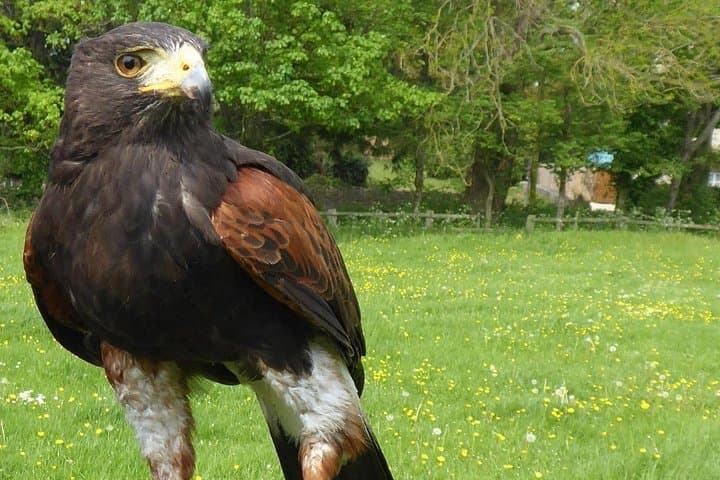
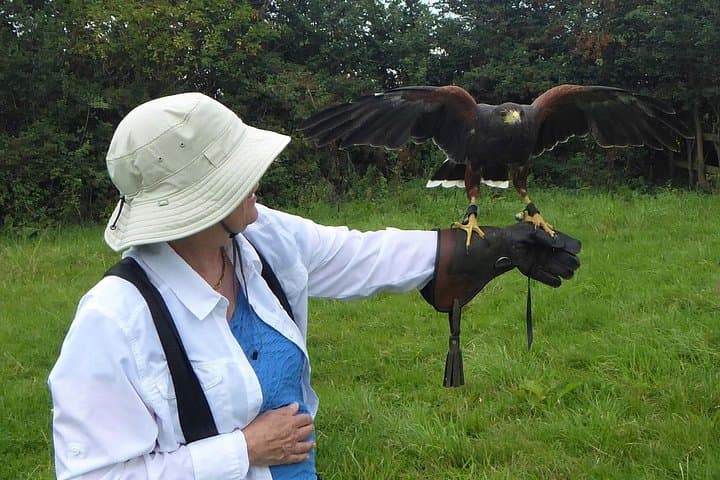
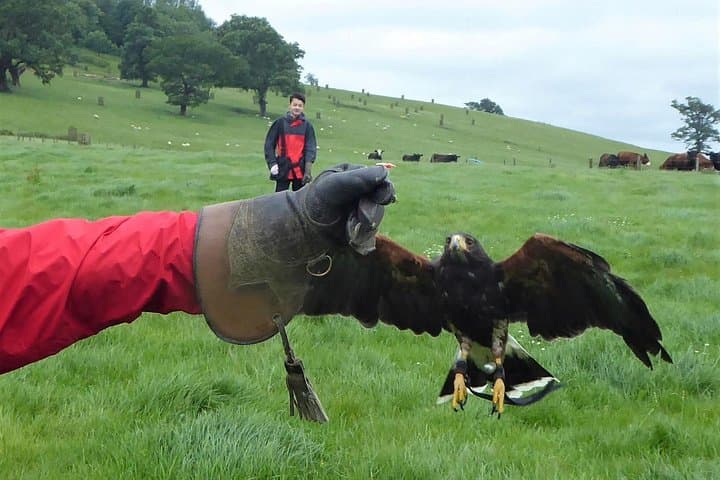
After a pub lunch you leave the city center and drive into the soft, rolling countryside that surrounds Bath. The landscape changes from cobbled streets to pasture; fields become an open theater for birds of prey. The falconry is a small nonprofit devoted to rescue and education. Falconry here combines an ancient craft — training hawks and owls to respond to a human partner — with modern conservation work. On a short 1 km field walk the hawk becomes physical proof that the wild still answers good stewardship: wings beat, talons find the glove, and the bird returns when called.
Practical matters are straightforward. The combined experience runs about 7 hours total; it’s private, capped at four people, and suitable for most fitness levels. Wear sturdy walking shoes for fields and a light waterproof in case the English weather turns. Children under eight cannot fly hawks; in poor weather the operator will offer an indoor owl session. Book ahead for morning departures to avoid crowds in Bath and to catch the hawks at their most responsive.
Expect hands-on learning, photo opportunities, and a day that pairs cultural context with an active, tactile wildlife encounter. It’s a single-day package that pairs the city’s architectural clarity with countryside motion — and gives you the rare satisfaction of letting a hawk fly from your glove back into the wild.
Children under 8 cannot fly hawks; older children can participate under adult supervision, but confirm ages when booking.
If conditions are unsuitable for hawk flying outdoors you will be offered an indoor owl session or a rescheduled slot subject to availability.
Yes — hotel pickup and drop-off within Bath is included; provide your hotel details when booking.
No prior experience required; a trained falconer will instruct and assist throughout the session.
Expect about 2 miles (3–4 km) in the city on paved surfaces and roughly 1 km across fields during the falconry portion.
No — the walking tour covers external viewpoints and history; entry to the Roman Baths or Thermae Bath Spa is not included.
Bath Insider Tours operates guided outdoor trips and adventures with an emphasis on safety, stewardship, and memorable experiences.

You start on a compact lane above the city, the morning light stripping the Roman stone of its damp grey and turning it a pale, warm ochre. From the viewpoint your guide — born and raised in Bath — traces the curve of the River Avon as if sketching the city's life: the compact ring of Georgian crescents, the towers of the Abbey, and the low ridge where hot water still pushes from the ground. The city's history is immediate here; the Romans dug these springs for a reason, and the local stone that built Pulteney Bridge feels like a story in your hands.
You start on a compact lane above the city, the morning light stripping the Roman stone of its damp grey and turning it a pale, warm ochre. From the viewpoint your guide — born and raised in Bath — traces the curve of the River Avon as if sketching the city's life: the compact ring of Georgian crescents, the towers of the Abbey, and the low ridge where hot water still pushes from the ground. The city's history is immediate here; the Romans dug these springs for a reason, and the local stone that built Pulteney Bridge feels like a story in your hands.
The first half of the day is a close, human-scale tour: about 2 miles (3–4 km) of mostly paved walking with gentle rises (roughly 30–50 m of elevation gain). You pass the Circus and Royal Crescent, hear the practical gossip of Bath's 18th-century builders, and get a clear account of how thermal springs shaped civic life — public bathing, spa culture, and the income that made the city fashionable across two centuries. Your guide points out Jane Austen's haunts and explains why the Roman Baths remain the town's origin story even if you don’t enter the museum.
After a pub lunch you leave the city center and drive into the soft, rolling countryside that surrounds Bath. The landscape changes from cobbled streets to pasture; fields become an open theater for birds of prey. The falconry is a small nonprofit devoted to rescue and education. Falconry here combines an ancient craft — training hawks and owls to respond to a human partner — with modern conservation work. On a short 1 km field walk the hawk becomes physical proof that the wild still answers good stewardship: wings beat, talons find the glove, and the bird returns when called.
Practical matters are straightforward. The combined experience runs about 7 hours total; it’s private, capped at four people, and suitable for most fitness levels. Wear sturdy walking shoes for fields and a light waterproof in case the English weather turns. Children under eight cannot fly hawks; in poor weather the operator will offer an indoor owl session. Book ahead for morning departures to avoid crowds in Bath and to catch the hawks at their most responsive.
Expect hands-on learning, photo opportunities, and a day that pairs cultural context with an active, tactile wildlife encounter. It’s a single-day package that pairs the city’s architectural clarity with countryside motion — and gives you the rare satisfaction of letting a hawk fly from your glove back into the wild.