THE ADVENTURE COLLECTIVE® · Independent discovery and booking for outdoor travel

Learn Khmer cooking in a local Battambang home after sourcing fresh ingredients at a bustling market. This hands‑on class pairs cultural context with practical technique—ideal for travelers who like to eat what they make.
Learn Khmer cooking in a local Battambang home after sourcing fresh ingredients at a bustling market. This hands‑on class pairs cultural context with practical technique—ideal for travelers who like to eat what they make.
You step out of a tuk‑tuk into the pulsing heart of Battambang’s market: crushed ice clinks, chilies gleam, and sellers call out herbs you’ll soon learn to fold into a curry. The market is a primer—the smells teach you what Khmer cooking values: freshness, contrast, and balance.
Verified experiences and guided adventures in the surrounding area.
Operated by Angkor Guide Adventure · Battambang, Battambang Province
You step out of a tuk‑tuk into the pulsing heart of Battambang’s market: crushed ice clinks, chilies gleam, and sellers call out herbs you’ll soon learn to fold into a curry. The market is a primer—the smells teach you what Khmer cooking values: freshness, contrast, and balance.
Battambang is Cambodia’s rice bowl, a provincial city shaped by riverine plains and French colonial streets. The ingredients you’ll pick—tumeric, kaffir lime, fish sauce—come from lowland farms fed by the Sangke River; nearby ancient temples and Cambodian wartime history give the region a quietly layered cultural backdrop.
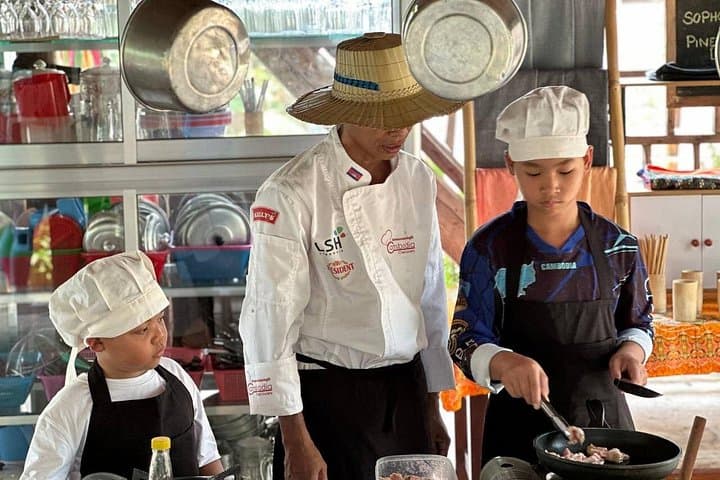
In a local home your instructor will guide you through two savory dishes and a sweet dessert, explaining technique as much as taste: how to toast spices, when to add lime for brightness, and how heat alters textures. The class mixes communal rhythm with practical steps so even a first‑timer leaves confident to recreate these recipes.
Practical notes: arrive with sensible shoes for uneven market alleys, pack a small daypack for purchases, and notify hosts of dietary needs in advance. Classes typically include pick‑up/drop‑off by tuk‑tuk and last 2–4 hours; vegetarian options are available. Bring a reusable bag for market finds and a willingness to get hands‑on—expect chopping, pounding, and tasting.
This experience suits travelers who want cultural immersion with tangible skills: you won’t just eat Battambang, you’ll learn to make it.
Yes—most classes can offer vegetarian versions if you indicate dietary preferences when booking.
No—classes are designed for beginners and focus on hands‑on learning with step‑by‑step guidance.
Yes—tuk‑tuk pickup and drop‑off are usually included; confirm your pickup point at booking.
Market aisles can be narrow but the operator notes accessibility; many parts are stroller and wheelchair accessible, though visitors should expect some uneven paving.
Angkor Guide Adventure operates guided outdoor trips and adventures with an emphasis on safety, stewardship, and memorable experiences.


You step out of a tuk‑tuk into the pulsing heart of Battambang’s market: crushed ice clinks, chilies gleam, and sellers call out herbs you’ll soon learn to fold into a curry. The market is a primer—the smells teach you what Khmer cooking values: freshness, contrast, and balance.
You step out of a tuk‑tuk into the pulsing heart of Battambang’s market: crushed ice clinks, chilies gleam, and sellers call out herbs you’ll soon learn to fold into a curry. The market is a primer—the smells teach you what Khmer cooking values: freshness, contrast, and balance.
Battambang is Cambodia’s rice bowl, a provincial city shaped by riverine plains and French colonial streets. The ingredients you’ll pick—tumeric, kaffir lime, fish sauce—come from lowland farms fed by the Sangke River; nearby ancient temples and Cambodian wartime history give the region a quietly layered cultural backdrop.
In a local home your instructor will guide you through two savory dishes and a sweet dessert, explaining technique as much as taste: how to toast spices, when to add lime for brightness, and how heat alters textures. The class mixes communal rhythm with practical steps so even a first‑timer leaves confident to recreate these recipes.
Practical notes: arrive with sensible shoes for uneven market alleys, pack a small daypack for purchases, and notify hosts of dietary needs in advance. Classes typically include pick‑up/drop‑off by tuk‑tuk and last 2–4 hours; vegetarian options are available. Bring a reusable bag for market finds and a willingness to get hands‑on—expect chopping, pounding, and tasting.
This experience suits travelers who want cultural immersion with tangible skills: you won’t just eat Battambang, you’ll learn to make it.