THE ADVENTURE COLLECTIVE® · Independent discovery and booking for outdoor travel

Experience Battambang’s rural curiosities on a private day trip: ride the improvised bamboo train, watch a bat exodus at Phnum Sampov, and explore the hilltop Banan temple. This off‑beaten track tour blends village life, history, and dramatic natural spectacle.
Experience Battambang’s rural curiosities on a private day trip: ride the improvised bamboo train, watch a bat exodus at Phnum Sampov, and explore the hilltop Banan temple. This off‑beaten track tour blends village life, history, and dramatic natural spectacle.
You arrive before dawn on a quiet country road; rice paddies lie like low, wet mirrors and the single-track railway cuts a straight line through villages. The day in Battambang begins with the odd rattle of a bamboo cart—local ingenuity riding on French-era iron—as you move away from the city toward Phnum Sampov and Banan temple.
Verified experiences and guided adventures in the surrounding area.
Operated by ANGKOR CAB-OFF BEATEN TRUCK · Battambang, Battambang Province
You arrive before dawn on a quiet country road; rice paddies lie like low, wet mirrors and the single-track railway cuts a straight line through villages. The day in Battambang begins with the odd rattle of a bamboo cart—local ingenuity riding on French-era iron—as you move away from the city toward Phnum Sampov and Banan temple.
This route maps layers of history: a colonial railway repurposed by farmers, an 11th-century Khmer temple high on a laterite hill, and the darker traces of the 1975–79 Khmer Rouge era at the Killing Caves. Geologically, the limestone outcrops around Phnum Sampov host caves and bat roosts shaped by centuries of solutional erosion; the caves become a living curtain at dusk when millions of bats stream out in search of food.
The experience mixes quiet village life with abrupt theatrical moments—the jolt of the bamboo train, the hush before bats pour skyward, the climb to small hilltop pagodas that frame rice-field panoramas. Local culture shows in roadside markets selling bamboo sticky rice and in the French colonial storefronts along the Sangke River.
Practical side: this is a long day (expect about 10 hours including drive time) with light walking, some stairs at Banan and Phnum Sampov, and uneven paths. Bring sun protection, insect repellent, sturdy shoes, and enough water. Timing matters—arrive at Phnum Sampov early to secure a good bat-viewing spot and plan transit with your guide to avoid the midday heat. Respect temple rules and avoid flash photography at the bat cave to minimize disturbance.
If departing Siem Reap expect roughly a 2.5–3 hour drive to Battambang depending on traffic and stops; the tour is often organized as a long day trip.
The bamboo carts are locally operated and popular with visitors; they travel at low speeds and guides coordinate loading and passing—standard caution and listening to operators keeps it safe.
Bat emergence is regular, but numbers and timing vary with season and weather—arrive early and follow local guidance for the best chance to witness the spectacle.
There are basic restroom facilities near major sites and several roadside vendors offering snacks and local food; bring snacks if you prefer specific dietary options.
ANGKOR CAB-OFF BEATEN TRUCK operates guided outdoor trips and adventures with an emphasis on safety, stewardship, and memorable experiences.
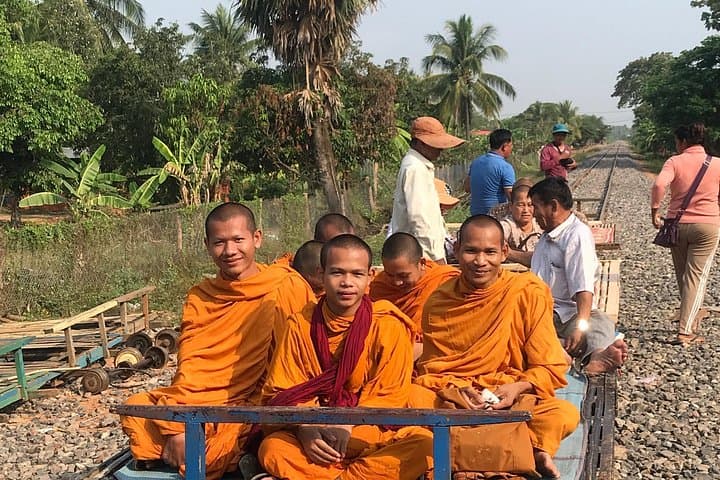


You arrive before dawn on a quiet country road; rice paddies lie like low, wet mirrors and the single-track railway cuts a straight line through villages. The day in Battambang begins with the odd rattle of a bamboo cart—local ingenuity riding on French-era iron—as you move away from the city toward Phnum Sampov and Banan temple.
You arrive before dawn on a quiet country road; rice paddies lie like low, wet mirrors and the single-track railway cuts a straight line through villages. The day in Battambang begins with the odd rattle of a bamboo cart—local ingenuity riding on French-era iron—as you move away from the city toward Phnum Sampov and Banan temple.
This route maps layers of history: a colonial railway repurposed by farmers, an 11th-century Khmer temple high on a laterite hill, and the darker traces of the 1975–79 Khmer Rouge era at the Killing Caves. Geologically, the limestone outcrops around Phnum Sampov host caves and bat roosts shaped by centuries of solutional erosion; the caves become a living curtain at dusk when millions of bats stream out in search of food.
The experience mixes quiet village life with abrupt theatrical moments—the jolt of the bamboo train, the hush before bats pour skyward, the climb to small hilltop pagodas that frame rice-field panoramas. Local culture shows in roadside markets selling bamboo sticky rice and in the French colonial storefronts along the Sangke River.
Practical side: this is a long day (expect about 10 hours including drive time) with light walking, some stairs at Banan and Phnum Sampov, and uneven paths. Bring sun protection, insect repellent, sturdy shoes, and enough water. Timing matters—arrive at Phnum Sampov early to secure a good bat-viewing spot and plan transit with your guide to avoid the midday heat. Respect temple rules and avoid flash photography at the bat cave to minimize disturbance.