THE ADVENTURE COLLECTIVE® · Independent discovery and booking for outdoor travel
Travel by bullet train from Beijing to Harbin for a concentrated winter experience: the colossal ice sculptures of Ice and Snow World, Russian-influenced architecture on Central Street, and the Songhua River’s frosty banks. Fast travel and short transfers let you see the highlights in two organized days.
Travel by bullet train from Beijing to Harbin for a concentrated winter experience: the colossal ice sculptures of Ice and Snow World, Russian-influenced architecture on Central Street, and the Songhua River’s frosty banks. Fast travel and short transfers let you see the highlights in two organized days.
On a crisp winter morning the high-speed train skims across northeastern plains, carrying travelers from Beijing’s urban hum toward Harbin’s frosted skyline. Arrival here feels cinematic: towers of carved ice catch artificial light, the Songhua River runs slow and cold, and St. Sophia Cathedral’s green dome stands like a foreign note in a northern Chinese city.
Verified experiences and guided adventures in the surrounding area.
Operated by Beijing Meitu Travel Agency Co., Ltd. · Harbin, Heilongjiang
On a crisp winter morning the high-speed train skims across northeastern plains, carrying travelers from Beijing’s urban hum toward Harbin’s frosted skyline. Arrival here feels cinematic: towers of carved ice catch artificial light, the Songhua River runs slow and cold, and St. Sophia Cathedral’s green dome stands like a foreign note in a northern Chinese city.
Harbin grew into a crossroads during the late 19th–early 20th century, shaped by Russian engineers, the Chinese Eastern Railway and waves of migrants; that history is readable in Central Street’s European façades and the Byzantine lines of St. Sophia. Geologically the region sits on flat river plains that freeze solid each winter, producing reliable ice for large-scale sculpture and seasonal architecture.
On this two-day itinerary travelers spend an afternoon in Harbin Ice and Snow World — a sprawling festival of illuminated ice architecture — and follow the next morning with a walking tour of Central Street, the Flood Control Memorial Tower and St. Sophia before returning by bullet train. Expect cold, sustained walking on packed snow and short transfers by private car between station and sites.
Practical edge: pack insulated boots with good traction, breathable base layers, and a windproof outer shell; plan for train travel of roughly five hours each way and allow extra time for luggage screening. Aim for daytime visits when sculptures are sunlit and evenings when colors are switched on. Bring a camera with spare batteries (cold drains power) and leave single-use plastics behind to reduce festival waste.
The high-speed ride between Beijing and Harbin is roughly 4.5–5 hours each way depending on the scheduled G-series service; expect a full travel day with transfers.
Yes—temperatures in Harbin during festival season commonly drop below freezing; insulating layers, gloves, hat and waterproof boots are recommended.
This itinerary includes admission to listed Harbin attractions and Ice and Snow World, plus round-trip bullet train tickets and local transfers as described.
The program is rated easy but involves walking outdoors on icy surfaces; families and visitors with limited mobility should request assistance in advance and use traction aids.
Beijing Meitu Travel Agency Co., Ltd. operates guided outdoor trips and adventures with an emphasis on safety, stewardship, and memorable experiences.


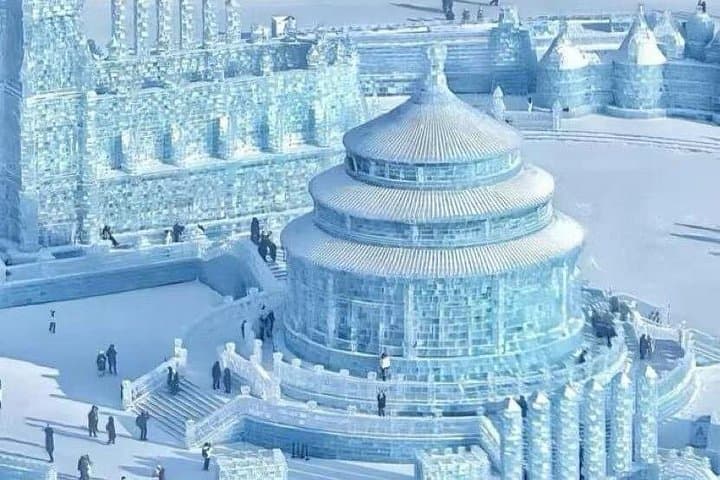

On a crisp winter morning the high-speed train skims across northeastern plains, carrying travelers from Beijing’s urban hum toward Harbin’s frosted skyline. Arrival here feels cinematic: towers of carved ice catch artificial light, the Songhua River runs slow and cold, and St. Sophia Cathedral’s green dome stands like a foreign note in a northern Chinese city.
On a crisp winter morning the high-speed train skims across northeastern plains, carrying travelers from Beijing’s urban hum toward Harbin’s frosted skyline. Arrival here feels cinematic: towers of carved ice catch artificial light, the Songhua River runs slow and cold, and St. Sophia Cathedral’s green dome stands like a foreign note in a northern Chinese city.
Harbin grew into a crossroads during the late 19th–early 20th century, shaped by Russian engineers, the Chinese Eastern Railway and waves of migrants; that history is readable in Central Street’s European façades and the Byzantine lines of St. Sophia. Geologically the region sits on flat river plains that freeze solid each winter, producing reliable ice for large-scale sculpture and seasonal architecture.
On this two-day itinerary travelers spend an afternoon in Harbin Ice and Snow World — a sprawling festival of illuminated ice architecture — and follow the next morning with a walking tour of Central Street, the Flood Control Memorial Tower and St. Sophia before returning by bullet train. Expect cold, sustained walking on packed snow and short transfers by private car between station and sites.
Practical edge: pack insulated boots with good traction, breathable base layers, and a windproof outer shell; plan for train travel of roughly five hours each way and allow extra time for luggage screening. Aim for daytime visits when sculptures are sunlit and evenings when colors are switched on. Bring a camera with spare batteries (cold drains power) and leave single-use plastics behind to reduce festival waste.
