THE ADVENTURE COLLECTIVE® · Independent discovery and booking for outdoor travel

Visit Besakih, Bali’s largest Hindu temple complex, with private transfers, an English guide, and lunch overlooking rice terraces. This 5–6 hour experience blends cultural interpretation with practical logistics—sarongs provided and skip-the-line access included.
Visit Besakih, Bali’s largest Hindu temple complex, with private transfers, an English guide, and lunch overlooking rice terraces. This 5–6 hour experience blends cultural interpretation with practical logistics—sarongs provided and skip-the-line access included.
You arrive at the base of Mount Agung with the volcano’s slope pushing the sky outward, and the largest Hindu complex in Bali opens ahead—stone stairways, tiered shrines, and the steady hum of ceremonial life.
Verified experiences and guided adventures in the surrounding area.
Operated by Seminyak Tour Driver Bali · Amlapura, Bali
You arrive at the base of Mount Agung with the volcano’s slope pushing the sky outward, and the largest Hindu complex in Bali opens ahead—stone stairways, tiered shrines, and the steady hum of ceremonial life.
Besakih sits high on Agung’s southeastern flank at roughly 1,000–1,200 m elevation. Its temples evolved over centuries, layered by bricks and belief; the compound is a living center of Balinese Hindu culture where rituals still shape daily rhythms. Geologically, the temple clings to volcanic soil and terraces that remember past eruptions, while rice fields below reflect light like small mirrors that track the sun.
Your English-speaking guide interprets shrine architecture, caste-linked precincts, and ritual etiquette; sarongs are provided at the gate. Lunch follows at Lereng Agung restaurant, where plateaus of rice terraces unfurl down the slope and a local buffet offers familiar Indonesian dishes and bottled water.
Practically: expect uneven stone steps, short uphill sections, and open-air exposure—moderate fitness helps. Transfers are private door-to-door; travel time from Ubud is typically 1–2 hours each way depending on traffic. Women on their period are traditionally restricted from inner sanctums, and visitors should dress modestly and remove shoes where indicated. Bring sun protection, a refillable water bottle, and a respectful attitude—photography is allowed but avoid obstructing worshippers.
In five to six hours you’ll move from vehicle to shrine to viewpoint, gaining context on Bali’s most important temple while standing where mountain, faith, and daily life meet.
The tour runs about 5–6 hours and includes private round-trip transfer, an English-speaking guide, Besakih entrance, sarong loan, bottled water, and buffet lunch at Lereng Agung.
Visitors can access most outer areas but inner sanctums are reserved for worshippers; women on their period are traditionally not allowed into certain inner shrines.
Yes—photography is generally permitted, but be respectful during ceremonies and avoid photographing people without permission.
Not recommended for those with serious spinal or mobility problems due to uneven stone steps and short uphill sections; the operator notes a moderate fitness requirement.
Seminyak Tour Driver Bali operates guided outdoor trips and adventures with an emphasis on safety, stewardship, and memorable experiences.
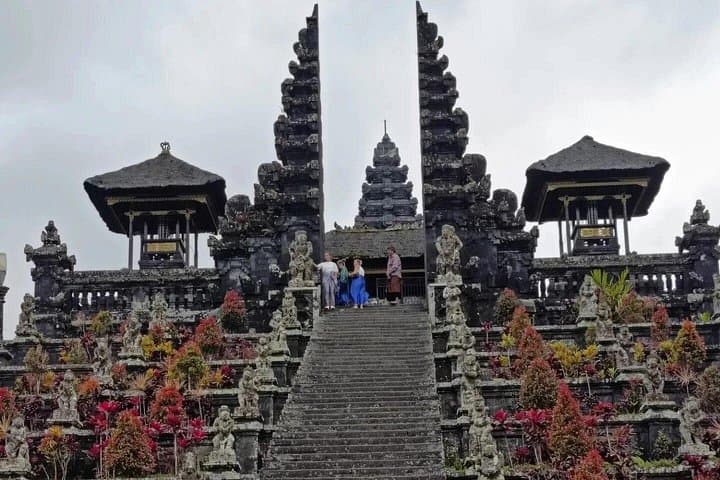


You arrive at the base of Mount Agung with the volcano’s slope pushing the sky outward, and the largest Hindu complex in Bali opens ahead—stone stairways, tiered shrines, and the steady hum of ceremonial life.
You arrive at the base of Mount Agung with the volcano’s slope pushing the sky outward, and the largest Hindu complex in Bali opens ahead—stone stairways, tiered shrines, and the steady hum of ceremonial life.
Besakih sits high on Agung’s southeastern flank at roughly 1,000–1,200 m elevation. Its temples evolved over centuries, layered by bricks and belief; the compound is a living center of Balinese Hindu culture where rituals still shape daily rhythms. Geologically, the temple clings to volcanic soil and terraces that remember past eruptions, while rice fields below reflect light like small mirrors that track the sun.
Your English-speaking guide interprets shrine architecture, caste-linked precincts, and ritual etiquette; sarongs are provided at the gate. Lunch follows at Lereng Agung restaurant, where plateaus of rice terraces unfurl down the slope and a local buffet offers familiar Indonesian dishes and bottled water.
Practically: expect uneven stone steps, short uphill sections, and open-air exposure—moderate fitness helps. Transfers are private door-to-door; travel time from Ubud is typically 1–2 hours each way depending on traffic. Women on their period are traditionally restricted from inner sanctums, and visitors should dress modestly and remove shoes where indicated. Bring sun protection, a refillable water bottle, and a respectful attitude—photography is allowed but avoid obstructing worshippers.
In five to six hours you’ll move from vehicle to shrine to viewpoint, gaining context on Bali’s most important temple while standing where mountain, faith, and daily life meet.