THE ADVENTURE COLLECTIVE® · Independent discovery and booking for outdoor travel

Spend two days crossing Bidoup-Nui Ba and the wind-swept Phuoc Binh grasslands on a 22 km trek that finishes in Ta Giang village. Ancient Po Mu forest, rare flat-leaf pines and a riverside lunch at Khe River make for a compact, immersive highland route.
Spend two days crossing Bidoup-Nui Ba and the wind-swept Phuoc Binh grasslands on a 22 km trek that finishes in Ta Giang village. Ancient Po Mu forest, rare flat-leaf pines and a riverside lunch at Khe River make for a compact, immersive highland route.
A chill before dawn, a shuttle humming out of Ho Chi Minh City, and then the air changes — cooler, resin-scented, threaded with the sound of running water. By first light you’re on a singletrack beneath ancient Po Mu trunks, their bark sheened with moss, and the forest feels older than the map that brought you here.
Verified experiences and guided adventures in the surrounding area.
Operated by Vietnam Cultural Tours · Da Lat, Lam Dong
A chill before dawn, a shuttle humming out of Ho Chi Minh City, and then the air changes — cooler, resin-scented, threaded with the sound of running water. By first light you’re on a singletrack beneath ancient Po Mu trunks, their bark sheened with moss, and the forest feels older than the map that brought you here.
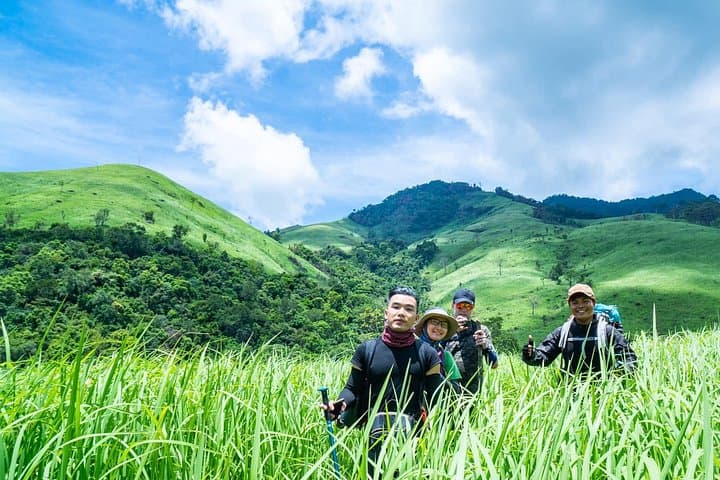
This two-day, roughly 22 km trek crosses Lam Dong into Phuoc Binh and ends at Ta Giang village, tracing mountain ridgelines, open grass hills, and the clear Khe River that marks a provincial border. Bidoup-Nui Ba National Park is geologically part of the Central Highlands’ eroded plateaus; soils are acidic, trailing to grassy summits where prehistoric flat-leaf pines still persist. The route delivers contrast — dense, orchid-rich montane forest in the morning and open grasslands with wind-scoured views by afternoon.
Culturally, the trail finishes in Raglai country: Ta Giang’s village life is a quiet counterpoint to the wilds, with simple wooden homes and communal farming. Expect basic campsite facilities: tents provided, communal meals, and an English-speaking guide on request.
Practical edge: pack waterproof layers and a warm midlayer for night air, use grippy hiking boots for wet roots and gravel slopes, and bring a small headlamp for early starts and campsite chores. Hydrate before steep sections, move steadily on grassy ascents, and be prepared for sudden mountain rain. The route rewards steady effort with riverside lunches, sweeping grassland sunsets, and a close look at rare highland flora — a short, concentrated taste of Vietnam’s Central Highlands.
The route is rated moderate and covers ~22 km over two days with camping; it’s suitable for hikers in regular walking shape and not recommended for people with serious heart or spinal conditions.
Camping equipment, meals (2 lunches, 2 dinners, 2 breakfasts), 1.5 L water bottle, raincoat, climbing poles, bus transfers, and basic medical equipment are included; an English guide is available on request.
Tents are provided and shared at the campsite on Phuoc Binh grass hill; expect basic facilities and communal sleeping unless an upgrade is arranged in advance.
The tour includes round-trip bus fare from Ho Chi Minh City with an overnight transfer; guests are picked up from District 1 hotels before the drive to Da Lat.
Vietnam Cultural Tours operates guided outdoor trips and adventures with an emphasis on safety, stewardship, and memorable experiences.



A chill before dawn, a shuttle humming out of Ho Chi Minh City, and then the air changes — cooler, resin-scented, threaded with the sound of running water. By first light you’re on a singletrack beneath ancient Po Mu trunks, their bark sheened with moss, and the forest feels older than the map that brought you here.
A chill before dawn, a shuttle humming out of Ho Chi Minh City, and then the air changes — cooler, resin-scented, threaded with the sound of running water. By first light you’re on a singletrack beneath ancient Po Mu trunks, their bark sheened with moss, and the forest feels older than the map that brought you here.
This two-day, roughly 22 km trek crosses Lam Dong into Phuoc Binh and ends at Ta Giang village, tracing mountain ridgelines, open grass hills, and the clear Khe River that marks a provincial border. Bidoup-Nui Ba National Park is geologically part of the Central Highlands’ eroded plateaus; soils are acidic, trailing to grassy summits where prehistoric flat-leaf pines still persist. The route delivers contrast — dense, orchid-rich montane forest in the morning and open grasslands with wind-scoured views by afternoon.
Culturally, the trail finishes in Raglai country: Ta Giang’s village life is a quiet counterpoint to the wilds, with simple wooden homes and communal farming. Expect basic campsite facilities: tents provided, communal meals, and an English-speaking guide on request.
Practical edge: pack waterproof layers and a warm midlayer for night air, use grippy hiking boots for wet roots and gravel slopes, and bring a small headlamp for early starts and campsite chores. Hydrate before steep sections, move steadily on grassy ascents, and be prepared for sudden mountain rain. The route rewards steady effort with riverside lunches, sweeping grassland sunsets, and a close look at rare highland flora — a short, concentrated taste of Vietnam’s Central Highlands.