THE ADVENTURE COLLECTIVE® · Independent discovery and booking for outdoor travel

Two contrasting birding habitats in one day: shade-grown coffee forest at Eco Parque El Espino and the high-elevation rim of El Boquerón. Join a biologist guide for targeted sightings of motmots, trogons and highland endemics.
Two contrasting birding habitats in one day: shade-grown coffee forest at Eco Parque El Espino and the high-elevation rim of El Boquerón. Join a biologist guide for targeted sightings of motmots, trogons and highland endemics.
A cool pre-dawn hush hangs over the coffee groves at Eco Parque El Espino as your guide scans the treetops. Light filters through shade-grown coffee and deciduous patches, and a turquoise flash—Turquoise-browed Motmot—perches like punctuation on a branch. Later, you gain altitude to El Boquerón’s rim where wind pushes across the crater lip and highland species call from cloud-scrub.
Verified experiences and guided adventures in the surrounding area.
Operated by Birdwatching Tours El Salvador · San Salvador, San Salvador Department
A cool pre-dawn hush hangs over the coffee groves at Eco Parque El Espino as your guide scans the treetops. Light filters through shade-grown coffee and deciduous patches, and a turquoise flash—Turquoise-browed Motmot—perches like punctuation on a branch. Later, you gain altitude to El Boquerón’s rim where wind pushes across the crater lip and highland species call from cloud-scrub.
The route traces two very different landscapes: a managed, biodiversity-rich coffee agroforest at 800–1,200 m and the volcanic highlands at roughly 1,800 m atop the dormant San Salvador Volcano. El Espino’s small geysers and mixed canopy support lowland and edge specialists; El Boquerón’s crater rim hosts cool-adapted endemics. Birds here mirror the country’s geological contrasts—species adapted to coffee corridors and those that prefer the crater’s mossy scrub.
Local guides often come from conservation networks and use decades of field experience to find skulking trogons and canopy motmots. Expect straightforward cultural contact with rural coffee stewards and a practical focus on bioacoustics and ethical viewing.
Practical guidance: tours run 4–5 hours with moderate walking on uneven trails and some elevation change; bring a binoculars, a field guide or app, layered clothing for a 10–15°C temperature swing, and rain protection in the wet months. Hydrate and arrive at dawn for peak activity. Listening is as important as looking—your guide will point out calls before the birds appear.
Tours run approximately 4–5 hours with a moderate, stop-and-search pace—expect short hikes and frequent pauses to scan and listen.
Yes—pickup and drop-off are provided from hotels or Airbnbs in San Salvador and Santa Tecla as part of the service.
You can expect regional endemics and highland specialists, especially at El Boquerón; sightings depend on season and weather but the guide targets priority species.
Binoculars and a printed bird guide are included, but bringing your own optics yields better, more comfortable viewing.
Birdwatching Tours El Salvador operates guided outdoor trips and adventures with an emphasis on safety, stewardship, and memorable experiences.


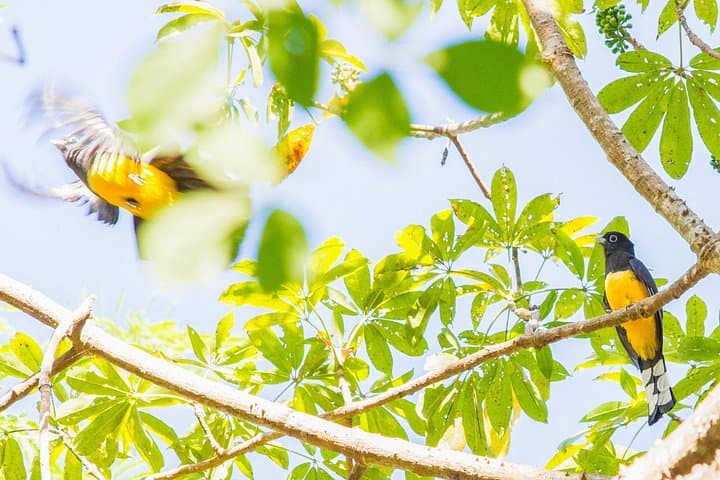

A cool pre-dawn hush hangs over the coffee groves at Eco Parque El Espino as your guide scans the treetops. Light filters through shade-grown coffee and deciduous patches, and a turquoise flash—Turquoise-browed Motmot—perches like punctuation on a branch. Later, you gain altitude to El Boquerón’s rim where wind pushes across the crater lip and highland species call from cloud-scrub.
A cool pre-dawn hush hangs over the coffee groves at Eco Parque El Espino as your guide scans the treetops. Light filters through shade-grown coffee and deciduous patches, and a turquoise flash—Turquoise-browed Motmot—perches like punctuation on a branch. Later, you gain altitude to El Boquerón’s rim where wind pushes across the crater lip and highland species call from cloud-scrub.
The route traces two very different landscapes: a managed, biodiversity-rich coffee agroforest at 800–1,200 m and the volcanic highlands at roughly 1,800 m atop the dormant San Salvador Volcano. El Espino’s small geysers and mixed canopy support lowland and edge specialists; El Boquerón’s crater rim hosts cool-adapted endemics. Birds here mirror the country’s geological contrasts—species adapted to coffee corridors and those that prefer the crater’s mossy scrub.
Local guides often come from conservation networks and use decades of field experience to find skulking trogons and canopy motmots. Expect straightforward cultural contact with rural coffee stewards and a practical focus on bioacoustics and ethical viewing.
Practical guidance: tours run 4–5 hours with moderate walking on uneven trails and some elevation change; bring a binoculars, a field guide or app, layered clothing for a 10–15°C temperature swing, and rain protection in the wet months. Hydrate and arrive at dawn for peak activity. Listening is as important as looking—your guide will point out calls before the birds appear.