THE ADVENTURE COLLECTIVE® · Independent discovery and booking for outdoor travel

Ride a super‑jeep across Vatnajökull’s outwash plains and step into a crystalline blue chamber carved by meltwater. This challenging 5–6 hour tour from Hali gives small groups rare access to one of Iceland’s transient ice caves.
Ride a super‑jeep across Vatnajökull’s outwash plains and step into a crystalline blue chamber carved by meltwater. This challenging 5–6 hour tour from Hali gives small groups rare access to one of Iceland’s transient ice caves.
The engine of a 4×4 super-jeep grumbles into life and the outwash plain opens like a grey ocean underfoot. Wind carves the moraine into sharp ribs and distant glaciers—Öræfajökull’s ice-clad dome and the fingers of Breiðamerkurjökull—loom like slow-moving tides. On the Blue Ice Cave Adventure, the landscape does the guiding: crevasses that breathe, streams that dare you to pick your footing, and a cave mouth that glows with a cobalt pulse once sunlight slips into the ice.
Verified experiences and guided adventures in the surrounding area.
Operated by Glacier Adventure · Hofn, Austurland
The engine of a 4×4 super-jeep grumbles into life and the outwash plain opens like a grey ocean underfoot. Wind carves the moraine into sharp ribs and distant glaciers—Öræfajökull’s ice-clad dome and the fingers of Breiðamerkurjökull—loom like slow-moving tides. On the Blue Ice Cave Adventure, the landscape does the guiding: crevasses that breathe, streams that dare you to pick your footing, and a cave mouth that glows with a cobalt pulse once sunlight slips into the ice.
This is not a casual walk-in cave. The route follows an old farm road called Þröng before the super-jeep drops the group onto the glacial foreland; from there it's a tracked approach across mixed moraine and compacted snow toward a glacier outlet where the cave forms. Ice caves on Vatnajökull are transient sculptures—carved by meltwater and shifted by crevasses—so each chamber is a moment in the glacier’s slow motion. Guides from Glacier Adventure, who limit groups to eight, interpret the shifting geology and keep the fragile space safe: helmets, headlamps, crampons and ropes are standard, and microspikes or lightweight rubber boots may be used for short stream crossings.
Vatnajökull’s story is written in fire and ice. Öræfajökull is a volcanic peak capped by the ice cap; an eruption can rearrange drainage and create the melt channels that hollow these caves. Local culture in the Eastfjords is tied to the rhythms of sea and glacier—fishermen’s villages like Höfn (Hofn) have long read the weather in the same winds you’ll feel here.
Practicalities shape the adventure: expect a 5–6 hour outing with moderate to challenging walking across uneven, icy terrain, and a short but careful approach to the cave. The operator asks you to be at the Glacier Adventure Base Camp in Hali 20 minutes early; they require at least two people per booking and advise staying nearby the night before in winter, when roads slow. The tour isn’t recommended for pregnant travelers or anyone with serious medical issues.
Bring waterproof, insulating layers and sturdy, ankle-supporting boots; guide-provided crampons are commonly fitted on-site. Protect batteries—cold drains them fast—and pack a wide-angle lens for interior shots, plus a headlamp for low-light adjustments. Time your visit for stable weather; guides will cancel for unsafe conditions.
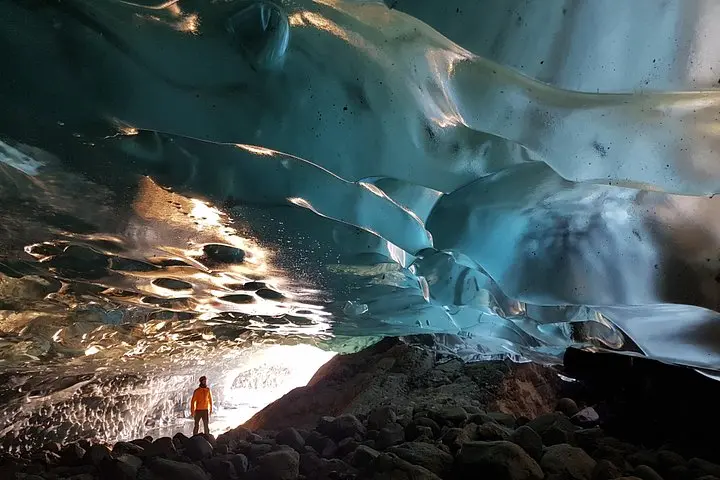
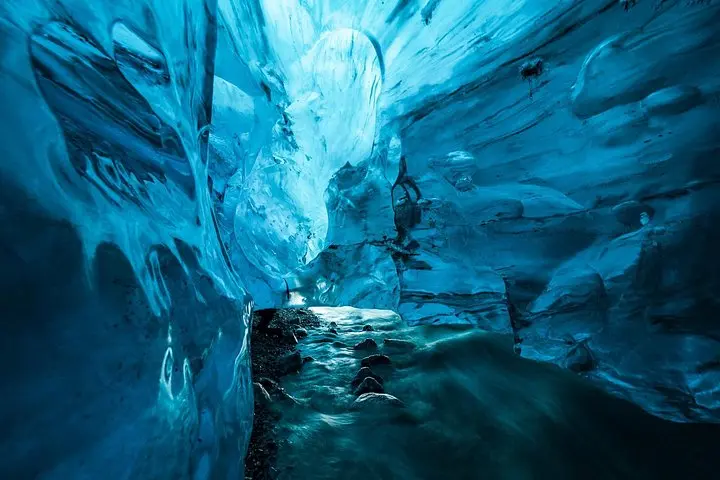
Inside the cave, light filters through ice like a rare blue lamp; the hush is not just silence but the glacier’s slow conversation. This is a place of careful movement and attention—rewarded by rare photographic moments and a clear sense of how dynamic Iceland’s ice really is.
Approach distances vary by season and ice position, but expect 30–60 minutes of walking across mixed moraine and compacted snow after the super‑jeep drop.
Yes—guides supply helmets, headlamps, and crampons or microspikes as needed; bring suitable boots for fitting.
Children can join if they are fit enough to walk on uneven and icy terrain; group size is limited to eight for safety and personal attention.
The operator will cancel or reschedule tours in unsafe weather—full refunds are available if cancelled 24 hours in advance per policy.
No technical experience is required—guides lead rope systems and handle technical aspects, but participants should be comfortable on rough terrain.
Meet at Glacier Adventure Base Camp in Hali 20 minutes before departure; there is no custom pickup—public transport options exist nearby.
Glacier Adventure operates guided outdoor trips and adventures with an emphasis on safety, stewardship, and memorable experiences.
The engine of a 4×4 super-jeep grumbles into life and the outwash plain opens like a grey ocean underfoot. Wind carves the moraine into sharp ribs and distant glaciers—Öræfajökull’s ice-clad dome and the fingers of Breiðamerkurjökull—loom like slow-moving tides. On the Blue Ice Cave Adventure, the landscape does the guiding: crevasses that breathe, streams that dare you to pick your footing, and a cave mouth that glows with a cobalt pulse once sunlight slips into the ice.
The engine of a 4×4 super-jeep grumbles into life and the outwash plain opens like a grey ocean underfoot. Wind carves the moraine into sharp ribs and distant glaciers—Öræfajökull’s ice-clad dome and the fingers of Breiðamerkurjökull—loom like slow-moving tides. On the Blue Ice Cave Adventure, the landscape does the guiding: crevasses that breathe, streams that dare you to pick your footing, and a cave mouth that glows with a cobalt pulse once sunlight slips into the ice.
This is not a casual walk-in cave. The route follows an old farm road called Þröng before the super-jeep drops the group onto the glacial foreland; from there it's a tracked approach across mixed moraine and compacted snow toward a glacier outlet where the cave forms. Ice caves on Vatnajökull are transient sculptures—carved by meltwater and shifted by crevasses—so each chamber is a moment in the glacier’s slow motion. Guides from Glacier Adventure, who limit groups to eight, interpret the shifting geology and keep the fragile space safe: helmets, headlamps, crampons and ropes are standard, and microspikes or lightweight rubber boots may be used for short stream crossings.
Vatnajökull’s story is written in fire and ice. Öræfajökull is a volcanic peak capped by the ice cap; an eruption can rearrange drainage and create the melt channels that hollow these caves. Local culture in the Eastfjords is tied to the rhythms of sea and glacier—fishermen’s villages like Höfn (Hofn) have long read the weather in the same winds you’ll feel here.
Practicalities shape the adventure: expect a 5–6 hour outing with moderate to challenging walking across uneven, icy terrain, and a short but careful approach to the cave. The operator asks you to be at the Glacier Adventure Base Camp in Hali 20 minutes early; they require at least two people per booking and advise staying nearby the night before in winter, when roads slow. The tour isn’t recommended for pregnant travelers or anyone with serious medical issues.
Bring waterproof, insulating layers and sturdy, ankle-supporting boots; guide-provided crampons are commonly fitted on-site. Protect batteries—cold drains them fast—and pack a wide-angle lens for interior shots, plus a headlamp for low-light adjustments. Time your visit for stable weather; guides will cancel for unsafe conditions.
Inside the cave, light filters through ice like a rare blue lamp; the hush is not just silence but the glacier’s slow conversation. This is a place of careful movement and attention—rewarded by rare photographic moments and a clear sense of how dynamic Iceland’s ice really is.