THE ADVENTURE COLLECTIVE® · Independent discovery and booking for outdoor travel

Leave Loreto’s marina for a small-boat marine safari into Loreto Bay National Park to find blue whales in their seasonal feeding and mating grounds. Small groups, experienced local captains, and protected waters make this a focused wildlife-watching outing with strong photo opportunities.
Leave Loreto’s marina for a small-boat marine safari into Loreto Bay National Park to find blue whales in their seasonal feeding and mating grounds. Small groups, experienced local captains, and protected waters make this a focused wildlife-watching outing with strong photo opportunities.
A dawn slip from Loreto’s marina pushes you into a liquid plain of pale gold and glass. The captain trims the throttle and scans for blows — the rhythm of the Sea of Cortez keeps time — and then a dark ridge breaches the horizon: the blue whale, enormous and deliberate, exhales like the ocean itself. On this small-boat excursion you watch those breaths and the slow arcs of a world’s largest animal while islands silhouette against a wide Baja sky.
Verified experiences and guided adventures in the surrounding area.
Operated by Guaycura Adventures · Loreto, Baja California Sur
A dawn slip from Loreto’s marina pushes you into a liquid plain of pale gold and glass. The captain trims the throttle and scans for blows — the rhythm of the Sea of Cortez keeps time — and then a dark ridge breaches the horizon: the blue whale, enormous and deliberate, exhales like the ocean itself. On this small-boat excursion you watch those breaths and the slow arcs of a world’s largest animal while islands silhouette against a wide Baja sky.
Loreto sits on a coastline carved by tectonics and ocean currents; the deep channels between islands draw nutrient-rich upwellings that feed krill and attract blue whales seasonally. The town’s history stretches back to 17th‑century Jesuit missions and its long relationship with the sea — local captains still read currents the way earlier fishermen read stars. Loreto Bay National Park protects many of these waters, and the boat routes keep distance to minimize disturbance.
Practically: tours run about five hours from the marina, on small six-passenger boats that allow intimate viewing and photography. Expect binoculars, a steady captain, and intermittent spotting of dolphins and sea lions alongside whales. Bring layered sun protection, a windbreaker for cool mornings, and medication if you’re prone to seasickness. Respect wildlife rules: no chasing, minimal engine noise during sightings, and follow crew instructions.
Best sightings come late winter into spring when blue whales feed and mate in these sheltered bays. For photographers, low-angle light and a compact group make it possible to get close-up frames while still keeping the animals’ space. This trip is as much about marine behavior and coastal geology as it is about a single sighting — the ocean here feels alive and watchful.
The scheduled duration is about five hours round-trip from Loreto marina.
Sightings cannot be guaranteed; blue whales are seasonally present and crew operate in protected feeding areas to maximize chances.
Small boats require stepping on and off a dock; passengers should be able to climb a short ladder or step. Check with the operator for specific accessibility accommodations.
Bring sun protection, a hat, sunglasses, water, motion‑sickness medication if needed, and a charged camera with spare memory.
Guaycura Adventures operates guided outdoor trips and adventures with an emphasis on safety, stewardship, and memorable experiences.
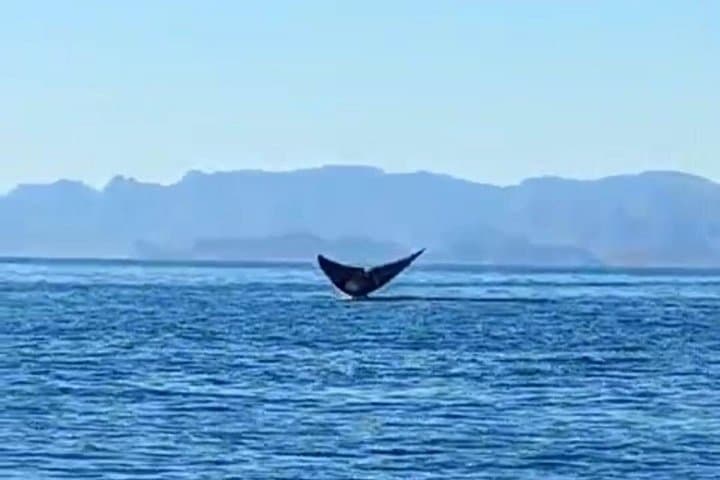

A dawn slip from Loreto’s marina pushes you into a liquid plain of pale gold and glass. The captain trims the throttle and scans for blows — the rhythm of the Sea of Cortez keeps time — and then a dark ridge breaches the horizon: the blue whale, enormous and deliberate, exhales like the ocean itself. On this small-boat excursion you watch those breaths and the slow arcs of a world’s largest animal while islands silhouette against a wide Baja sky.
A dawn slip from Loreto’s marina pushes you into a liquid plain of pale gold and glass. The captain trims the throttle and scans for blows — the rhythm of the Sea of Cortez keeps time — and then a dark ridge breaches the horizon: the blue whale, enormous and deliberate, exhales like the ocean itself. On this small-boat excursion you watch those breaths and the slow arcs of a world’s largest animal while islands silhouette against a wide Baja sky.
Loreto sits on a coastline carved by tectonics and ocean currents; the deep channels between islands draw nutrient-rich upwellings that feed krill and attract blue whales seasonally. The town’s history stretches back to 17th‑century Jesuit missions and its long relationship with the sea — local captains still read currents the way earlier fishermen read stars. Loreto Bay National Park protects many of these waters, and the boat routes keep distance to minimize disturbance.
Practically: tours run about five hours from the marina, on small six-passenger boats that allow intimate viewing and photography. Expect binoculars, a steady captain, and intermittent spotting of dolphins and sea lions alongside whales. Bring layered sun protection, a windbreaker for cool mornings, and medication if you’re prone to seasickness. Respect wildlife rules: no chasing, minimal engine noise during sightings, and follow crew instructions.
Best sightings come late winter into spring when blue whales feed and mate in these sheltered bays. For photographers, low-angle light and a compact group make it possible to get close-up frames while still keeping the animals’ space. This trip is as much about marine behavior and coastal geology as it is about a single sighting — the ocean here feels alive and watchful.