THE ADVENTURE COLLECTIVE® · Independent discovery and booking for outdoor travel
Cut through the British Museum’s vast holdings with a qualified archaeologist who links finds to the field stories behind them. This 2.75‑hour guided walk highlights major exhibits and hard-to-find gems while offering scholarly context and practical viewing tips.
Cut through the British Museum’s vast holdings with a qualified archaeologist who links finds to the field stories behind them. This 2.75‑hour guided walk highlights major exhibits and hard-to-find gems while offering scholarly context and practical viewing tips.
Step through the museum's great glass roof into a corridor of human stories: stone reliefs watch like old companions, bronze faces hold their weathered expressions, and the galleries open like chapters of a long, messy human book. A qualified archaeologist guides the group, pointing out the detective work behind each object and the field stories that returned them to these rooms.
Verified experiences and guided adventures in the surrounding area.
Step through the museum's great glass roof into a corridor of human stories: stone reliefs watch like old companions, bronze faces hold their weathered expressions, and the galleries open like chapters of a long, messy human book. A qualified archaeologist guides the group, pointing out the detective work behind each object and the field stories that returned them to these rooms.
The British Museum began in 1753 from Sir Hans Sloane’s collection and grew into one of the world’s most comprehensive repositories of human culture. Geology and ancient trade routes are visible in the materials—Egyptian limestone, Mesopotamian clay, Aegean marble—each object a material clue to past environments and exchange networks. The tour weaves these threads with cultural context: the card of empire-era collecting, the crafty techniques of ancient artisans, and the unresolved mysteries that still challenge scholars.
Practical knowing is part of the experience. Expect about 2¾ hours of standing and short walks across gallery floors; the guide will pace explanations between major highlights and quieter, lesser-seen rooms. Photography rules vary by gallery—follow signage. The route reduces aimless wandering in a building that can bewilder first-time visitors, and it focuses on conservation-friendly viewing: no touching, dim-light sensitive objects, and respect for rotation schedules.
For visitors, wear comfortable shoes, carry water, and bring a small notebook or camera. The tour suits curious people who want context beyond label text: it turns display cases into timelines and museum corners into field reports.
Admission to the British Museum’s permanent collection is free; the tour fee covers the guide service—special exhibitions may have separate charges.
Yes—this family-friendly tour uses storytelling and field anecdotes to engage young visitors, though younger children may tire during the full duration.
Many main galleries and the Great Court are accessible, but some rooms and temporary displays may have limited access—contact the operator in advance for specifics.
Operators typically meet near the museum’s main entrance under the glass roof (Great Court); arrive 10–15 minutes early to allow security and ticket checks.
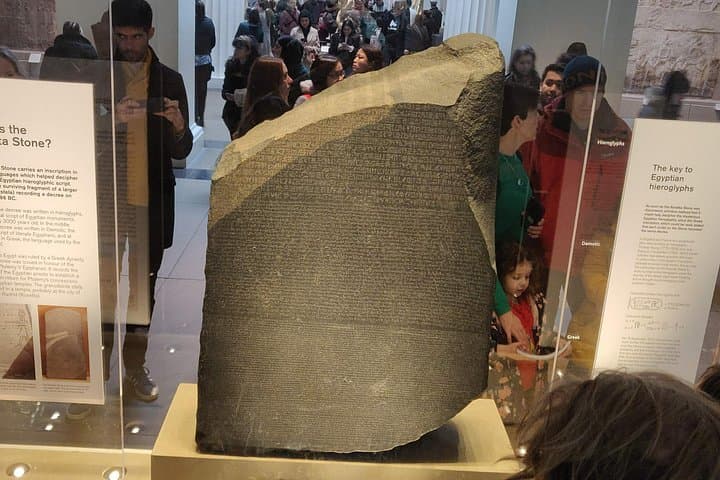
Step through the museum's great glass roof into a corridor of human stories: stone reliefs watch like old companions, bronze faces hold their weathered expressions, and the galleries open like chapters of a long, messy human book. A qualified archaeologist guides the group, pointing out the detective work behind each object and the field stories that returned them to these rooms.
Step through the museum's great glass roof into a corridor of human stories: stone reliefs watch like old companions, bronze faces hold their weathered expressions, and the galleries open like chapters of a long, messy human book. A qualified archaeologist guides the group, pointing out the detective work behind each object and the field stories that returned them to these rooms.
The British Museum began in 1753 from Sir Hans Sloane’s collection and grew into one of the world’s most comprehensive repositories of human culture. Geology and ancient trade routes are visible in the materials—Egyptian limestone, Mesopotamian clay, Aegean marble—each object a material clue to past environments and exchange networks. The tour weaves these threads with cultural context: the card of empire-era collecting, the crafty techniques of ancient artisans, and the unresolved mysteries that still challenge scholars.
Practical knowing is part of the experience. Expect about 2¾ hours of standing and short walks across gallery floors; the guide will pace explanations between major highlights and quieter, lesser-seen rooms. Photography rules vary by gallery—follow signage. The route reduces aimless wandering in a building that can bewilder first-time visitors, and it focuses on conservation-friendly viewing: no touching, dim-light sensitive objects, and respect for rotation schedules.
For visitors, wear comfortable shoes, carry water, and bring a small notebook or camera. The tour suits curious people who want context beyond label text: it turns display cases into timelines and museum corners into field reports.
