THE ADVENTURE COLLECTIVE® · Independent discovery and booking for outdoor travel

A long, scenic day from Toronto that threads limestone cliffs, clear-water coves and forest trails. Hike short, varied sections—including the Grotto and Indian Head—then finish at Inglis Falls.
A long, scenic day from Toronto that threads limestone cliffs, clear-water coves and forest trails. Hike short, varied sections—including the Grotto and Indian Head—then finish at Inglis Falls.
You step off the coach into a wind that smells of limestone and cold water—Georgian Bay on one side, the darker expanse of the Niagara Escarpment on the other. Over the course of a single, long day you move between cliff-edge viewpoints, cedar-lined shorelines and inland lakes, following trails that thread around the Grotto, Indian Head Cove, Overhanging Point, Marr Lake and Horse Lake before a final stop at Inglis Falls.
Verified experiences and guided adventures in the surrounding area.
You step off the coach into a wind that smells of limestone and cold water—Georgian Bay on one side, the darker expanse of the Niagara Escarpment on the other. Over the course of a single, long day you move between cliff-edge viewpoints, cedar-lined shorelines and inland lakes, following trails that thread around the Grotto, Indian Head Cove, Overhanging Point, Marr Lake and Horse Lake before a final stop at Inglis Falls.
The Bruce Peninsula sits where the Niagara Escarpment meets the Great Lakes; its dolomitic limestone was laid down 430 million years ago and sculpted by glacial scouring. Indigenous people of the Saugeen Ojibway Nation have lived off these waters and forests for generations; the region’s place names and seasonal practices reflect that continuing relationship. The terrain alternates exposed, rocky ridgelines with sheltered mixed forest, and boardwalks protect fragile orchid meadows and alvars.
Practical guidance: this is a long, full-day excursion from Toronto—expect 10–14 hours door-to-door. Hikes on the tour are beginner to intermediate: plan for several short bursts of up-and-down walking, loose rocks and rooty singletrack, and combined walking of roughly 6–10 km total with localized elevation changes up to 150–200 m on some sections. Wear grippy footwear, bring 2+ litres of water, layered clothing for sudden winds off the water, and a waterproof layer for spray near cliff edges. Start early, keep to marked trails and boardwalks to protect sensitive habitat, and leave time to enjoy the clear-water viewpoints—those limestone shelves dare you to stand close and look down.
Expect roughly 3.5–4 hours one-way depending on traffic and season; the tour schedules travel and stops across a full day.
Bruce Peninsula National Park requires a day-use fee or park reservation in some seasons—your tour operator typically handles park access but confirm before you go.
Yes, swimming is possible in calm conditions; water is cold year-round—use caution near cliffs and strong currents at exposed shorelines.
Many sections are family-friendly but involve uneven ground and some cliff-edge exposure—check with the operator about specific itinerary pacing for children or limited-mobility travelers.
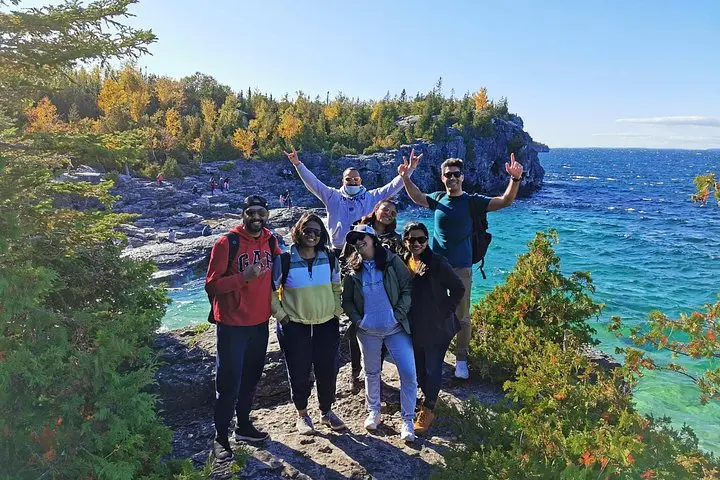
You step off the coach into a wind that smells of limestone and cold water—Georgian Bay on one side, the darker expanse of the Niagara Escarpment on the other. Over the course of a single, long day you move between cliff-edge viewpoints, cedar-lined shorelines and inland lakes, following trails that thread around the Grotto, Indian Head Cove, Overhanging Point, Marr Lake and Horse Lake before a final stop at Inglis Falls.
You step off the coach into a wind that smells of limestone and cold water—Georgian Bay on one side, the darker expanse of the Niagara Escarpment on the other. Over the course of a single, long day you move between cliff-edge viewpoints, cedar-lined shorelines and inland lakes, following trails that thread around the Grotto, Indian Head Cove, Overhanging Point, Marr Lake and Horse Lake before a final stop at Inglis Falls.
The Bruce Peninsula sits where the Niagara Escarpment meets the Great Lakes; its dolomitic limestone was laid down 430 million years ago and sculpted by glacial scouring. Indigenous people of the Saugeen Ojibway Nation have lived off these waters and forests for generations; the region’s place names and seasonal practices reflect that continuing relationship. The terrain alternates exposed, rocky ridgelines with sheltered mixed forest, and boardwalks protect fragile orchid meadows and alvars.
Practical guidance: this is a long, full-day excursion from Toronto—expect 10–14 hours door-to-door. Hikes on the tour are beginner to intermediate: plan for several short bursts of up-and-down walking, loose rocks and rooty singletrack, and combined walking of roughly 6–10 km total with localized elevation changes up to 150–200 m on some sections. Wear grippy footwear, bring 2+ litres of water, layered clothing for sudden winds off the water, and a waterproof layer for spray near cliff edges. Start early, keep to marked trails and boardwalks to protect sensitive habitat, and leave time to enjoy the clear-water viewpoints—those limestone shelves dare you to stand close and look down.